Espresso machines
Pressurized vs Non‑Pressurized Portafilter Baskets
What each basket does, and which one your machine ships.
Assessment based on manufacturer documentation and independent published sources; we have not physically tested these products.
By Syed Hyder Ali · Updated · How we research
In short
A pressurized (dual-wall) basket has a second wall with one small exit hole; a non-pressurized (single-wall) basket leaves the resistance to your grind, dose and tamp. Breville states dual-wall for pre-ground coffee and older beans, single-wall for freshly ground beans; Gaggia advises starting on its pressurized filter. No burr grinder: dual-wall. Fresh-ground beans: single-wall.
Assumptions and exclusions
This assumes
- A machine with a portafilter
- The maker's own box list
- US models only
This does not cover
- Which basket tastes better
- Basket sizes and part numbers
- Dose and shot-time recipes
- Pump bar ratings
What is the difference between pressurized and non-pressurized baskets?
The two baskets handle resistance differently. In a pressurized basket, which Breville says is "sometimes called" a dual-wall filter, the inner walls have many holes at the base and the outer wall has one small hole. Breville's page says that smaller hole "creates pressure to make up for inconsistencies in the grind size or uneven tamping". In a non-pressurized (single-wall) basket there is one wall with many holes, and Breville says it calls "for finely ground coffee and a precise tamping technique". The independent reviewer Acquired Coffee (an undated page, accessed 2026-11-17) describes the same split: the single hole restricts the flow so that espresso collects in the space and builds back pressure.
The consequence is simple. A pressurized basket is more forgiving of a loose grind or a rough tamp. A single-wall basket gives you the controls, and with them the work. How to dial in espresso assumes a single-wall basket for that reason.
Basket or portafilter? The part that differs is the basket that sits inside the portafilter. Breville's blog names portafilters by the basket they hold ("pressurized portafilters"), and Gaggia's book calls its filter holder with the crema perfetta filter the "pressurized filter holder". Below, "basket" is the part and "portafilter" the handle that holds it.
| Maker | Word for the basket with a second wall | Word for the other |
|---|---|---|
Breville | "Dual wall" (books); "pressurized" (blog) | "Single wall" (books); "non-pressurized" (blog) |
Gaggia | "Pressurized"; "crema perfetta" for the filter fitted | "Traditional"; "commercial-style" (page) |
De'Longhi | "Dual wall" (Dedica page); "crema disk" (Stilosa page data) | Not listed |
CASABREWS | "Dual Wall" (manual) | "Non-pressurized" (accessory page) |
Flair | "Pressurized" (page) | Low-flow and high-flow baskets |
Which basket should you use for the coffee you have?
The makers agree on this one. Pre-ground coffee goes in a dual-wall basket; fresh whole beans go in a single-wall basket if you will adjust the grind.
| Your coffee | Basket | Who says so |
|---|---|---|
Pre-ground coffee | Dual-wall | Breville: "Use Dual Wall filter baskets if using pre-ground coffee". CASABREWS: the dual-wall filter "is the best option" for pre-ground coffee |
Beans roasted more than 30 days ago | Dual-wall | Breville's book for the Bambino Plus: for pre-ground coffee "and older beans that are past the 30 day roast date" |
Fresh whole beans and a burr grinder | Single-wall | Breville: single-wall baskets "allow you to experiment with grind, dose and tamp to create a more balanced espresso" |
E.S.E. pods | A pod filter, or Gaggia's pressurized single-shot basket | De'Longhi lists a pod filter for the Dedica and a 1-shot filter that suits pods for the Stilosa; Gaggia's page says its pressurized single-shot basket takes pods |
A new Gaggia owner with no grinder | The crema perfetta filter first | Gaggia: "Our advice is to start with the crema perfetta filter" and move to the traditional filters with experience |
If a shot has no crema, Breville's Barista Express book lists one cause: "Single Wall filter baskets are being used with pre-ground coffee". Its fix is dual-wall baskets for pre-ground coffee.
The choice flips for a different buyer. If you will not buy a burr grinder, the maker's rule is a dual-wall basket, and a machine whose box holds only dual-wall baskets, like the CASABREWS CM5418, suits you. The Dedica's page also lists dual-wall filters; its manual does not say whether they regulate pressure. If you want to control grind, dose and tamp, you need a single-wall basket and a grinder that reaches espresso: best coffee grinders lists them, and whole bean vs ground coffee covers the coffee itself. Choosing a machine by its box? Best espresso machines for beginners matches machines to a first-time buyer. For the first shot, making espresso at home gives each maker's steps, basket included.
Which basket does each machine ship?
The "Baskets in the box" column is what the maker lists. "Not listed" means the maker's pages and manuals say nothing on the point, which is different from "none exist". "Conflict" means the sources disagree and both are printed.
| Model | Portafilter | Baskets in the box | Notes |
|---|---|---|---|
Breville Bambino (BES450) | 54 mm | 1-cup and 2-cup single-wall; 1-cup and 2-cup dual-wall. The 2-cup single-wall is fitted | Dual-wall for pre-ground coffee; Breville says they regulate the pressure |
Breville Bambino Plus (BES500) | 54 mm | The same four; the 2-cup single-wall is fitted | Single-wall suits beans roasted within 30 days; dual-wall suits pre-ground or older beans |
Breville Barista Express (BES870) | 54 mm | The same four; grinder built in | Single-wall for fresh whole beans; dual-wall for pre-ground |
Breville Barista Express Impress (BES876) | 54 mm | The same four | Grinder built in; same rule as the Express |
Breville Barista Pro (BES878) | 54 mm | Single-wall and dual-wall, 1-cup and 2-cup | Grinder built in |
Breville Barista Touch Impress (BES881) | 54 mm | Single-wall and dual-wall, 1-cup and 2-cup | Grinder built in |
Breville Dual Boiler (BES920) | 58 mm | Single-wall and dual-wall, 1-cup and 2-cup (58 mm) | No grinder built in |
Breville Oracle Jet (BES985) | 58 mm | Single-wall 1-cup and 2-cup; the 2-cup is fitted | No pressurized basket listed |
58 mm | Conflict. Gaggia's book: one "crema perfetta" filter for 1 or 2 cups, fitted, plus traditional 1-cup and 2-cup filters. Gaggia's page: pressurized single-shot, pressurized double-shot and commercial-style baskets | The crema perfetta filter works only with the frothing jet device. Gaggia also lists a 58 mm non-pressurized pod filter basket as a separate part | |
58 mm | Conflict on sizes. US MAP sheet: 8 g and 16 g baskets in a double-spout portafilter; other Rancilio documents list other sizes | No pressurized basket listed | |
De'Longhi Dedica EC685 | Not listed | 1-cup and 2-cup filters ("Dual wall 1 & 2 cups" on the page) and a pod filter; the manual lists a "ground coffee filter" and a "pod filter" | Whether the dual-wall filters regulate pressure: Not listed |
De'Longhi Stilosa EC260 | Not listed | A 1-shot filter (suits E.S.E. pods) and a 2-shot filter, each with a screw-off cap and plastic disk | The page data calls it a "crema disk"; whether it is single-wall or dual-wall: Not listed |
51 mm | 1-cup and 2-cup dual-wall | Only dual-wall in the box; the maker sells a bottomless portafilter with a non-pressurized basket separately | |
58 mm | Conflict. Flair's page "What's in the Box" and its FAQ: three baskets including a pressurized one. Its "What's Included" list and the manual: low-flow and high-flow baskets | Lever machine; needs a grinder, kettle and scale |
Bean-to-cup machines have no portafilter, so there is no basket to choose: semi-automatic vs super-automatic covers that decision. Basket and tamper sizes, and which parts fit which machine, are in which basket and tamper sizes fit. Each row comes from the maker's manual or product page; the sources list gives them.
What does each basket need from your grinder, dose and tamp?
On a single-wall basket the grind, dose and tamp do the work, so they are where a shot goes wrong. Breville's Barista Express book adds a practical point: with a finer espresso grind in single-wall baskets "you may need to increase the grind amount" so the basket is dosed correctly. Dial-in figures are in how to dial in espresso.
On a dual-wall basket the makers say those controls matter less. Breville says dual-wall baskets "regulate the pressure and help to optimize the extraction regardless of the grind, dose, tamp pressure or freshness". Gaggia's page says its pressurized baskets "allow for the use of most types of pre-ground coffee". Breville's Smart Grinder Pro book starts a grinder at setting 12 for espresso and, "if using dual wall filters", at setting 30, then finer if needed; grind settings by grinder covers other grinders.
Where sources disagree
Tamping a pressurized basket. Gaggia's page says pressurized baskets "eliminate the need to tamp". Gaggia's own book says to "press the coffee using the dedicated tamper" with the crema perfetta filter. Breville's dual-wall steps keep the tamp step. Acquired Coffee reports that a pressurized portafilter "must still be tamped, although the tamp doesn't have to be absolutely even", and Corner Coffee Store, a retailer (updated 2026-05-30), says a pressurized portafilter is "more forgiving when it comes to tamping and your grind size". The practical reading is that pressing the coffee level is safe; skipping it is the claim that sources dispute.
Crema. Breville's blog says pressurized baskets give "a consistent flow rate and rich crema at the top of each espresso shot". Acquired Coffee reports that a pressurized portafilter makes "strong espresso and faux crema". Only one independent source says "faux", so read each as that source's claim. Breville separately says a bottomless portafilter gives "often more crema than a pressurized basket", which is a comparison with a different part.
What ships in a Gaggia, and in a Flair. The Gaggia page and book list different baskets, and Flair's page lists three baskets in one place and two in another. The table above prints both sides; only the physical box would settle each.
What changes when you switch from one to the other?
- On a Gaggia: Gaggia's book says the crema perfetta filter must be used only with the frothing jet device and that the traditional filters must not be. Without the device, the machine "will squirt out the coffee, which may result in burns". Gaggia's page adds that the black two-way pin goes in the portafilter before a pressurized basket; the book names no pin.
- On a Breville: the grinder start moves from setting 12 to 30 when you change to dual-wall baskets, per the Smart Grinder Pro book.
- Cleaning the holes: Breville's Barista Express book says to unblock a blocked basket with the pin on the end of the provided cleaning tool. Gaggia says not to clean its pressurized filter holder in the dishwasher or with washing-up liquid.
- Parts: baskets do not swap across machine sizes or families; the fit guide lists what fits.
What about a bottomless portafilter, or a higher bar rating?
A bottomless (naked) portafilter has no spout or second wall, so you see the espresso as it comes out. Breville says it "might not be the best choice for beginners", because tamping and reading extraction problems take skill. A pump's bar rating is a separate question: 15 bar vs 20 bar espresso machines answers it.
Models this page mentions
We may earn a commission when you buy through links on this page.
In the order the page mentions them; not a ranking.
Mentioned in: Which basket should you use for the coffee you have?
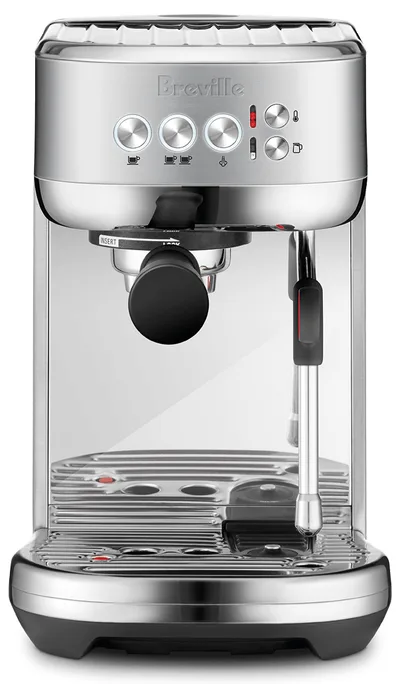
Breville the Bambino Plus
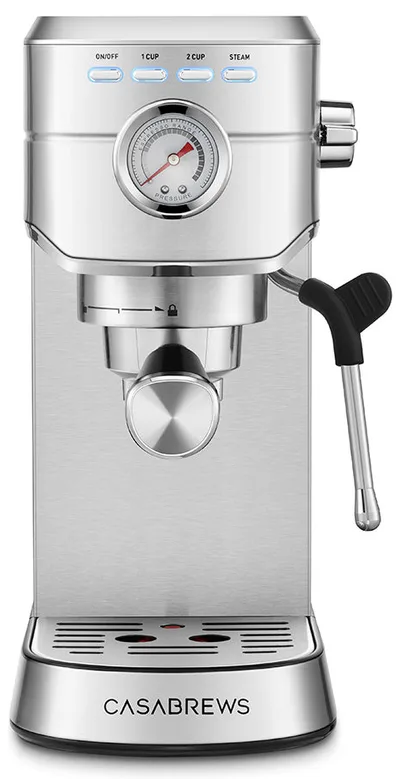
CASABREWS CM5418
Mentioned in: Which basket does each machine ship?
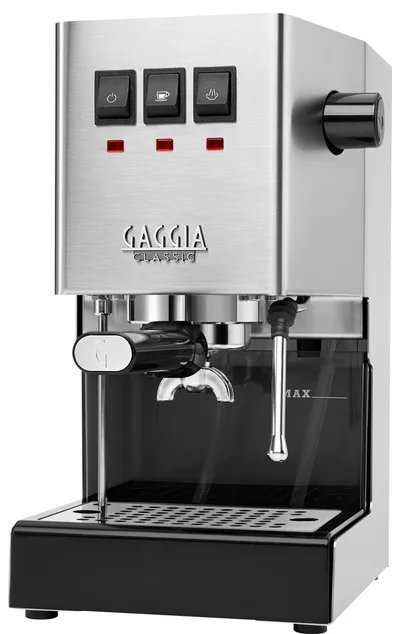
Gaggia Classic Pro E24
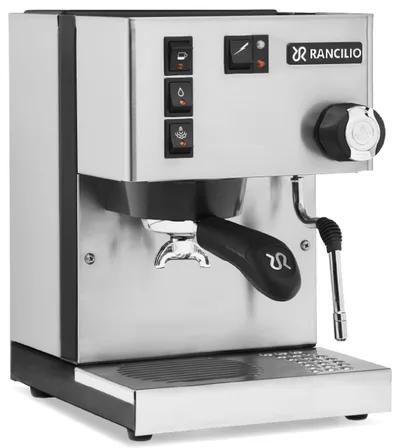
Rancilio Silvia
Mentioned in: What does each basket need from your grinder, dose and tamp?
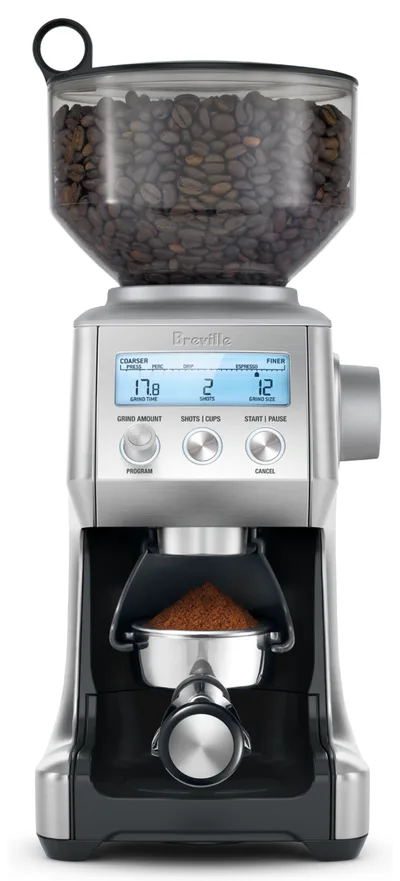
Breville the Smart Grinder Pro
Sources
- What are the different types of portafilters? — Breville US, accessed November 17, 2026
- Bambino Plus BES500 instruction book (US, Y25), p. 8, 11 — Breville, accessed November 17, 2026
- Barista Express BES870 instruction book (US, X26), pp. 12, 17, 30 — Breville, accessed November 17, 2026
- Smart Grinder Pro BCG820 instruction book (US, L26), pp. 9-10 — Breville, accessed November 17, 2026
- Gaggia Classic E24 operating instructions, USA (6420-010-18419, Rev 00), pp. 12-13, 17, 19 — Gaggia, accessed November 17, 2026
- Brewing (filter baskets, tamp pressure) — Gaggia North America, accessed November 17, 2026
- CM5418 user manual — CASABREWS, accessed November 17, 2026
- Dedica EC685 instructions for use, US (asset 167828) — De'Longhi, accessed November 17, 2026
- Pressurized vs. Non‑Pressurized Portafilters (Scott M. Brodie; undated page) — Acquired Coffee, accessed November 17, 2026
- What Is a Pressurized Portafilter on an Espresso Machine? Pros & Cons (updated 2026-05-30) — Corner Coffee Store, accessed November 17, 2026