Grinders
Manual vs Electric Coffee Grinder: Which Fits Your Routine?
Which kind suits one serving or four, what each costs you in time, noise and upkeep, and what no source has measured.
Assessment based on manufacturer documentation and independent published sources; we have not physically tested these products.
By Syed Hyder Ali · Updated · How we research
In short
A manual grinder suits one or two servings per grind, a quiet kitchen and travel; an electric grinder suits four or more servings, speed and no cranking. Four V60 servings need 40-48 g at Hario's dose, which is one to three fills of a hand grinder's catch cup (20-40 g, by model) and one fill of an electric grounds bin (100-120 g). A hand grinder's limit is time and cup size; an electric one's is noise and counter space.
Espresso depends on the model, not the drive: some hand grinders and some electrics are built for it, and others say they are not.
Worked example
- Brewer
- Hario V60 02, rated 1-4 cups; cup size not listed
- Hario's dose
- 10-12 g per 120 mL serving
- Servings
- 4
4 × 10 g = 40 g; 4 × 12 g = 48 g
40-48 g of coffee
Arithmetic from Hario's dose, not a measured grind. Fills = coffee ÷ the cup's limit, rounded up. A 40 g cup at 10 g a serving takes one fill; a 35-40 g cup at 12 g takes two; a 20 g cup at 12 g takes three (48 ÷ 20 = 2.4); a 100-120 g bin takes one. This counts the catch cup only; a hand grinder's bean chamber is a separate limit.
Assumptions and exclusions
This assumes
- Hario's dose of 10-12 g per 120 mL serving
- Each maker's catch cup or bin limit, as listed
- The cup is emptied between fills
This does not cover
- Grind time, covered below
- Espresso doses
- Which model to buy
- Prices
Manual or electric: which fits your routine?
Start from how much you grind at once and whether you will crank. Brian's Coffee Spot (January 8, 2022) compared his small Aergrind with the Baratza Encore he used on a visit on cafetière and V60 batches. Given the choice between those two, he used the Encore every time; he has made coffee for two on the Aergrind, and refilling it "is a pain". He would still not buy an electric grinder for himself: he enjoys hand grinding, and was "quite happy" making coffee for two on his larger Feldgrind.
| Your situation | Lean toward | What decides it |
|---|---|---|
One or two servings, quiet morning | Manual | The catch cup holds that, and a hand grinder is quiet. |
Four or more servings in one go | Electric | Catch cups hold 20-40 g here; bins hold 100-120 g. |
Travel, or no outlet | Manual | The J‑Ultra and K‑Ultra have foldable handles; the J‑Ultra comes with a carrying case. |
You will not crank | Electric | Coffee Chronicler: a hand grinder "does take some effort". |
One dose at a time, either kind | Either | For an electric single-dose grinder see best single-dose grinders. |
Espresso | The model | See the espresso section: some of each say yes, some no. |
Still on a blade grinder | Either, after reading | Start with burr vs blade grinder. |
Chose manual? The best manual coffee grinders list picks one. Chose electric? The best coffee grinders list does the same.
How many servings does one grind give?
A grind is limited by the catch cup or grounds bin that collects it, and for a hand grinder also by how many beans the chamber takes. Hario's V60 manual lists 10-12 g of coffee per 120 mL serving (medium-fine grind). On a Hario V60 02, rated for 1-4 cups with no cup size listed, four servings need 40-48 g. For another brewer, use its maker's dose; coffee to water ratio sets out the ratios.
| Grinder | Kind | Cup or bin limit | Servings | Fills for 4 servings |
|---|---|---|---|---|
Timemore Chestnut C3, standard cup | Manual | 20 g | 1-2 | 2-3 |
Timemore Chestnut C3, XL cup | Manual | 30 g | 2-3 | 2 |
1Zpresso J‑Ultra | Manual | 35-40 g | 2-4 | 1-2 |
1Zpresso K‑Ultra | Manual | 35-40 g | 2-4 | 1-2 |
Fellow Ode Gen 2 | Electric | 100 g | 8-10 | 1 |
Baratza Encore | Electric | 120 g | 10-12 | 1 |
Baratza Virtuoso+ | Electric | 120 g | 10-12 | 1 |
The hand-grinder rows are the cup only. 1Zpresso lists no bean-chamber size for the J‑Ultra or K‑Ultra, so a full cup does not prove the grinder takes that many beans in one go. Brian's Coffee Spot reports that his small Aergrind takes not much more than 25 g of beans, while his larger Feldgrind takes up to 40 g, and KINGrinder's pages put the K6's hopper at 30-35 g in its manual and 25-30 g in its store listing. For four servings the table shows one to three fills of a hand grinder's cup, so expect to load, crank and empty more than once. Fellow lists 100 g as the most the Ode Gen 2 should grind without emptying its catch.
How long does grinding take, and how hard is it?
Each reporter ground a different dose of different beans on a different setting, so read each row on its own; none is averaged or compared.
| Grinder | Kind | Dose | Time | Reported by |
|---|---|---|---|---|
Baratza Encore | Electric | 36 g | 35-45 s | Brian's Coffee Spot, Jan 8, 2022 |
A hand grinder (his usual) | Manual | 36 g | about 2 min | Brian's Coffee Spot, Jan 8, 2022 |
Baratza Virtuoso+ | Electric | 20 g, pour-over | about 12 s | Home Grounds, Apr 30, 2024 |
Breville Smart Grinder Pro | Electric | 20 g, pour-over | 10-12 s | Home Grounds, May 2, 2024 |
KINGrinder K6 | Manual | 15 g, pour-over | 20 s | CNN Underscored, Sep 16, 2026 |
Comandante C40 MK4 | Manual | 20 g | 50 s | Coffee Chronicler, Oct 22, 2026 |
1Zpresso J‑Ultra | Manual | 16-18 g, espresso | 40-55 s | Coffee Chronicler, Oct 22, 2026 |
Coffee Chronicler's general line for hand grinders is "around 30-60 seconds to grind enough for a big cup", and that "the finer you grind, the more times you'll have to turn the crank." It adds that the effort is real: "It does take some effort to grind by hand." The same reporter suggests an electric grinder for anyone who wants one for espresso.
No source we read measures hand-cranking effort in force or number of turns for these models, so how tiring a given grinder is for your hands is not something this page can say.
Does one kind grind better?
No source we read compares a hand grinder and an electric grinder with a measured test on the same method. The two kinds of evidence below cover different grinders, so they do not answer it.
- Hand grinders only. CNN Underscored sifted 15 g ground for pour-over through 700 and 1,200 micron screens and weighed what landed in that range: Comandante C40 MK4 9.1 g, Timemore Chestnut C3 8.8 g, KINGrinder K6 7.6 g (September 16, 2026). CNN calls the C3 discontinued; Timemore's US store still lists it.
- Electric grinders only. Coffee Review's laser particle-size analysis covered four mid-range electric grinders and put the Virtuoso+ a close third, about 6% less consistent than the best, the Breville Smart Grinder Pro (June 13, 2020).
- One side-by-side, by eye. Brian's Coffee Spot, with no measurements, saw "slightly more uniform" grounds from his Aergrind and "more large, chaff-like particles" from the Encore, and judged there was "not a lot between the two" (January 8, 2022).
Retention is the same story: Brian writes that the Encore suffers from retention and that he has never had retention problems with his hand grinders, but he gives no figure for either, and no source we read gives a measured retention figure for any hand grinder. For electric grinders that load one dose at a time, see best single-dose grinders.
What about espresso?
The drive does not decide it; the model does. Two sources split on the drive itself: Coffee Chronicler names the J‑Ultra its top manual pick for espresso and also suggests an electric grinder for anyone wanting a grinder for espresso, because finer grinds need more turns.
| Grinder | Kind | What is listed |
|---|---|---|
1Zpresso J‑Ultra | Manual | The maker: optimized for espresso; 8 microns a click |
1Zpresso K‑Ultra | Manual | The maker: all brewing methods, pour over to espresso; 20 microns a click |
Timemore Chestnut C3 | Manual | The maker: "fine enough for espresso"; a finer dial is an option |
Breville Smart Grinder Pro | Electric | 60 settings, espresso range 1-30, two portafilter cradles |
Baratza Virtuoso+ | Electric | The manual gives a suggested starting setting and no dedicated range; Home Grounds: "not great for espresso" |
Baratza Encore | Electric | Home Grounds: "not suitable for espresso" |
Fellow Ode Gen 2 | Electric | The maker: not intended for espresso |
For the hand grinder named for espresso, the J‑Ultra, see the 1Zpresso K‑Ultra review, which also sets the two side by side. For an electric grinder that loads one dose at a time, see best single-dose grinders.
How loud, how big, how portable?
Noise. No source we read gives a decibel figure for a hand grinder. Brian's Coffee Spot, with no measurements, says the Encore is "far, far louder than hand grinding". Home Grounds measured about 85 dB for the Encore (May 20, 2024) and 77 to 81 dB for the Smart Grinder Pro (May 2, 2024), which it calls below the average of about 85 dB. CNN Underscored writes that manual grinders are "usually quieter, smaller and lighter than electric grinders". For the Virtuoso+ and Ode Gen 2 noise reports, see best coffee grinders for pour-over.
Size. Electric grinders need counter space under a cabinet: the Encore is listed at 34 cm (13.4 in) tall, the Smart Grinder Pro at 15.3 in and the Ode Gen 2 at 248.3 mm (9.8 in). 1Zpresso lists no dimensions with labelled axes for the J‑Ultra, so no hand-grinder size is given here.
Power and travel. Hand grinders need no outlet; the electrics here need 100-120 V. The J‑Ultra and K‑Ultra have foldable handles, the J‑Ultra ships with a carrying case, and some Timemore C3 configurations have a pull-to-fold handle.
What does each kind need from you?
Each maker's manual says what to avoid:
- Electric. Baratza says to hand-wash the hopper, lid and grounds bin of the Encore and Virtuoso+ and never to wet the burrs; to change the grind setting only while the grinder is running or empty; and, for the Encore and Virtuoso+, not to leave it on unattended. Fellow says to run the Ode Gen 2 under 90 seconds at a time with 90 seconds of rest. Breville says to run the Smart Grinder Pro no longer than 2 minutes and let it cool for 2 minutes.
- Manual. 1Zpresso says not to wash the J‑Ultra or K‑Ultra with water, to clean with a brush and a blower, and to recalibrate the J‑Ultra's zero point after reassembly. Comandante says not to undo the three screws around the C40's burr.
The steps are in how to clean a coffee grinder.
Models this page mentions
We may earn a commission when you buy through links on this page.
Mentioned in: How long does grinding take, and how hard is it?
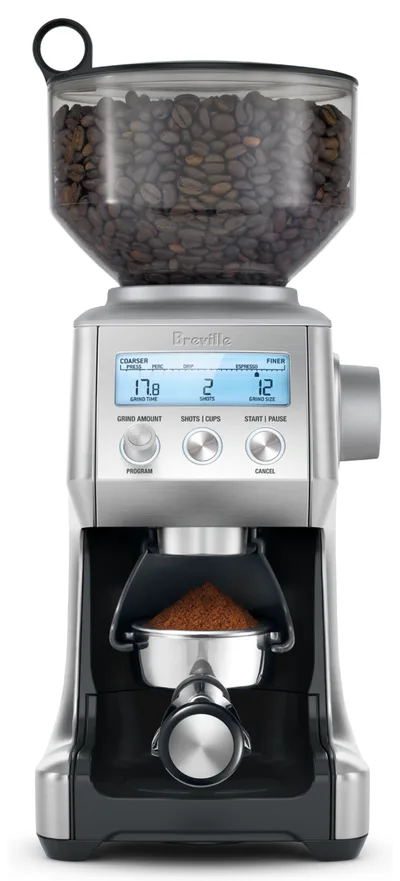
Breville the Smart Grinder Pro
Frequently asked questions
Can a hand grinder be motorised?
Sources
- V60 Dripper manual (VD series) — Hario, accessed November 17, 2026
- Making Coffee at Home: Manual vs Electric Grinders (January 8, 2022) — Brian's Coffee Spot, accessed November 17, 2026
- The Best Manual Coffee Grinders on the Market (October 22, 2026) — The Coffee Chronicler, accessed November 17, 2026
- Best manual coffee grinders (updated September 16, 2026) — CNN Underscored, accessed November 17, 2026
- Baratza Virtuoso+ Coffee Grinder Review (June 13, 2020) — Coffee Review, accessed November 17, 2026
- My Baratza Virtuoso Review (updated April 30, 2024) — Home Grounds, accessed November 17, 2026
- Baratza Encore vs Virtuoso (updated May 20, 2024) — Home Grounds, accessed November 17, 2026
- Breville Smart Grinder Pro review (updated May 2, 2024) — Home Grounds, accessed November 17, 2026
- J‑Ultra Manual Coffee Grinder and User Manual — 1Zpresso, accessed November 17, 2026
- K‑Ultra Manual Coffee Grinder — 1Zpresso, accessed November 17, 2026
- Encore ZCG485 product page — Baratza (Breville USA), accessed November 17, 2026
- Virtuoso+ Operations Manual v1.6 — Baratza (Breville USA), accessed November 17, 2026
- Ode Brew Grinder Gen 2 product page and Safety and Maintenance manual — Fellow, accessed November 17, 2026
- Smart Grinder Pro instruction book (BCG820) — Breville, accessed November 17, 2026