Manual brewers
How to use a moka pot: Bialetti's own steps
Bialetti's own steps, and where popular advice differs.
Assessment based on manufacturer documentation and independent published sources; we have not physically tested these products.
By Syed Hyder Ali · Updated · How we research
In short
The steps change with your model and your hob. Bialetti's three leaflets say: cold water in the heater, ground coffee for Moka in the funnel without pressing it, the lid closed, and a flame inside the rim or a medium electric setting. Take the pot off when the upper unit is full; the Brikka the moment its froth forms.
Worked example
- Pot
- Bialetti Moka Express, 6-cup
- Water, beside the heater drawing
- 300 mL (10.1 oz)
- Coffee, beside the finished-pot drawing
- 270 mL (9.1 oz)
- Bialetti's "cup"
- an espresso-size serving, about 2 oz
Read from the leaflet's table row for 6 cups; nothing is calculated.
270 mL (9.1 oz) of coffee from 300 mL (10.1 oz) of water
Bialetti's table names its two columns only by drawings. The 9.1 oz is also the 6-cup figure on Bialetti's US size list, which prints "oz".
Assumptions and exclusions
This assumes
- You own a Bialetti Moka Express, Venus or Brikka
- Bialetti's "oz" means fluid ounces
- The leaflets are edition 01/2021
- A gas, electric, ceramic or induction hob
This does not cover
- Taste or crema results
- Other makers' pots and electric moka pots
- Coffee doses and ratios in grams
- Beans, roasts and milk drinks
How do you use a moka pot, according to Bialetti?
Start with the pot you own: the Moka Express (aluminum, below), the Venus (stainless steel) or the Brikka (aluminum with a pressure valve). The Moka Express leaflet is the fullest, so its six steps come first. They are Bialetti's words with its part numbers and figure letters left out.
Moka Express: the six steps
- Fill the heater with cold water up to the lower edge of the safety valve, following the amounts indicated in the table.
- Insert the funnel filter into the heater.
- Fill the funnel filter with ground coffee for Moka, without pressing it down, taking care not to leave coffee powder on the rim of the coffee maker.
- Screw the upper part on the heater and tighten well, without pressing too much and avoiding to force the handle.
- Put the coffee maker on the heat source. In case of flame, prevent it from going beyond the rim of the coffee unit. In case of electric/ceramic glass plate, do not use the highest heat.
- When the upper unit is full of coffee, remove the coffee maker from the heat source.
Source: Bialetti Moka Express instruction leaflet, edition 01/2021, "Making coffee", English section; one leaflet covers every size. Read 2026-11-17.
Step 1 points to a table of water amounts, which is a picture in the leaflet. Here it is as Bialetti prints it. Fill the heater to the lower edge of the safety valve; the table shows what that holds for each size.
| Bialetti's "cups" | Water to fill (heater drawing) | Coffee in the pot (finished-pot drawing) |
|---|---|---|
1 | 63 mL (2.1 oz) | 60 mL (2 oz) |
2 | 103 mL (3.5 oz) | 90 mL (3 oz) |
3 | 150 mL (5.1 oz) | 130 mL (4.4 oz) |
4 | 220 mL (7.4 oz) | 190 mL (6.4 oz) |
6 | 300 mL (10.1 oz) | 270 mL (9.1 oz) |
9 | 460 mL (15.5 oz) | 420 mL (14.2 oz) |
12 | 670 mL (22.6 oz) | 600 mL (20.3 oz) |
18 | 885 mL (30 oz) | 800 mL (27 oz) |
The coffee column matches the sizes on Bialetti's US store, except the 12-cup: the US page lists 22 oz, the leaflet 20.3 oz beside the finished pot and 22.6 oz beside the heater. Both are printed here as Bialetti gives them.
What Bialetti does not give: a coffee dose in grams, a brewing time, or a pressure. For the coffee it says "ground coffee for Moka" in the funnel, not pressed. If the pot misbehaves, the leaflet's own checks are further down.
A safety line from all three leaflets: the coffee maker "requires a heat source for its operation and develops pressure inside", and failing to follow the instructions "may cause the risk of burn or the coffee maker burst". The leaflets also say not to leave it unattended, to point the safety valve away from you, and not to open or close the pot by its handle.
What do you need, and what does a "cup" mean?
- Ground coffee for Moka, and water. Bialetti says the pot is for water and ground coffee for Moka only, and lists "coffee for percolating filters or espresso machines" among the things not to put in it. How fine that coffee may be is in the grind row of the differences table below.
- A heat source. Gas, or an electric or ceramic plate. For induction, the stainless-steel Venus works without an adapter (the leaflet limits induction to its 4, 6 and 10-cup sizes). The aluminum Moka Express and Brikka are not induction-ready; Bialetti sells a stainless-steel induction plate adapter that its page says supports Bialetti moka pots from 1 to 9 cups.
- Parts in place before every brew: the valve, funnel, gasket and filter plate, intact and correctly positioned.
A Bialetti "cup" is an espresso-size serving, about 2 oz, not a mug. Plan by the ounce figure, not the cup count. Bialetti's US size list for the Moka Express reads 1 cup 2 oz, 3 cup 4.4 oz, 6 cup 9.1 oz, 9 cup 14.2 oz, 12 cup 22 oz and 18 cup 27.3 oz, with no figure for the 4-cup. The Venus reads 4 cup 5.7 oz, 6 cup 7.9 oz and 10 cup 15.5 oz. Bialetti prints "oz"; this page reads it as fluid ounces. Which size to buy is in best moka pots.
The models this guide mentions by name are the Bialetti Moka Express 6-Cup, the Bialetti Venus 6-Cup Stainless Steel and the Bialetti Brikka 2-Cup.
What should you do with a new pot?
Bialetti's pages agree that a new pot is washed in water only and that the first coffees are thrown away. They differ on the middle step, so the table keeps each source apart.
| Document | Washing | First brews |
|---|---|---|
Moka Express and Brikka leaflets | "Wash thoroughly with water" | Fill it only with water, without coffee. "Make at least 3 cups of coffee, discarding them (do not drink them)." |
Venus leaflet | "Wash it thoroughly, only with water" | "Make at least three cups of coffee, discarding them (do not drink them)." |
Bialetti US blog, "New Moka? Here is what to do to get off to a good start" (2025-07-10) | Water only, no detergent or abrasives | A no-load run first (water to the valve, no coffee), then three disposable coffees made with room-temperature water |
Bialetti US support FAQ | "Rinsing and assembling the pot" | "Brew a few cycles using coffee (not just water) to season the pot" |
Three sources say three discarded coffees; the FAQ says "a few cycles". Whether the first run is water only is the real split: the Moka Express and Brikka leaflets and the blog do it, the Venus leaflet and the FAQ go straight to coffee. Follow the leaflet for your pot. The Moka Express and Brikka leaflets also say the first three dispensings of coffee "are necessary for enhancing the aroma of coffee at best", and Bialetti's blog says the oils and waxes in the discarded coffees "create an insulating and protective coating" inside the pot.
Where does popular advice differ from Bialetti's text?
Two popular guides, Coffee Kev and Blackout Coffee, tell you to start with hot water, grind finer, leave the lid open and stop at the first gurgle. Bialetti's documents say otherwise on several of these points. The table sets the two side by side and prints text only. It makes no claim about taste.
| Point | What Bialetti says | What the two popular guides say | What it means for you |
|---|---|---|---|
Water | Cold water in all three leaflets, up to the lower edge of the safety valve; "room temperature" in the blog. | Hot water: "just-off-the-boil" (Coffee Kev), pre-boiled (Blackout Coffee). | A hot start is not in any Bialetti document read. Home Grounds, an independent reviewer, reports that kettle-hot water shortened the wait on the stove for its Brikka. |
Grind | Ground coffee for Moka; "never use fine grinding coffee" (Moka Express and Brikka leaflets). The blog says "medium to coarse", coarser than an espresso blend, "otherwise the water would have trouble passing through the powder". | Medium-fine, "finer than drip, coarser than espresso" (Blackout Coffee); slightly finer for lighter roasts (Coffee Kev). | Bialetti's leaflets say never fine, and list coffee for espresso machines among products not to use; the guides' medium-fine is finer than the "medium to coarse" in Bialetti's blog. Bialetti's check: turn the cup before drinking, and a lot of powder at the bottom means the grind was too fine. What a grinder must manage is in burr vs blade grinders. |
Lid | "During use, close the lid" (all three leaflets). | Leave it open to watch the coffee (both). | On the Brikka the two collide: Home Grounds reports its cut-out top "can't be closed when it sputters". Both statements are printed; there is no verdict. |
Heat | Gas: the flame must not go beyond the rim. Electric or ceramic: not the highest heat, a medium setting. The blog says "preferably on low heat" so the water rises slower. | Medium to medium-low (Blackout Coffee); Coffee Kev names no setting. | The leaflets set limits, not a number: inside the rim, off the highest setting. Only the blog names low heat. |
When to stop | When the upper unit is full (Moka Express, Venus). The Brikka comes off the heat immediately after its froth forms. | At the first gurgle, hiss or sputter (both). | Bialetti's cue is a full upper unit, except on the Brikka. |
Cooling | "After use, allow the coffee maker to cool down before opening it." Bialetti lists no step to speed cooling. | Run the base under cold water or dunk the pot (Coffee Kev); wrap it in a cold damp cloth (Blackout Coffee). | Bialetti's care text says to wait until the pot has cooled completely before cleaning. |
One consequence is in Bialetti's warranty: it does not cover "failures and/or defects caused by an use, which is improper or not-compliant with the instructions".
What changes with the Venus and the Brikka?
Venus (stainless steel; 4, 6 and 10 cups)
- The steps are the Moka Express's: cold water to the lower edge of the safety valve, ground coffee for Moka not pressed down, screw shut, heat, and take it off and pour when the upper unit is full.
- Gas: keep the flame low so that it does not go beyond the rim. Electric, ceramic or induction (4, 6 and 10-cup sizes only): not the highest heat, a medium setting. Induction needs no adapter.
- A little water may be left in the heater after brewing. Bialetti says that is expected and helps avoid a colour change on the heater surface if the pot stays on the heat.
- The Venus leaflet is shorter than the others. It has no tips list and no FAQ, so the "never fine" and "never press" lines are in the Moka Express and Brikka leaflets, not in this one. The "not pressed down" instruction is in its steps.
- The leaflet says the pot can go in the dishwasher; hand-washing without detergent is recommended so as not to alter the coffee's flavour.
Brikka (aluminum; 2 and 4 cups)
- Fill the heater with cold water using the graduated measuring cup supplied, to the amount in the leaflet's table. For the 2-cup that is 120 mL (4 oz) of water for 100 mL (3.4 oz) of coffee; for the 4-cup, 180 mL (6.1 oz) for 170 mL (5.7 oz). Bialetti marks these as indicative values.
- Coffee and heat follow the Moka Express: ground coffee for Moka, not pressed; flame inside the rim, or a medium setting on an electric or ceramic plate.
- After a few seconds, check that froth has formed in the upper part, and remove the pot from the heat immediately. If it stays on, "the froth might disappear and the coffee might overflow from the upper part". You may still hear dispensing from the valve for a few seconds after it comes off.
- Lid: Bialetti's leaflet says to close the lid during use. Home Grounds reports the Brikka's cut-out top cannot be closed once the coffee sputters.
- Never unscrew the valve system from the column. The leaflet also says that for an excellent creamy coffee it is "very important to respect the right amounts of water and coffee".
- Induction: the Brikka is not induction-ready and needs Bialetti's adapter plate.
Pressure and espresso: Bialetti's US pages call the Brikka's result "real Italian espresso with thick crema". Home Grounds says the foam it saw had gone from the cup about 20 seconds later and that the valve opened at about 1 bar. Whether a moka pot makes espresso sets out what each maker states.
What does Bialetti say to check when the pot leaks, vents or will not brew?
Bialetti's three warnings for the funnel and valve: never press the coffee into the funnel, never fill the water above the valve, and never knock the funnel on a surface to empty it ("it might get damaged or get ovalized, jeopardizing a proper sealing"). The Moka Express leaflet's FAQ lists these checks; the Brikka leaflet repeats most of them and adds two. The Venus leaflet has no FAQ.
| What happens | What the leaflet says to check |
|---|---|
The pot does not dispense coffee | All parts are present. Tightening is right. The pot is not leaking. |
The safety valve vents | The coffee is ground for Moka, is not pressed into the funnel, and there is not too much water. If it keeps venting, Bialetti says it could signal a malfunction: stop using the pot and contact the dealer. |
Water leaks from the pot | The pot is closed tightly enough. The gasket is not worn; replace it if it is. There is no coffee powder on the edge of the heater. |
The coffee is cold or too hot | The water level is the bottom edge of the valve. |
Brikka: no froth | Water level (always use the measuring cup), and that the pot came off the heat after the froth formed fully. |
Brikka: coffee leaks from the upper part | The pot was not left on the heat after the dispensing and froth ended. |
No taste fault, such as bitter or sour coffee, is in any leaflet, so none is covered here.
How do you look after a moka pot?
- After each use: let it cool, then wash with warm water, without detergents or abrasives. The Moka Express and Brikka leaflets say they cannot go in the dishwasher.
- Storing: every part perfectly dry, and the pot not closed.
- Descaling: regularly, with the heater filled to the usual level, two teaspoons of citric acid or vinegar, one brew without coffee, the solution thrown away, then a wash with running water. The leaflets give no fixed interval.
- The safety valve: move its small piston along its axis while washing, to keep limescale from clogging the hole.
- Parts: check the filter plate's holes are open (a soft brush or a needle clears them), and replace the gasket when worn, and in any case at least once a year, with Bialetti spare parts for your model.
Which pot if you do not own one, and is it espresso?
To choose between the Moka Express, Venus and Brikka by size and hob, see best moka pots, and for the Moka Express's sizes, induction rules and warranty, its review. Bialetti calls the Moka Express a "stovetop espresso maker" and its result "espresso-style coffee", and prints no pressure figure; making espresso without a machine compares it with the AeroPress and manual levers. If you are weighing a moka pot against a machine or a French press, see moka pot vs espresso machine and moka pot vs French press.
Models this page mentions
We may earn a commission when you buy through links on this page.
Mentioned in: What do you need, and what does a "cup" mean?
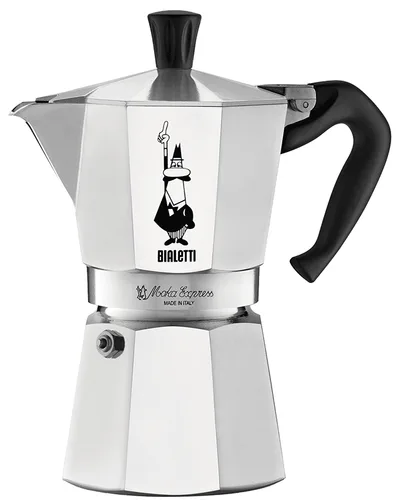
Bialetti Moka Express 6-Cup
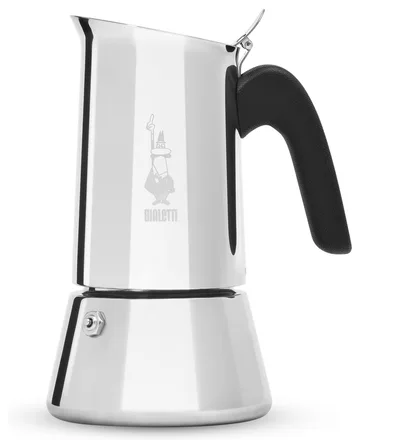
Bialetti Venus 6-Cup Stainless Steel
Frequently asked questions
Can you use a Moka for regular coffee?
Can I use a moka pot on an induction stove?
Sources
- Moka Express instruction leaflet, edition 01/2021 (English section) — Bialetti, accessed November 17, 2026
- Brikka instruction leaflet, edition 01/2021 (English section) — Bialetti, accessed November 17, 2026
- Venus (Acciaio) instruction leaflet, edition 01/2021 (English section) — Bialetti, accessed November 17, 2026
- Bialetti Moka Pot, Italian stovetop espresso maker (US product page, size list) — Bialetti US, accessed November 17, 2026
- Bialetti Venus Stainless Steel Moka Pot 6 Espresso Cup (US product page) — Bialetti US, accessed November 17, 2026
- Bialetti Brikka Moka Pot (US product page) — Bialetti US, accessed November 17, 2026
- Induction Plate Adapter for Moka Pots (US product page) — Bialetti US, accessed November 17, 2026
- Client support FAQ — Bialetti US, accessed November 17, 2026
- Ground coffee for Moka should never be pressed! (blog, 2025-07-10) — Bialetti US, accessed November 17, 2026
- New Moka? Here is what to do to get off to a good start (blog, 2025-07-10) — Bialetti US, accessed November 17, 2026
- Bialetti Brikka Review: Better Than The Moka Express? (updated 2026-11-03) — Home Grounds, accessed November 17, 2026
- How to Use a Moka Pot — Coffee Kev, accessed November 17, 2026
- How to Use a Moka Pot — Blackout Coffee, accessed November 17, 2026