Espresso machines
Is an espresso machine worth it?
It depends on what it replaces. The cost lines, what the makers say about upkeep, and a payback formula you can run with your own prices.
Assessment based on manufacturer documentation and independent published sources; we have not physically tested these products.
By Syed Hyder Ali · Updated · How we research
In short
An espresso machine is worth it if the drink it replaces costs you more than the beans, milk and upkeep it needs, and the saving repays the machine, grinder and accessories within the time you will actually use them. It is not worth it if you make only a few drinks a week, if you will not keep up the routine, or if what you make now already costs about the same per drink. The formula below takes your own prices. No maker page, book or manual for these machines lists a service life, so how long you count on a machine is your choice, not a figure this page can give.
Worked example
- Bag
- 340 g (12 oz)
- Dose range, Bambino Plus manual, 2 cup basket
- 16-19 g
- Ideal dose, Bambino Plus page
- 18 g
340 ÷ 19 = 17.9; 340 ÷ 18 = 18.9; 340 ÷ 16 = 21.25. Whole doubles only: 17, 18 and 21.
17 to 21 doubles per 340 g bag
Arithmetic from Breville's basket range, not a measured yield. Before any coffee lost to dialling in; your bag and dose change it. Divide your bag price by the doubles to get the bean cost of one double.
Assumptions and exclusions
This assumes
- US machines, maker documents read 2026-11-17
- A drink is a double or a milk drink you make
- Your own prices go into the formula; none are printed here
This does not cover
- Prices and any payback time
- Service life, electricity, water and your time
- Taste, and which items to buy
Is an espresso machine worth it?
Three inputs decide it, and all three are yours: what you pay now for the drink you would replace, how many drinks you make a week, and how long you will keep up the routine. A machine that suits a daily café drinker is a poor buy for someone who makes two drinks a week.
- It tends to be worth it when the drink you replace costs clearly more than a home drink, you make drinks most days, and you will use the machine for longer than the payback takes.
- It tends not to be when you make a few drinks a week, when the drink you make now already costs about what a home drink would, or when you will not keep the routine the makers' upkeep asks for (see the upkeep section).
If the answer is yes, the picks are in best espresso machines, and espresso machines with a built-in grinder if you want the grinder counted as part of the machine.
What are you comparing it with?
The saving is what you pay now minus what a home drink costs, so it changes with what you replace. Three common baselines:
- Café drinks. Use your own price per drink. This is the comparison the formula below is written for.
- Capsules. Use your pack price divided by the capsules in it. The capsule route has its own comparison, including what each system locks you to: espresso machine vs Nespresso.
- A home drip machine. The saving per drink may be small, and the question is then closer to espresso against drip: espresso machine vs drip coffee maker.
What does a home espresso setup cost, line by line?
The lines are the machine, a grinder unless the machine has one built in, anything the box leaves out, beans, milk and the supplies the maker names. The table shows what the makers list for six machines.
| Model | Grinder | In the box, as the maker lists it | Supplies the maker names |
|---|---|---|---|
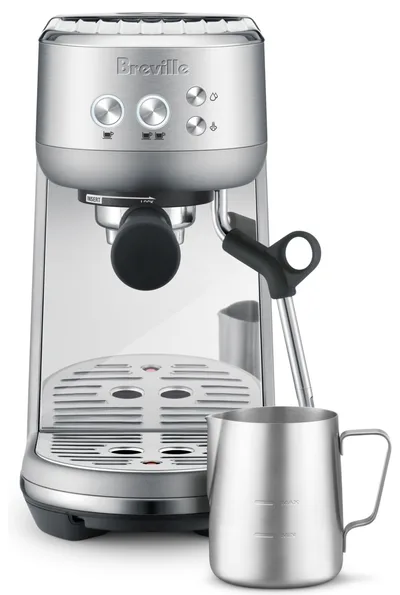
Breville Bambino | None in the machine | Stainless milk jug, 54 mm tamper, steam wand tip cleaning tool, single-wall and dual-wall baskets, descaling powder | Descaling powder, in the box |
Breville Bambino Plus | None in the machine | Milk jug, 54 mm tamper, Razor trimming tool, cleaning disc, cleaning tablets, descaling powder, both basket types | Cleaning tablets and descaling powder |
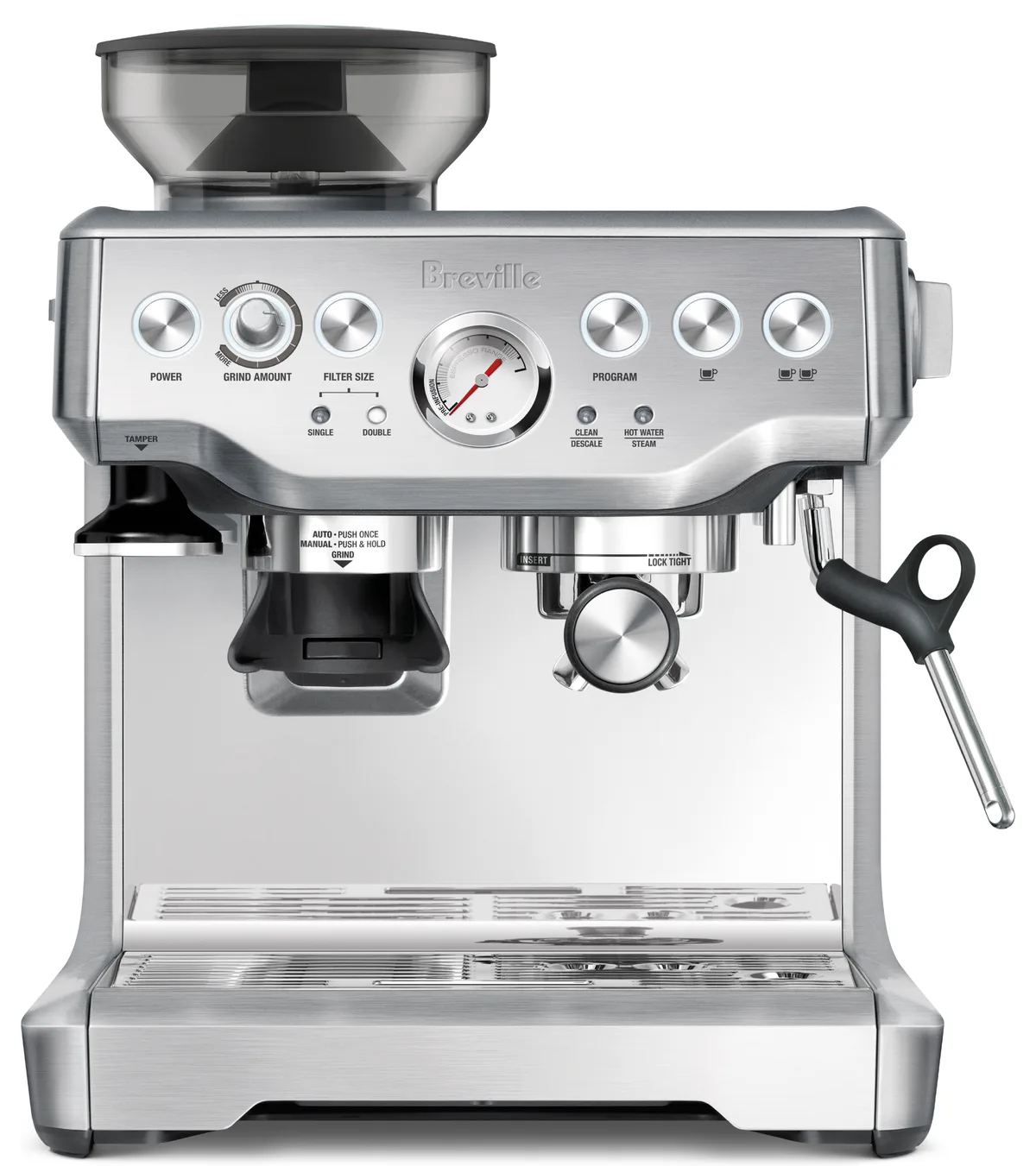
Built-in conical burr grinder | Milk jug, cleaning disc, both basket types, water filter and holder, cleaning tablets, descale powder, dosing funnel, Razor trimming tool | Water filter; cleaning tablets; descale powder | |
None in the machine | Tamper and measuring scoop in its parts list; no milk jug in that list | Gaggia's manual says to use Gaggia's descaling product only, never vinegar, and Gaggia cleaning tablets for the filters | |
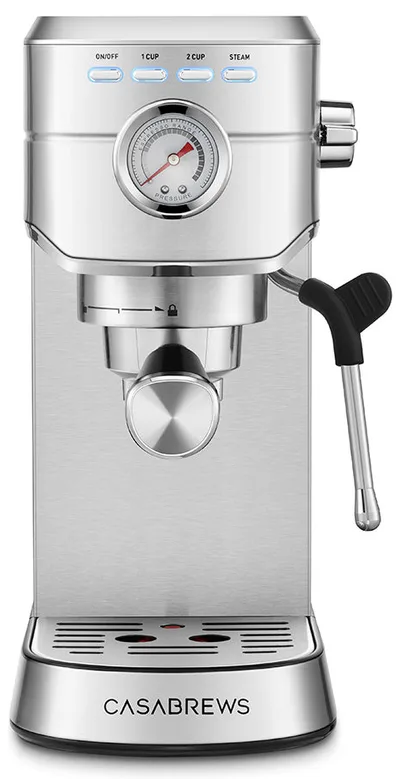
None in the machine | Two 51 mm dual-wall baskets, a 2-in-1 coffee spoon and tamper, a needle tool; no milk jug in that list | Descaling solution, which the manual says is not included in the box | |
None in the machine | Measuring spoon and tamper, 1-shot filter (suitable for E.S.E. pods), 2-shot filter | De'Longhi descaler, "purchase separately" |
What this means when you add it up. A Bambino or Bambino Plus (how the two differ), the Gaggia and the CASABREWS are each a second purchase away from a working setup, because none has a grinder; the Barista Express has one, and so does the De'Longhi Magnifica Evo. A Bambino box includes a milk jug, while the Gaggia and CASABREWS parts lists do not show one, so milk drinks add a jug on those two. Part of what the price of a machine buys is this: a built-in grinder, an automatic steam wand (Bambino Plus) or a pressure gauge (Barista Express, CASABREWS). Choosing the actual items is in the whole home espresso setup.
Not counted: electricity, water, repairs and your own time. The makers list power ratings in watts, not what a drink uses, so the page leaves energy out rather than guess.
How do you work out the cost per drink and the payback?
Use your own prices. In words:
- A home drink = bag price × your dose in grams ÷ grams in the bag, plus milk and other extras. The worked example near the top gives the doubles per bag, so bag price ÷ doubles is the same number.
- Upkeep per drink = what you spend on descaler, tablets and filters in a year ÷ your drinks in a year.
- Saving per drink = what you pay now − home drink − upkeep per drink. If it is zero or negative, there is no payback.
- Drinks to payback = machine + grinder + accessories ÷ saving per drink. Divide by your drinks a week for weeks.
- Net over your horizon = saving per drink × drinks a year × years you expect to use it − equipment. Because upkeep is inside the saving, payback and net always agree: a payback longer than your horizon gives a negative net, and a negative net is shown as negative.
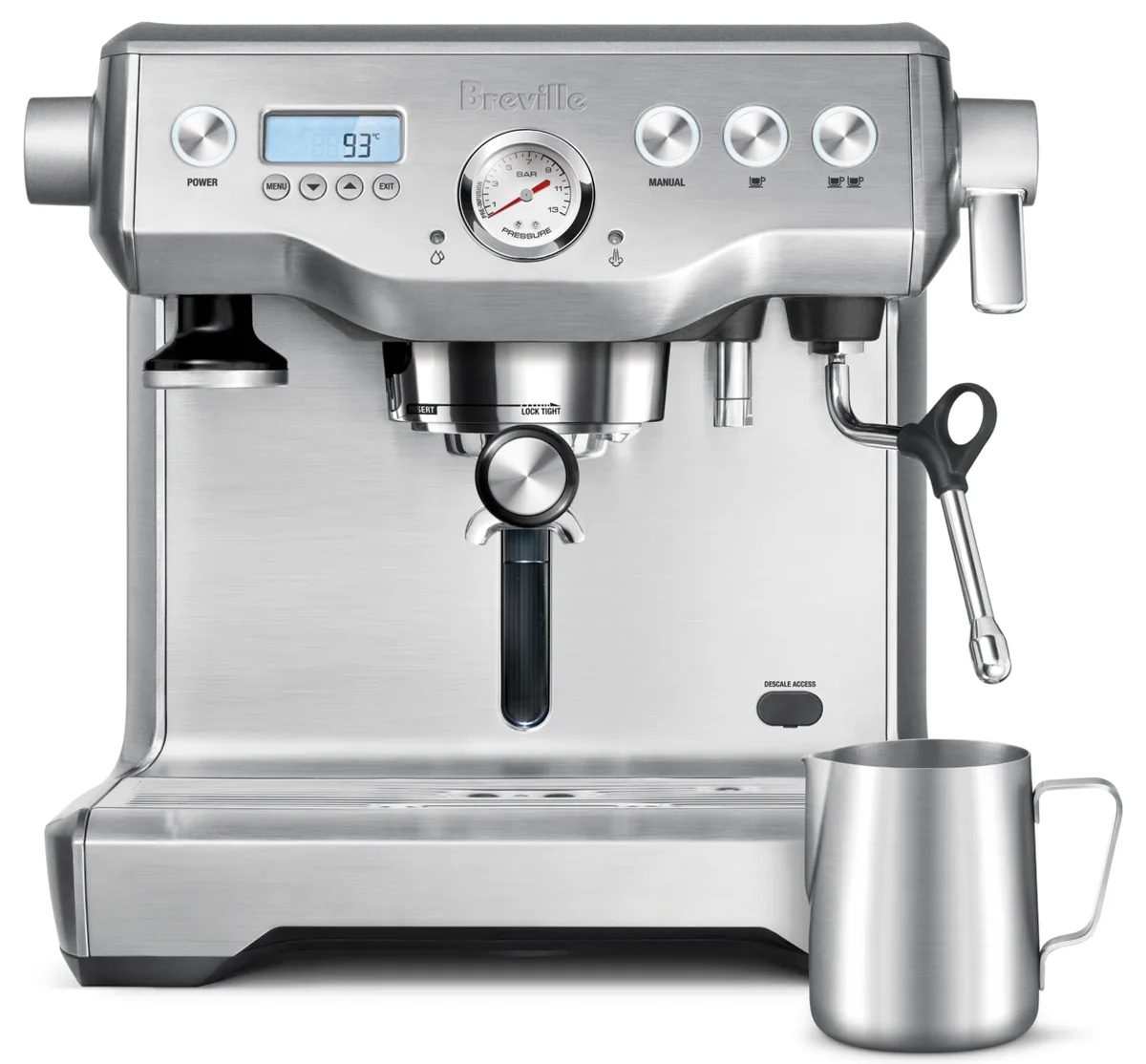
Dose is your own number. Breville's books say the 1 cup basket is designed for 8-11 g and the 2 cup basket for 16-19 g. Breville's product pages name 18 g as the ideal dose for the 54 mm machines, inside that range, and 22 g for the Dual Boiler's 58 mm basket. For a made-up-units example of the payback arithmetic, see espresso machine vs Nespresso.
What upkeep do the makers ask of you?
Upkeep is a cost in supplies and a routine in time, and the makers state it differently:
| Model | Interval the maker states | Supplies | Maker's warranty |
|---|---|---|---|
Breville Bambino Plus | A cleaning cycle after 200 extractions; descale when the machine signals | Cleaning tablets and descaling powder are in the box | 2 years |
Breville Barista Express | Descale when the CLEAN / DESCALE light is solid; water filter steps say to set a replacement date 2 months ahead | Water filter, cleaning tablets, descale powder are in the box | 1 year |
Gaggia Classic Pro | Descale every 2 months (descaling page); every 2-3 months (safeguards page) | Gaggia descaling product; Gaggia cleaning tablets | Not listed: the manual refers to a separate warranty booklet |
CASABREWS CM5418 | A descaling reminder after 500 brew cycles | Descaling solution, not in the box | 12 months, valid only in the country of purchase |
De'Longhi Stilosa | Descale about every 200 coffees; clean the filters thoroughly every 200 cups | De'Longhi descaler, bought separately | 1 year, plus 1 more with product registration |
Nespresso Essenza Mini | After 300, 600 or 1,200 espressos of 40 mL by water hardness (manual); every 3 months or 300 capsules (Nespresso's US guide for the CitiZ) | Nespresso Descaling Kit | 1 year (Nespresso's manual) |
Nespresso Vertuo Pop+ | Descale when the button blinks orange 3 times then turns steady white; clean monthly | Nespresso descaling kit | 1 year |
Two of those rows carry two figures from the same maker. Gaggia's manual says every 2 months on one page and 2-3 months on another; Nespresso's manual and its US guide disagree on the Essenza and CitiZ interval. Both are printed, not averaged. How many times a year that means for you is your own division: at the interval a maker states and your drinks a week. The steps for each are in how to descale an espresso machine, and Nespresso's in how to descale a Nespresso.
How long will a machine last?
No maker page, book or manual for the machines in this guide gives a service life or an expected number of drinks. What they give is a warranty: 1 or 2 years on the Breville models above, 12 months on the CASABREWS, 1 year on the Nespresso models; the Stilosa lists 1 year plus 1 more with product registration; the Gaggia lists none in the documents. A warranty is not a lifespan, so this page offers no "lasts N years" figure, and the years input in the formula above is a number you choose.
When is it not worth it, and what do you do instead?
The formula says no when the saving per drink is zero or negative, when your drinks a week are so few that the payback runs past the years you will use it, when you will not keep the routine in the upkeep table, or when you will not buy and own a grinder for a machine that has none (the Bambino, the Gaggia and the CASABREWS). Routes that avoid a machine's equipment bill, each with its own page:
- A manual espresso maker. No electric machine and no pump, but a lever press still needs a burr grinder and a kettle: see the home espresso setup.
- A moka pot. See best moka pots and the Bialetti Moka Express.
- An AeroPress. The AeroPress Original.
- Capsules. One button and one system's capsules: espresso machine vs Nespresso and the Vertuo Pop+.
- A bean-to-cup machine. Grinding and dosing are done by the machine; see best super-automatic espresso machines.
None of these is better or cheaper by itself; each changes what you spend and what you do. Run the formula with your own prices to see which it is.
Models this page mentions
We may earn a commission when you buy through links on this page.
In the order the page mentions them; not a ranking.
Mentioned in: What does a home espresso setup cost, line by line?
Breville the Bambino
Breville the Barista Express
CASABREWS CM5418
Mentioned in: How do you work out the cost per drink and the payback?
Breville the Dual Boiler
Sources
- the Bambino BES450, US product page — Breville, accessed November 17, 2026
- Bambino BES450 instruction book (US) — Breville, accessed November 17, 2026
- the Bambino Plus BES500, US product page — Breville, accessed November 17, 2026
- Bambino Plus BES500 instruction book (US) — Breville, accessed November 17, 2026
- the Barista Express BES870, US product page — Breville, accessed November 17, 2026
- Barista Express BES870 instruction book (US) — Breville, accessed November 17, 2026
- the Dual Boiler BES920, US product page — Breville, accessed November 17, 2026
- Classic Pro E24 USA manual — Gaggia North America, accessed November 17, 2026
- CM5418 user manual — CASABREWS, accessed November 17, 2026
- CM5418, US product page — CASABREWS, accessed November 17, 2026
- Stilosa EC260BK, US product page — De'Longhi, accessed November 17, 2026
- Stilosa EC260 instruction manual — De'Longhi, accessed November 17, 2026
- Magnifica Evo ECAM29084SB, US product page — De'Longhi, accessed November 17, 2026
- Essenza Mini C30 instruction manual (Zone 1, 2017) — Nespresso, accessed November 17, 2026
- User manual for CitiZ, Essenza Mini, Inissia and Pixie (2021) — Nespresso, accessed November 17, 2026
- CitiZ descaling guide — Nespresso, accessed November 17, 2026
- Vertuo Pop+ user manual (2025) — Nespresso, accessed November 17, 2026
- Vertuo Pop+, US product page — Nespresso, accessed November 17, 2026