Tools and guides
Coffee vs espresso: what differs and which to make at home
How method, grind, dose and caffeine differ, and which suits the drinks you make.
Assessment based on manufacturer documentation and independent published sources; we have not physically tested these products.
By Syed Hyder Ali · Updated · How we research
In short
Coffee vs espresso is a difference of method, not bean: fine grounds under pressure for 20 to 30 seconds make a 1 to 2 fl oz shot. Per fl oz, USDA reference values put espresso at about five times brewed coffee's caffeine, but a 12 fl oz mug holds a little more than a double shot. Espresso suits milk drinks and needs a fine grinder; brewed coffee suits mugs.
Worked example
- Drip dose
- 8 g per 5 fl oz cup (OXO Brew 8-Cup)
- Double basket
- 16 to 19 g (Breville Bambino, 2 cup)
- Double preset
- about 60 mL, 2.03 fl oz (Breville Bambino)
Drip: 8 g ÷ 5 fl oz = 1.6 g per fl oz. Double: 16 to 19 g ÷ 2.03 fl oz = 7.9 to 9.4 g per fl oz.
7.9 to 9.4 g of ground coffee per fl oz in a double, against 1.6 in a drip cup
The same weight of grounds can fill either drink: at OXO's rate a 12 fl oz mug takes 19.2 g (12 ÷ 5 × 8), about the top of a double basket's 16 to 19 g. Breville's preset and a 1:2 yield give different amounts of liquid for a double; both are shown below.
Assumptions and exclusions
This assumes
- OXO's rated cup of 5 fl oz and 8 g
- Breville's basket and preset figures for a double
- USDA reference servings for caffeine
- A double of 2 fl oz, as Breville presets it
This does not cover
- Decaf and caffeine by drink
- Capsule machines, moka pots and AeroPress
- Machine picks and prices
Which should you make at home?
Choose by what you drink most. Espresso also needs a grinder with a fine setting, or pre-ground coffee: a machine like the Bambino has no grinder built in.
| If you drink | Make | It needs | The choice changes if |
|---|---|---|---|
Black coffee by the mug, or for a household | Brewed coffee | A brewer and a grinder. An OXO Brew 8-Cup rates a full batch at 8 cups of 5 fl oz. | You want a small, concentrated cup: then espresso. For brewers, see drip coffee makers. |
Milk drinks: latte, cappuccino, flat white | Espresso | A machine with a steam wand or milk system, and a grinder that goes fine or pre-ground coffee. | You want a button and no grinding: look at super-automatic machines. For the rest, see espresso machines. |
One small, strong cup | Espresso | The same grinder and machine as above. | You do not want a machine: see moka pot against an espresso machine. |
Both, in one household | Both | One grinder can start both: Baratza's Encore manual lists a suggested setting of 8 for espresso and 28 for French press. Coffee Chronicler, though, calls the Encore unsuitable for espresso in a regular 58 mm portafilter. | You mostly want one: buy for that one first. |
Still undecided? Espresso machine against a drip coffee maker puts the two machines side by side.
What is the difference between coffee and espresso?
Espresso is a way of brewing, not a bean or a roast. The National Coffee Association (NCA) puts it this way: "It's a coffee drink, named after the method used to brew it." Against drip, pour-over or French press, what changes is how fine the coffee is ground, how long water touches it, and how much liquid comes out of the same weight of grounds.
| Espresso | Brewed coffee (drip, pour-over, French press) | |
|---|---|---|
Method | High pressure forces nearly boiling water through finely ground coffee (NCA). | A drip machine "slowly drips hot water over ground coffee beans in a filter" (NCA). Pour-over and French press are brewed coffee too. |
Pressure | SCA's definition lists 9 to 10 atmospheres; the Barista Guild survey SCA reports averaged 8.5 bars. Breville states a 9 bar extraction from a 15 bar pump. | Not listed for drip (NCA). |
Grind | Fine, "like table salt" (NCA). | Drip medium, "like kosher salt"; pour-over medium; French press coarse, "like rock salt" (NCA). |
Contact time | 20 to 30 seconds (NCA, SCA). | About 5 minutes for drip (NCA). |
Liquid in the cup | A single is 25 to 35 mL (0.85 to 1.2 fl oz); a double is twice that (SCA's heritage definition). Breville's presets are about 30 mL (≈ 1.0 fl oz) and about 60 mL (≈ 2.0 fl oz). | OXO rates a cup at 5 fl oz (≈ 148 mL). This page uses a 12 fl oz mug (≈ 355 mL) as its example. |
Coffee per drink | 7 to 9 g a single and 14 to 18 g a double (SCA). Breville's baskets hold 8 to 11 g and 16 to 19 g. | About 8 g per 5 fl oz cup (OXO 8-Cup manual). NCA's drip page suggests 1 to 2 tablespoons per 6 ounces of water. |
Not sure how fine "fine" is on your grinder? The grind size chart shows each brewing method's range side by side.
How do they taste and feel different?
NCA puts it this way: "In terms of taste, yes – espresso is denser and more concentrated than brewed coffees, so it has a stronger flavor." It describes the shot's top layer as "the crema, or velvety, golden-brown top layer". KitchenAid ties the thick body to the oils its espresso roast brings out, together with a fine grind. Roast and origin change flavour as well, and neither is part of the method.
Where sources disagree: what a double is
- Coffee in a double. SCA's heritage definition lists 14 to 18 g. Breville's 2 cup basket holds 16 to 19 g, and La Marzocco Home's recipe starts from 18 g. In the Barista Guild survey SCA reports, 66% of respondents' doses fell between 18 and 20 g.
- Liquid from a double. By volume, Breville's preset is about 60 mL (≈ 2.0 fl oz) and SCA's heritage definition gives 50 to 70 mL for a double; in the same 275-respondent survey, those who measured by volume averaged 1.8 fl oz (74.2 mL). By weight, NCA's 1:2 on a 16 to 19 g dose gives 32 to 38 g of espresso, La Marzocco Home aims for about 28 to 36 g, and the survey's average output was 36.5 g.
Millilitres poured and grams on a scale are different measures, so each is shown as its source gives it, not averaged.
Are moka pots and capsule machines espresso?
Whether a moka pot counts as espresso is covered in moka pot against an espresso machine, and whether a capsule machine does in espresso machine against Nespresso.
How much ground coffee goes into each?
A shot and a mug can start from the same weight of ground coffee. What differs is how much liquid that coffee is spread through.
| Drink | Maker's dose | Liquid in the cup | Ground coffee per fl oz |
|---|---|---|---|
Drip cup, OXO Brew 8-Cup | About 8 g of medium-ground coffee per cup | 5 fl oz (≈ 148 mL) | 1.6 g |
Single, Breville Bambino 1 cup basket | 8 to 11 g | Preset about 30 mL (≈ 1.0 fl oz) | 7.9 to 10.8 g |
Double, Breville Bambino 2 cup basket | 16 to 19 g | Preset about 60 mL (≈ 2.0 fl oz) | 7.9 to 9.4 g |
Double at NCA's 1:2 | 16 to 19 g | 32 to 38 g of espresso, about 1.1 to 1.3 fl oz if 1 g counts as 1 mL | 14.8 g |
Per fl oz, Breville's double holds five to six times the ground coffee of an OXO drip cup, and a 1:2 yield about nine times. That is why a shot tastes concentrated. It is also why a 12 fl oz mug at OXO's rate (19.2 g) starts from about as much coffee as a double basket (16 to 19 g).
Does espresso have more caffeine than coffee?
Per fl oz, yes: about five times as much. Per serving, it depends on the size of the drink. On USDA's reference entries, a double holds less than a 12 fl oz mug of brewed coffee.
| Drink | Serving | Caffeine | Per fl oz |
|---|---|---|---|
Espresso, single | 1 fl oz (29.6 g) | About 63 mg | 62.8 mg |
Espresso, double | 2 fl oz (59.2 g) | About 126 mg | 62.8 mg |
Brewed coffee, cup | 8 fl oz (237 g) | About 95 mg (71 to 104 mg across USDA's 30 to 44 mg per 100 g) | 11.8 mg |
Brewed coffee, mug | 12 fl oz (355 g) | About 142 mg | 11.8 mg |
The ratio per fl oz is 5.3 (62.8 against 11.8 mg), and a double equals about 10.6 fl oz of brewed coffee, so a 12 fl oz mug holds a little more than a double (142 against 126 mg). If a double is closer to 36 g of liquid, as in the survey's average output of 36.5 g, it holds about 77 mg on the same entry (2.12 mg per g), and the mug holds more still.
Two cautions go with those numbers. USDA's espresso entry averages 2 samples and its brewed entry 8, and both were last revised on April 1, 2019. And they are reference servings: a real shot moves with its dose and yield. The caffeine in espresso guide covers the spread between real shots, decaf and capsules.
So "stronger" has two meanings here. In flavour and concentration, espresso is stronger: NCA calls it "denser and more concentrated". In caffeine, NCA's answer is "Not necessarily – it depends on how much you drink": per cup, the bigger drink wins.
Are espresso beans different from coffee beans?
Not by definition. NCA says espresso "is not a type of coffee bean or even a roast". NCA adds that coffee "specifically roasted for espresso will best bring out its characteristics", and that a variety of roasts work well for it.
Where sources disagree: what an espresso bean is
KitchenAid writes that "an espresso bean is simply a type of coffee bean that is roasted longer and darker". NCA, quoted above, says espresso is not a roast. The difference matters mainly when you pick a bag; the machine documents ask for something else.
What the makers' documents ask for is a fine grind and the right basket, not a label. Breville's Bambino ships single-wall baskets for freshly ground coffee and dual-wall baskets for pre-ground, and its manual recommends "quality 100% Arabica beans with a 'Roasted On' date stamped on the bag". Baratza's Encore manual suggests a starting grind setting of 8 for espresso out of 40, against 28 for French press. De'Longhi's Magnifica Evo takes whole roasted beans, "not green, caramelised or candied", or pre-ground coffee for one cup at a time, and Philips's manual for its fully automatic machines warns that caramelized or flavored beans can cause damage the warranty does not cover.
That answers "can you make espresso with regular coffee?": the machine and the grind decide it, and no document quoted here requires a bag labelled espresso. If your grinder cannot go fine, buy pre-ground coffee and a dual-wall basket, or expect to need a new grinder.
What can you make with a shot?
A shot is the base of every drink with milk or water added. La Marzocco Home gives an americano as a double plus about 8 fl oz of hot water, and a latte as a double plus steamed milk. Espresso drinks sets out what each one is and which machines can make it.
Models this page mentions
We may earn a commission when you buy through links on this page.
Mentioned in: Which should you make at home?
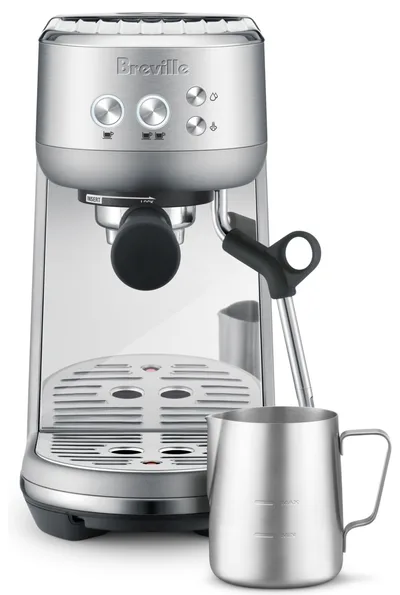
Breville the Bambino
Sources
- Espresso — National Coffee Association (About Coffee), accessed November 17, 2026
- Drip Coffee — National Coffee Association (About Coffee), accessed November 17, 2026
- The Beginner's Guide to Espresso Drinks (12/04/2020) — La Marzocco Home, accessed November 17, 2026
- Baratza Encore review — Coffee Chronicler, accessed November 17, 2026
- Defining the Ever‑Changing Espresso (25 Magazine, issue 3) — Specialty Coffee Association, accessed November 17, 2026
- Beverages, coffee, brewed, espresso, restaurant-prepared (FDC 171891, SR Legacy) — USDA FoodData Central, accessed November 17, 2026
- Beverages, coffee, brewed, prepared with tap water (FDC 171890, SR Legacy) — USDA FoodData Central, accessed November 17, 2026
- 20 Types of espresso drinks and how to make them (20 October 2025) — KitchenAid US, accessed November 17, 2026
- Bambino BES450 instruction book, US/Canada/Mexico — Breville, accessed November 17, 2026
- The Bambino BES450 product page — Breville, accessed November 17, 2026
- OXO Brew 8-Cup Coffee Maker instruction manual (Brew_8718800 M03) — OXO, accessed November 17, 2026
- Encore Operations Manual v4.3 (December 2022) — Baratza (Breville USA), accessed November 17, 2026
- ECAM29X instructions for use, US — De'Longhi, accessed November 16, 2026
- Important Information Manual, Philips fully automatic espresso machines — Philips (Versuni), accessed November 16, 2026