Pour-over
Coffee to water ratio: calculator and what makers list
How much coffee for your water: the Specialty Coffee Association's (SCA) 55 g/L, the doses makers list and where they differ, and a calculator from water in mL, fl oz or cups to coffee, or back.
Assessment based on manufacturer documentation and independent published sources; we have not physically tested these products.
By Syed Hyder Ali · Updated · How we research
In short
The coffee-to-water ratio sets the coffee's weight against the water you put in, not the drink. The Specialty Coffee Association (SCA) recommends 55 g/L ± 10%, about 1:18: 27.5 g for 500 mL, or 19.5 g for 12 fl oz (≈ 355 mL) of water. If your manual gives a dose per amount of water, start there; some brewers cap the dose.
Worked example
- Input water
- 500 mL (0.5 L)
- Ratio
- 55 g/L (the SCA reference)
55 g/L × 0.5 L = 27.5 g
27.5 g of coffee
SCA reference range for this water: 24.75 to 30.25 g (55 g/L ± 10%, computed).
Assumptions and exclusions
This assumes
- If you weigh water, 1 g counts as 1 mL
- The ratio is against input water
- You weigh the dose in grams
- The SCA's liter is taken as water; its document doesn't say
This does not cover
- Brew steps and recipes
- Grind, water temperature and brew time
- Taste outcomes
- Drink volume after brewing
Coffee-to-water ratio calculator
Start from the water you brew with or the coffee you have, in the units you use, and a ratio: it gives the other amount. The ratio is pre-filled with the Specialty Coffee Association’s recommended 55 g per liter.
Worked example: 350 mL × 55 g per liter ÷ 1,000 = 19.25 g of coffee.
Result
Enter an amount and a ratio to see how much coffee or water to use.
- 1 : x means x mL of water for each gram of coffee; 55 g per liter is about 1 : 18.2.
- Cups are 8 fl oz measuring cups, not a coffee maker’s cup.
Worked examples (text version)
Coffee in grams = water in mL × g per liter ÷ 1,000; water in mL = coffee in grams × 1,000 ÷ g per liter. A ratio of 1 : x is 1,000 ÷ x g per liter.
| Start from | Ratio | Result |
|---|---|---|
| 350 mL of water | 55 g per liter | 19.3 g of coffee (≈ 0.68 oz) |
| 12 fl oz of water | 1 : 16 | 22.2 g of coffee (≈ 0.78 oz) |
| 4 cups of water | 55 g per liter | 52 g of coffee (≈ 1.84 oz) |
| 20 g of coffee | 1 : 16 | 320 mL of water (≈ 10.8 fl oz) |
| 1 oz of coffee | 55 g per liter | 515 mL of water (≈ 17.4 fl oz) |
| 1,000 mL of water | 55 g per liter | 55 g of coffee (≈ 1.94 oz) |
Refused, with the message shown
- Enter the amount of water.
- The amount of water must be from 10 mL to 5,000 mL.
- The amount of water must be from 10 mL to 5,000 mL.
- The amount of water must be from 10 mL to 5,000 mL.
- Choose a unit from the list.
- Enter the ratio in g per liter.
- The ratio must be from 1:1 to 1:50.
- The ratio in g per liter must be a number, from 20 to 1,000.
- Choose how the ratio is written from the list.
- Choose how the ratio is written.
What is a coffee-to-water ratio?
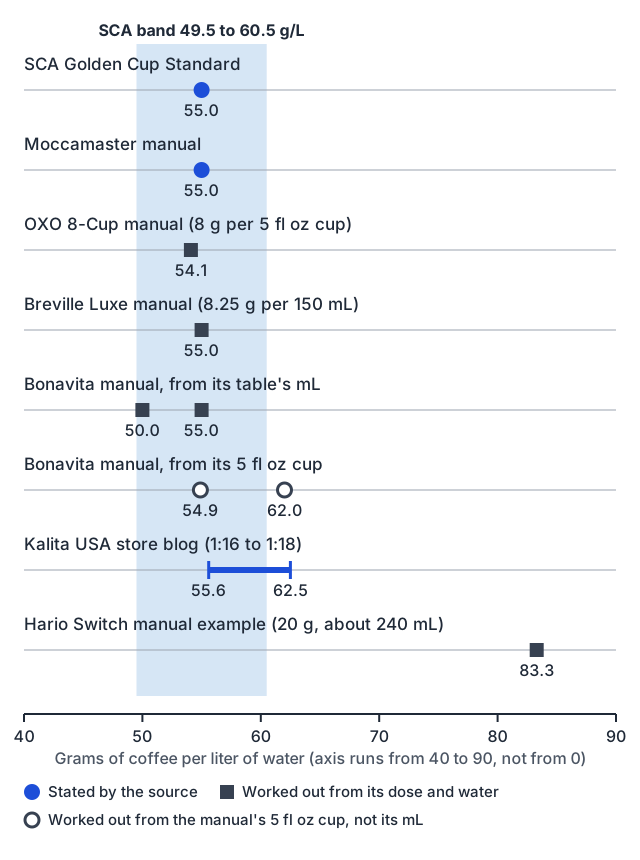
The ratio compares the coffee you weigh with the input water: the water you put in the brewer, not the drink that ends up in the cup. If you work from cups, a maker's cup is a set volume of water (5 fl oz for the OXO and Bonavita brewers below), not the drink you pour; maker cup sizes and drink volume covers how to convert maker cups. Written as 1:x, the ratio is x mL of water for each gram of coffee; written as g/L, it is grams of coffee per liter of water. To convert, g/L = 1000 ÷ x. The SCA's Golden Cup Standard recommends 55 g/L ± 10%: 1:18.2, with the band of 49.5 to 60.5 g/L running from 1:20.2 to 1:16.5 (all computed). A bigger x means less coffee for the same water. Choosing a brewer rather than a dose? The pour-over guides cover the options.
How much coffee for your water?
Type the water you put in (mL, fl oz, or cups of 8 fl oz, not a coffee maker's cup) and a ratio, as g per liter or 1 : x, and the calculator returns grams of coffee. Type the coffee you have (g or oz) and it returns the water. The ratio starts at 55 g/L; to try a maker's figure, type it from the table below. Coffee shows to 0.1 g and water to the nearest mL. The calculator does not check your ratio against the SCA band, so compare it with 49.5 to 60.5 g/L yourself.
| Ratio (1:x) | g/L | Coffee in 500 mL of water |
|---|---|---|
1:15 | 66.7 | 33.33 g |
1:16 | 62.5 | 31.25 g |
1:17 | 58.8 | 29.41 g |
1:18 | 55.6 | 27.78 g |
1:19 | 52.6 | 26.32 g |
1:20 | 50.0 | 25.00 g |
Each step on the 1:x scale moves a 500 mL dose by 1.3 to 2.1 g; going from 1:18 to 1:16 adds 3.47 g (27.78 to 31.25 g). Once you have the dose, weigh it: coffee scales compares scales.
What ratios do the SCA and the makers list?
Which figure to start from depends on your brewer. Where your manual gives a clear dose for a stated amount of water, that is the figure written for your machine; where it does not, use the SCA's.
- A Moccamaster. The manual gives 55 g per liter and a table by water volume. Its 1.25 L row is 69 g (± 5), which is 55.2 g/L, so the manual and the SCA agree: 55 × 1.25 = 68.75 g.
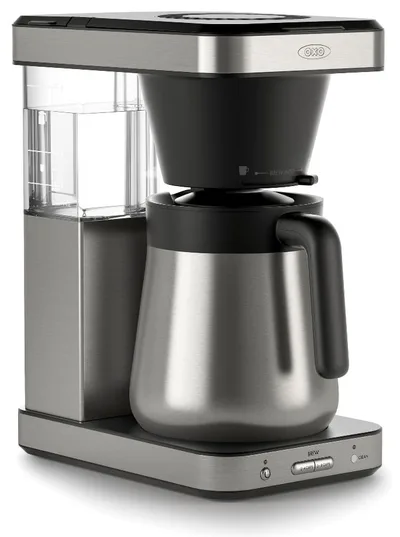
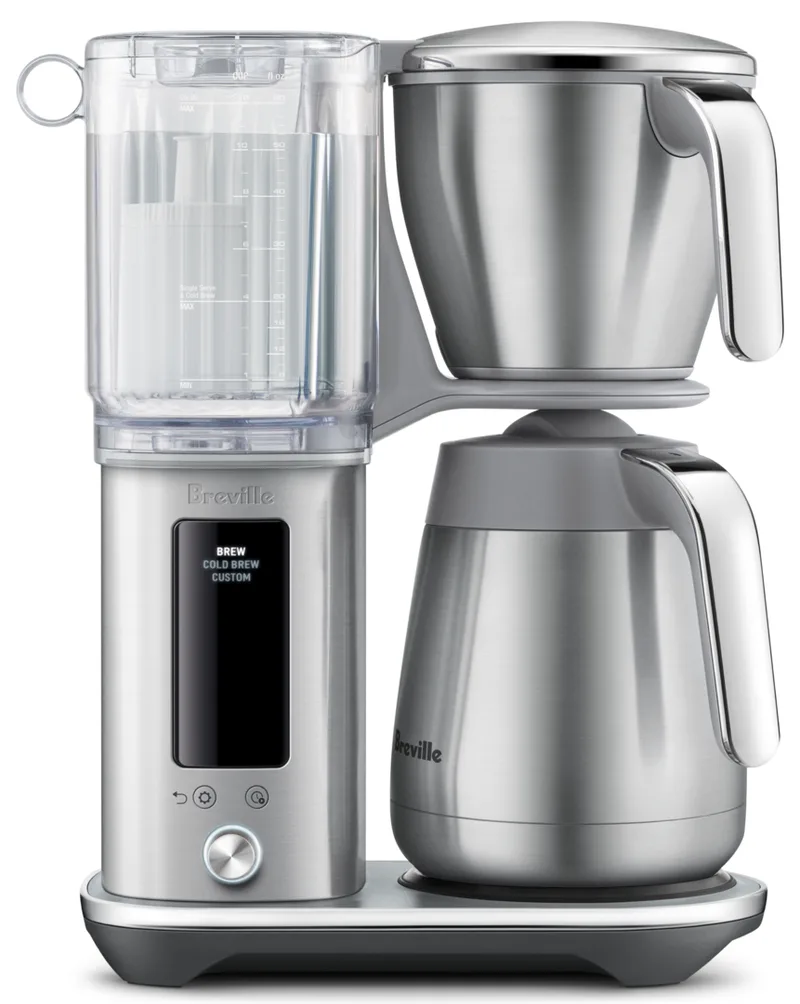
- An OXO 8-Cup or 9-Cup, or a Breville Luxe. Their figures work out to 54.1 and 55.0 g/L, inside the SCA band, so the SCA arithmetic lands within about 1 g/L of theirs.
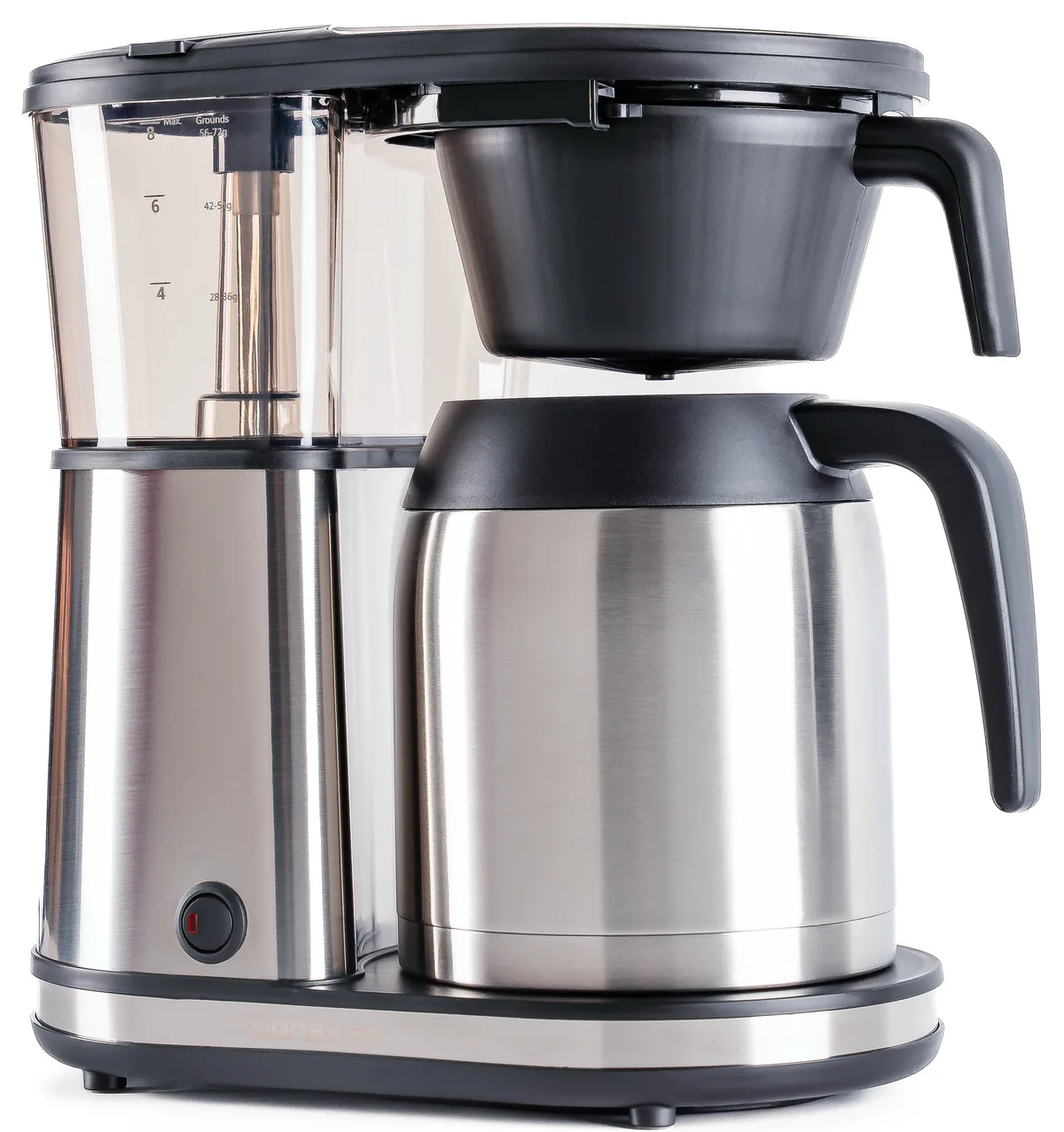
- A Bonavita Connoisseur 8-Cup. Its manual's table and its cup size give different doses per liter (see Where sources disagree), so start from the SCA figure and weigh your water.
- An AeroPress. Two AeroPress pages disagree on what a scoop weighs (14 g against 16-18 g) and give no water volume, so weigh the dose instead of counting scoops; the pages' figures run from 14 to 18 g and this page cannot say which is right.
Pour-over ratio
Of the pour-over sources here, only Kalita USA's store blog states a ratio, 1:16 to 1:18 (62.5 to 55.6 g/L); for a V60 or a Chemex, start from the SCA's 55 g/L and weigh the dose.
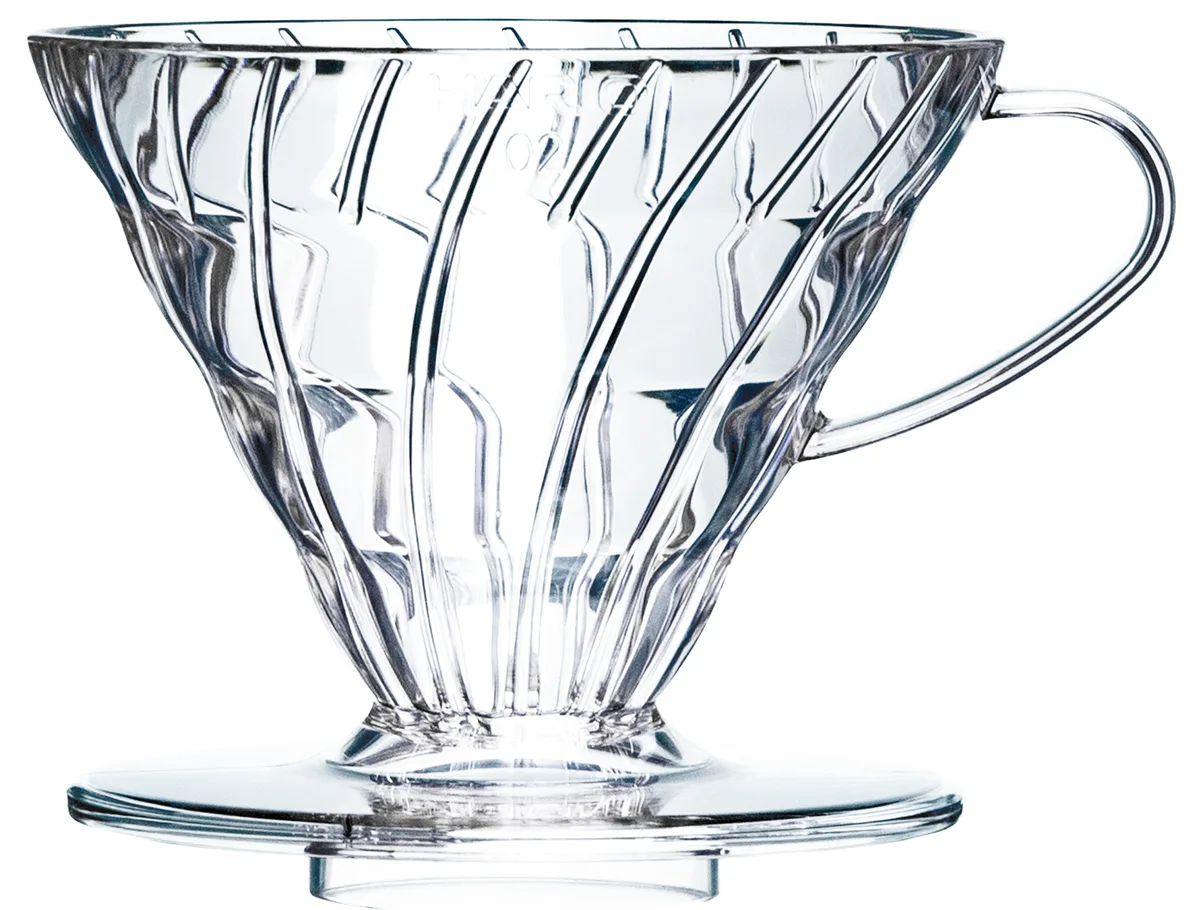
- A Hario V60 or a Chemex. Hario lists 10-12 g for one serving (120 mL) without saying whether that is water in or drink out, and Chemex lists one rounded tablespoon per cup and no grams. Neither gives a water amount to compute from, so use the SCA figure in the calculator and weigh the dose.
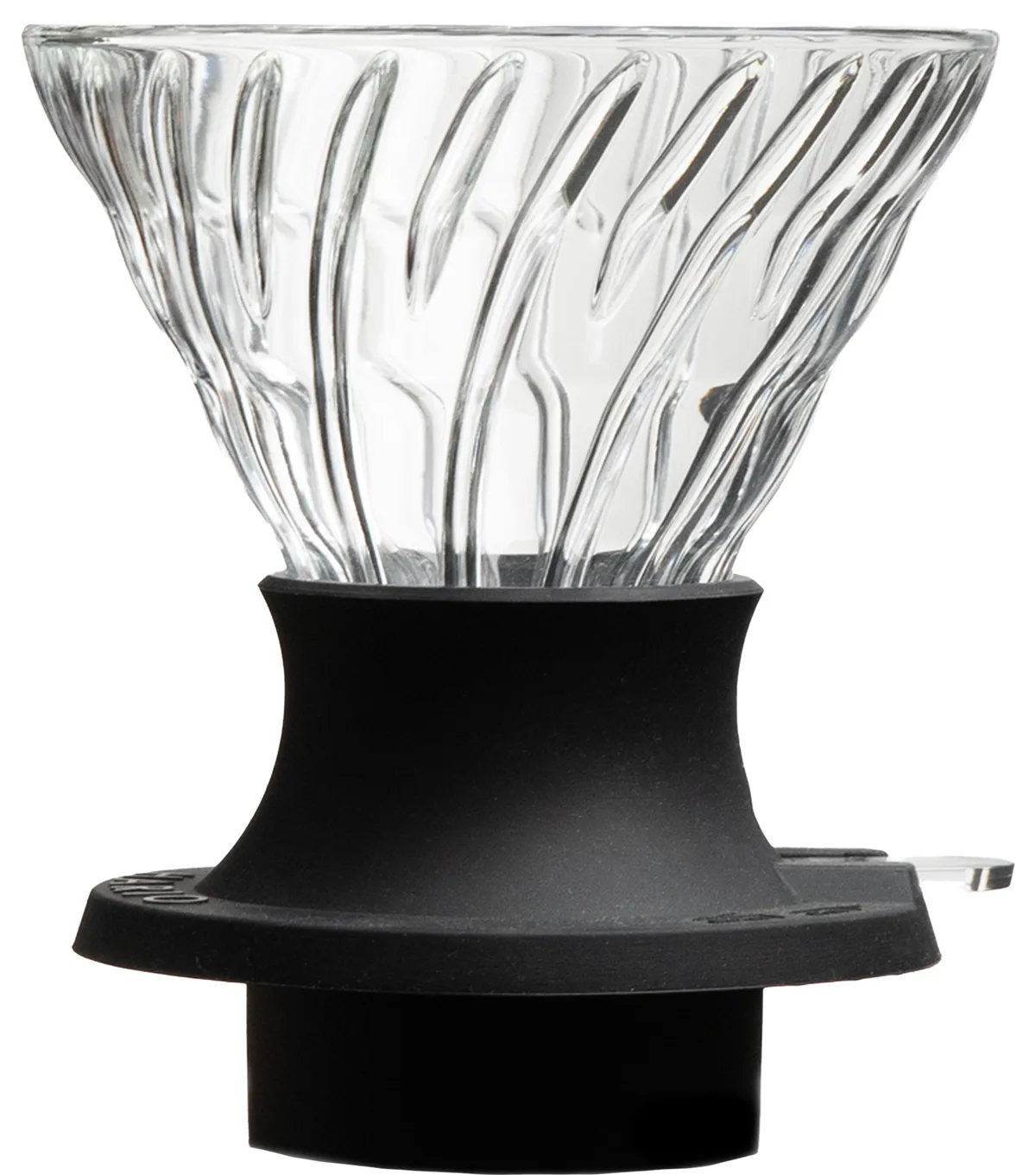
- A Hario Switch. The manual's example is 20 g in about 240 mL, 83.3 g/L: about 1.5 times the SCA's 55 g/L (83.3 ÷ 55) and above the band's 60.5 top. It is an example, not a stated ratio.
- A Kalita pour-over. Kalita USA's store blog says 1:16 to 1:18, which is 62.5 to 55.6 g/L: 1:18 and 1:17 sit inside the SCA band, 1:16 above it, so 1:17 to 1:18 satisfies both.
The table keeps each source's own figure and what it is measured against. The g/L and 1:x columns are worked out on this page, with 1 g of water counted as 1 mL, unless a cell says stated. Sources are not averaged, and where a source gives no water amount no ratio is computed.
| Source | Figure as stated | Measured against | g/L | 1:x | Applies to |
|---|---|---|---|---|---|
Reference | |||||
SCA, Protocols and Best Practices (cover: Revised 2018) | "the recommended coffee-to-water ratio is 55 g/L ± 10%" | Per liter of water (the SCA document does not say "of water"; this page reads it that way) | 55 stated; 49.5 to 60.5 (± 10%) | 1:18.2 (1:20.2 to 1:16.5) | The Golden Cup Standard, not a brewer |
SCA, same document, cupping protocol | "The optimum ratio is 8.25 grams of coffee per 150 ml of water" (± .25 g) | Water, in a cupping glass | 55.0 | 1:18.2 | A tasting protocol, not brewing advice |
Pour-over | |||||
Hario, V60 manual | "10-12g is normally good for one serving (120ml)" | The manual says "one serving (120ml)"; whether that is water in or drink out is not stated | Not computed | Not computed | V60 dripper manual (Hario V60 Plastic Dripper 02 review) |
Hario, Switch manual example | 20 g of coffee and "plenty of hot water (approx. 240mL)" | Hot water | 83.3 | 1:12.0 | Hario V60 Immersion Dripper Switch 02; a manual example, not a stated ratio |
Kalita USA blog (Kalita's US site, run by Espresso Parts; a store blog, not a maker document) | "stick to the 1:16 - 1:18 ratio"; example "Coffee: 20 grams for 1-2 cups. Water volume: 320 grams" | Water | 62.5 to 55.6 for 1:16 to 1:18; the example is 62.5 | 1:16 to 1:18 stated; example 1:16 | Kalita pour-over method (store blog) |
Chemex, classic series support page | "one rounded tablespoon of ground coffee for every 5 oz. cup" | The cup, which Chemex sizes in "5 ounce increments" (read here as 5 fl oz) | Not computed (no grams listed) | Not computed | Chemex Classic series |
Electric brewers | |||||
OXO, 8-Cup and 9-Cup manuals | "approximately 8 grams of medium-ground coffee per cup (5 fl oz)"; the 9-Cup table lists 72 g for 9 cups, 45 oz (read as 45 fl oz) | Water for the cup count | 54.1 | 1:18.5 | OXO Brew 8-Cup Coffee Maker and the 9-Cup manual |
Moccamaster USA manual v23.0 | "2 tbsp. of ground coffee to every 6 oz. of water – or 55 grams of ground coffee per liter"; its table lists 69 g (+/- 5) for 1.25 L and 55 g for 1 L | Water volume | 55 stated; 55.2 for 69 g in 1.25 L | 1:18.2; 1:18.1 for 69 g in 1.25 L | The general Moccamaster manual; its table is by water volume (1.25 L and 1 L rows) |
Bonavita Connoisseur manual (2021) | 6-cup batch: 1000 ml, 55 grams; 8-cup batch: 1300 ml, 65 grams | Water volume, as the manual's table lists it; the manual's own cup size conflicts with it (see Where sources disagree) | 55.0 and 50.0, from the table's mL | 1:18.2 and 1:20.0 | Connoisseur 8-Cup Drip Coffee Brewer (BV1901TS) |
Breville Luxe Brewer manual (2025) | "1 level Breville scoop of coffee grounds per 150ml cup of water"; its table lists 8.25 g for 150 ml and 99 g for 1.8 L | Water, a 150 mL cup | 55.0 | 1:18.2 | the Luxe Brewer Thermal |
Immersion | |||||
AeroPress, how-to-use page and FAQ page | How-to-use: "16-18 grams or 1 heaping Scoop". FAQ: "one heaping scoop of medium-fine grind coffee, or 14-15 grams of coffee per cup" | Water filled "up to #4 marked on the side of the Chamber"; no volume in the text read | Not computed | Not computed | AeroPress Original and Clear, not XL (AeroPress Original Coffee Maker review); the two pages conflict, see Where sources disagree |
The SCA row is a standard for a brewing outcome, not a rule your brewer follows. Where a source gives a water amount, the computed figures run from 50.0 to 83.3 g/L, against the SCA band of 49.5 to 60.5 g/L. Hario's V60 manual gives a serving volume but not what it measures, and Chemex gives a tablespoon dose with no grams, so nothing is computed for either and neither is in that range.
Where sources disagree
- Bonavita Connoisseur. The manual's table lists 1000 ml for the 6-cup batch and 1300 ml for the 8-cup batch. The same manual states "In the case of Bonavita brewers, 1 cup is equal to 5oz"; read as 5 fl oz, 6 cups is 30 fl oz (≈ 887 mL) and 8 cups is 40 fl oz (≈ 1,183 mL). The doses of 55 g and 65 g then compute to 62.0 g/L (1:16.1) and 54.9 g/L (1:18.2), against 55.0 and 50.0 from the table's mL. Both 8-cup readings are inside the SCA band, so start from the SCA figure and weigh your water.
- AeroPress. The how-to-use page equates one heaping scoop with 16-18 grams; the FAQ page states a heaping scoop holds 14 grams and a level scoop 11.5 grams, and lists 14-15 grams per cup. Neither page gives a water volume, so no ratio is computed.
How do you scale a batch?
Dose and water scale together. Doubling the input water doubles the dose, and the ratio stays the same: at 55 g/L, 250 mL of water takes 13.75 g, 500 mL takes 27.5 g and 1000 mL takes 55 g. The calculator does this for any ratio.
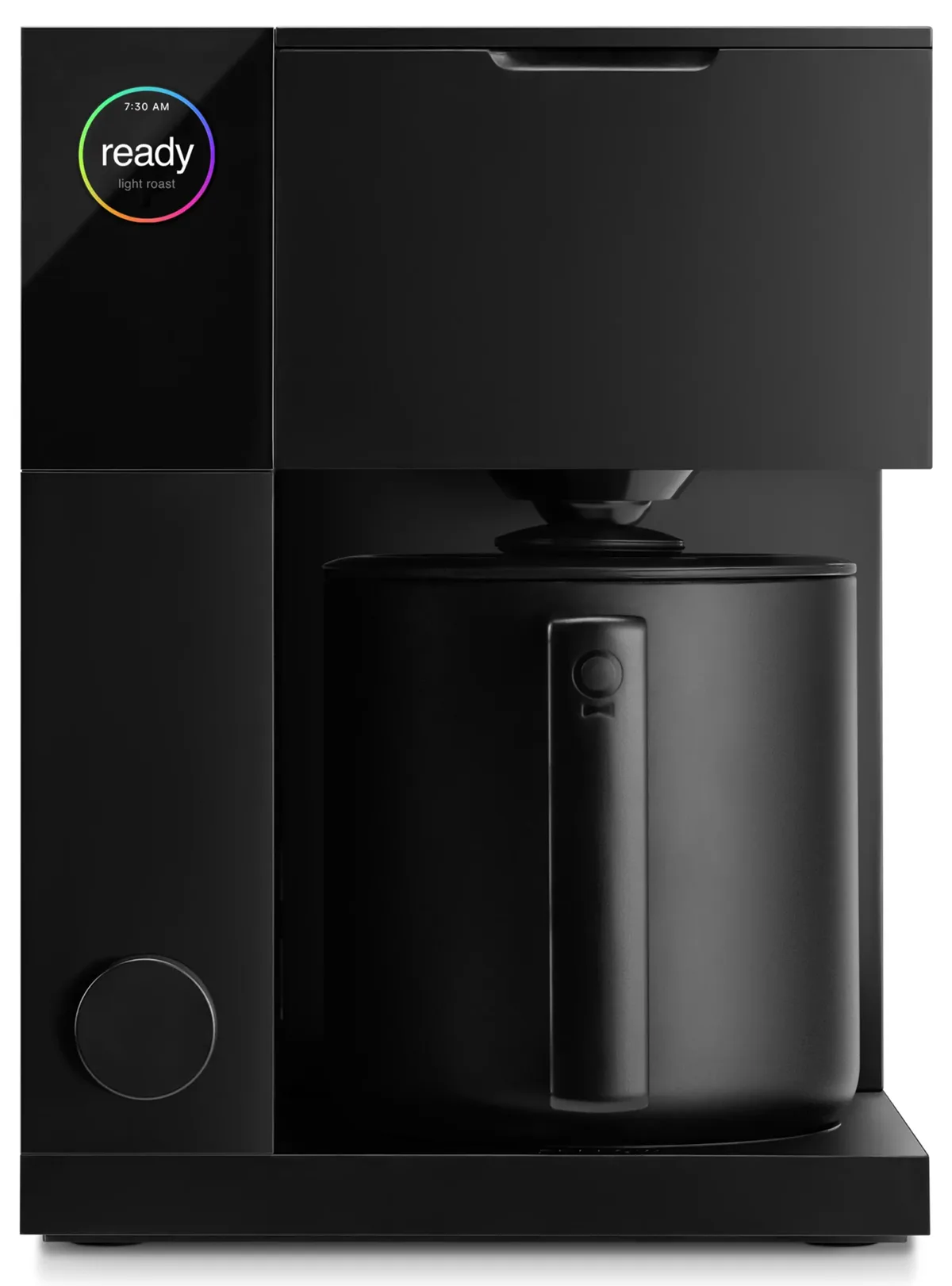
A brewer's own dose limit overrides the proportion. Fellow's get-to-know-you guide states a maximum coffee dose of 82.5 g for the blue (batch) basket in standard brewing, and 110 g for cold brew; above the limit there is a risk of overflow (Fellow Aiden Precision Coffee Maker review). At 55 g/L, 82.5 g is the dose for 1.5 L of water (82.5 ÷ 55), so a larger batch at that ratio goes over the limit, which Fellow says risks overflow. If you are choosing a Chemex by batch size, see Chemex sizes.
How do you make coffee stronger or weaker, or dilute it?
Three changes alter strength, each as arithmetic:
- More coffee, same water. In 500 mL of water, going from 27.5 g to 30.25 g is 10% more coffee and 60.5 g/L, the top of the SCA band. Not every maker allows it; see below.
- Less input water, same coffee. 27.5 g in 450 mL of water is 61.1 g/L (1:16.4), above the SCA band.
- Add water after brewing. Final volume is the brewed volume plus the added water, and the drink's concentration is the original multiplied by brewed ÷ final. Adding 100 mL to 300 mL brewed gives 300 ÷ 400, a concentration of 0.75 of the original.
The first change is not open to every owner. Moccamaster's manual states that if coffee is too weak, "DO NOT add more coffee", and offers a different roast or growing region instead; Chemex's support page says "Feel free to use more if you prefer it stronger". Check your brewer's manual before raising the dose.
What if you have no scale?
Makers list scoops, and the scoops differ:
- OXO: one OXO scoop is approximately 8 g of medium-ground coffee.
- Breville: one level Breville scoop per 150 mL cup; its table lists a scoop as 8.25 g.
- Moccamaster: its manual lists 7 level scoops (69 g, +/- 5) for 1.25 L of water and 6 level scoops (55 g) for 1 L. That works out to 9.9 g (69 ÷ 7) and 9.2 g (55 ÷ 6) a scoop.
- Bonavita: its manual states two level tablespoons per cup, which it equates to approximately 7 to 9 grams per cup.
- Chemex: one rounded tablespoon per cup, which Chemex sizes in 5 ounce increments, with no grams listed.
- AeroPress: one heaping scoop, which the how-to-use page equates with 16-18 grams and the FAQ page with 14 grams; see Where sources disagree (AeroPress Original review).
Use the scoop that came with your brewer and count it the way its maker does: on these figures a Moccamaster scoop is 9.2 to 9.9 g against about 8 g for an OXO scoop. Maker conversions are quoted above and this page makes none of its own; a scale removes the question: coffee scales.
How much coffee per cup?
At 55 g/L, a cup of 8 fl oz (≈ 237 mL) of water takes about 13 g of coffee and a 12 fl oz mug of water about 19.5 g (arithmetic: 55 g/L × 0.237 L and × 0.355 L). A maker's cup can be smaller, 5 fl oz for the OXO and Bonavita brewers, so use the scoop figures above for a maker's own cups; this page does not convert tablespoons to grams.
Models this page mentions
We may earn a commission when you buy through links on this page.
In the order the page mentions them; not a ranking.
Mentioned in: What ratios do the SCA and the makers list?
OXO Brew 8-Cup Coffee Maker
Hario V60 Plastic Dripper 02 (Clear)
Hario V60 Immersion Dripper Switch 02
Bonavita Connoisseur 8-Cup Drip Coffee Brewer
Breville the Luxe Brewer Thermal
- AeroPress Original Coffee MakerView on Amazon, AeroPress Original Coffee Maker (opens in a new tab)
Mentioned in: How do you scale a batch?
Fellow Aiden Precision Coffee Maker
Sources
- SCA Protocols and Best Practices (cover: Revised 2018) — Specialty Coffee Association, accessed November 16, 2026
- Moccamaster USA instruction manual v23.0 — Moccamaster USA, accessed November 16, 2026
- OXO 8-Cup Coffee Maker instruction manual (Brew_8718800 M03) — OXO, accessed November 16, 2026
- OXO 9-Cup Coffee Maker instruction manual (Brew_8710100) — OXO, accessed November 16, 2026
- Connoisseur Performance Coffee Brewer 8-Cup BV1901TS manual (2021 edition) — Bonavita, accessed November 16, 2026
- Luxe Brewer instruction book BDC415/BDC465 (US/Canada, 2025) — Breville, accessed November 16, 2026
- V60 Dripper instruction manual (VD.pdf) — Hario, accessed November 16, 2026
- Immersion Dripper SWITCH instruction manual (SSD‑200.pdf) — Hario, accessed November 16, 2026
- Brew like a pro: the Kalita pour-over method (store blog) — Kalita USA, accessed November 16, 2026
- Classic Series product support — Chemex, accessed November 16, 2026
- How many grams of coffee for AeroPress coffee makers — AeroPress, accessed November 16, 2026
- How to use the AeroPress — AeroPress, accessed November 16, 2026
- Aiden: get-to-know-you guide (US) — Fellow, accessed November 16, 2026