Tools and guides
How much caffeine in espresso? Shots, doubles and capsules
Averages for a shot and a double, the spread between real shots, what a shot is on your machine, and Nespresso's capsule ranges.
Assessment based on manufacturer documentation and independent published sources; we have not physically tested these products.
By Syed Hyder Ali · Updated · How we research
In short
A 1 fl oz (≈ 30 mL) shot of espresso averages about 63 mg of caffeine. A double depends on how much liquid reaches the cup: about 76-85 mg at Breville's café yield of 36-40 g, about 126 mg at 2 fl oz. One Glasgow lab study of 20 high-street espressos found a six-fold spread. Decaf is not zero.
Worked example
- Drink
- A café-style double
- Espresso in the cup
- 36-40 g (Breville's café figure)
- USDA average
- 212 mg per 100 g, or 2.12 mg per g
36 g × 2.12 = 76 mg and 40 g × 2.12 = 85 mg. As a check, 1 fl oz is 29.6 g, and 29.6 g × 2.12 = 63 mg, the same as Mayo Clinic's figure.
76-85 mg
An average built on 2 USDA data points. Your shot moves with dose, blend and yield; the survey below shows by how much.
Assumptions and exclusions
This assumes
- Averages for restaurant-prepared espresso (USDA, Mayo Clinic)
- A shot is 1 fl oz; doubles shown by liquid weight
- US figures, except one Glasgow survey and Nespresso's Canadian ranges
This does not cover
- Advice on how much caffeine you should have
- Cold brew, moka pot, AeroPress, instant and energy drinks
- Which beans have the most caffeine
- Medical conditions, pregnancy and medicines
How much caffeine is in one shot of espresso?
About 63 mg, counting a shot as 1 fl oz (≈ 30 mL). Mayo Clinic's caffeine chart lists espresso at 1 fl oz (30 mL) and 63 mg. USDA's FoodData Central entry for restaurant-prepared espresso reports 212 mg per 100 g, and one fluid ounce of it weighs 29.6 g, which works out to the same 63 mg (212 mg × 0.296).
| Source | What it reports | Behind the number |
|---|---|---|
Mayo Clinic, caffeine chart (Feb. 6, 2025) | Espresso, 1 fl oz (30 mL): 63 mg | A chart of typical drinks; no sample size |
USDA FoodData Central 171891 | 212 mg per 100 g; 1 fl oz is 29.6 g, so about 63 mg | 2 analytical data points, restaurant-prepared espresso |
So 63 mg is a planning number, not a measurement of your cup. An average of two samples cannot know your machine's dose or your beans, which is why the rest of this page shows what moves it. For scale, an 8 fl oz cup of brewed coffee averages 96 mg (Mayo Clinic): a single shot holds less caffeine than a mug of drip, and so does a café-style double (76-85 mg), while a double counted as 2 fl oz (about 126 mg) holds more. Coffee vs espresso sets the two drinks side by side.
How much caffeine is in a double, a café shot or a latte?
"Double" has no single size, so its caffeine depends on how much espresso lands in the cup. Breville describes most café milk drinks as built on 36-40 g of espresso from 18-20 g of coffee. Counted as 2 fl oz, a double is 59.2 g. Both are in the table, so you can pick the row that matches your cup.
| What you drink | Espresso in the cup | Average caffeine | Where the figure comes from |
|---|---|---|---|
A single shot | 1 fl oz (29.6 g) | 63 mg | Mayo Clinic; USDA |
A café-style double | 36-40 g | 76-85 mg | Our arithmetic: grams × 2.12 mg per g (USDA) |
A double counted as 2 fl oz | 59.2 g | about 126 mg | Our arithmetic: 2 × 63 mg (Mayo Clinic, USDA) |
A "12-ounce" latte with two shots | Not stated | around 125 mg | Breville's blog |
If you can put your cup on a scale, weigh the espresso and multiply the grams by 2.12 for the average. That answers "how much is in my double" better than the word "double" does.
A latte is the same shots with milk added, so its caffeine follows the shots, not the cup size. Breville says most coffee shops use two shots in a latte and that you can add or remove one to suit your caffeine tolerance. The Glasgow survey's authors make the same point from the other side: coffee houses make larger drinks such as lattes and cappuccinos "by dilution of a single or double shot". Count the shots, not the ounces. The build is in how to make a latte at home, and espresso drinks explained shows which drinks sit on a single and which on a double.
Why can two shots differ six-fold?
Because a shot is a serving, not a standard. Researchers at the University of Glasgow analysed 20 commercial high-street espressos and found 6-fold differences in caffeine (Food & Function, 2012). The strongest single espresso held 322 mg and three more held over 200 mg. The abstract does not give each cup's volume, so those are milligrams per serving as sold, not per fluid ounce, and they should not be set directly against the 63 mg average.
The authors name four reasons: batch-to-batch bean composition, possible blending of arabica with robusta, roasting and grinding. They call the predominant factor "likely to be the amount of beans used" in the coffee-making and barista process. At home that is the dose, the grams of ground coffee in the basket, and it is the number you change when you dial in a shot: how to dial in espresso.
The blend is the next lever. Nespresso states that robusta averages 2.4% caffeine and arabica approximately 1.2%, which is why a robusta share changes a cup. Arabica vs robusta compares four sources on that gap.
What counts as a shot on your machine?
Machine makers publish a basket dose in grams and, on some machines, a preset volume in millilitres. None of the portafilter machines below lists a caffeine figure, so grams and millilitres are settings, not caffeine. Use them to see whether your shot is bigger or smaller than the 1 fl oz behind the 63 mg.
| Machine | Basket dose | Shot volume |
|---|---|---|
Breville Bambino Plus | 1 cup basket 8-11 g; 2 cup basket 16-19 g | Preset 1 CUP about 30 mL; 2 CUP about 60 mL (the manual says "1oz" and "2oz") |
CASABREWS CM5418 (51 mm, pressurized baskets) | 1 cup about 7-9 g; 2 cup about 13-15 g | Not listed |
Rancilio Silvia | 8 g and 16 g in the US price and spec sheet; the 2026 catalogue lists 8.5 g and 16 g | Not listed |
Gaggia Classic Pro | Filter baskets hold 7-18 g (a capacity range, not a 1 cup or 2 cup dose) | Not listed |
Nespresso Essenza Mini (Original line) | Set by the capsule | Espresso 40 mL (1.35 fl oz); Lungo 110 mL |
Nespresso Vertuo Lattissima (Vertuo line) | Set by the capsule | Espresso 40 mL (1.35 fl oz); Double Espresso 80 mL (2.7 fl oz) |
Two things follow. First, a preset volume is the water the machine pumps through the coffee, not a promise about what ends up in the cup: Breville's manual says the preset volume "will be extracted", while Tom's Guide, reviewing the Bambino Plus, reports that a preset gave around 32-35 g of espresso against Breville's 30 mL single and 60 mL double. Weigh the cup if the number matters. Second, the dose moves caffeine more than the button does, so a 16-19 g double basket and a 13-15 g one are different drinks even with the same 2 CUP preset. Choosing a machine partly by its basket and preset lines? Start with best espresso machines.
How much caffeine does a Nespresso capsule give?
Nespresso publishes ranges by drink size, not one figure per capsule. These ranges come from Nespresso's Canadian FAQ, so US capsules may differ; check your capsule's own listing.
| Line | Drink (cup volume) | Caffeine per cup |
|---|---|---|
Original | Ristretto and Espresso (25-40 mL) | ranges from 40 to 130 mg |
Original | Lungo (110 mL) | ranges from 70 to 110 mg |
Original | Decaffeinated | ranges from 2 to 4 mg |
Vertuo | Espresso (40 mL) | ranges from 60 to 150 mg |
Vertuo | Double Espresso (80 mL) and Gran Lungo (150 mL) | ranges from 120 to 200 mg |
Vertuo | Mug (230 mL) and Alto (414 mL) | ranges from 130 to 200 mg |
Vertuo | Decaffeinated; Half Caffeinated | 4 to 12 mg; about 70 mg |
Nespresso states that the concentration depends on the amount of coffee, the variety of green coffee in the capsule and the length of extraction, and that because of those variables it can give only a range for each size. For you: on a Vertuo machine the floor rises with the cup (60 mg for an Espresso, 120 for a Double Espresso or Gran Lungo, 130 for a Mug or Alto), but the two bigger groups share the same 200 mg top. On an Original machine the Lungo is not reliably stronger than the Espresso, because the two ranges overlap. If you are choosing between lines, which Nespresso machine compares them.
Does decaf espresso have caffeine?
Yes, a little, and the sources disagree on how much. Nothing below is averaged, because the figures describe different cups.
| Source | Drink | Caffeine |
|---|---|---|
Mayo Clinic | Decaf espresso, 1 fl oz (30 mL); brewed decaf, 8 fl oz (237 mL) | 1 mg; 1 mg |
FDA | Decaf coffee, 8 fl oz cup | typically 2 to 15 mg |
Nespresso's Canadian FAQ | Decaf capsule, per cup | Original 2 to 4 mg; Vertuo 4 to 12 mg |
USDA FoodData Central 174125 | Decaf espresso, restaurant-prepared | 1.0 mg per 100 g, calculated from another form of the food rather than measured (0 data points) |
The USDA row is not a second measurement: it is derived, so it adds nothing independent to Mayo Clinic's 1 mg. Nespresso also states that its decaffeinated capsules contain less than 0.1% caffeine. The FDA's own heading puts the practical point plainly: "Decaffeinated" does not mean caffeine-free. If you avoid caffeine entirely, ask your provider rather than relying on "about 1 mg".
How much caffeine in a day is too much?
The FDA's wording: "For most adults, the FDA has cited 400 milligrams a day — that's about two to three 12-fluid-ounce cups of coffee — as an amount not generally associated with negative effects." The FDA adds that people vary widely in how sensitive they are and how fast they clear caffeine, that certain conditions and some medications raise sensitivity, and that if you are pregnant, trying to become pregnant or breastfeeding, it recommends talking to your health care provider about whether you need to limit caffeine. Mayo Clinic's chart page says the same figure, up to 400 mg a day may be safe for most adults, and sends pregnant and breastfeeding readers to their healthcare professionals.
One line of arithmetic, labelled as ours: at the 63 mg average, 400 mg is about six 1 fl oz shots. Because one espresso in the Glasgow survey held 322 mg, counting shots is a rough guide only. This page gives no personal limit.
If caffeine decides your method, what are the options?
Models this page mentions
We may earn a commission when you buy through links on this page.
In the order the page mentions them; not a ranking.
Mentioned in: What counts as a shot on your machine?
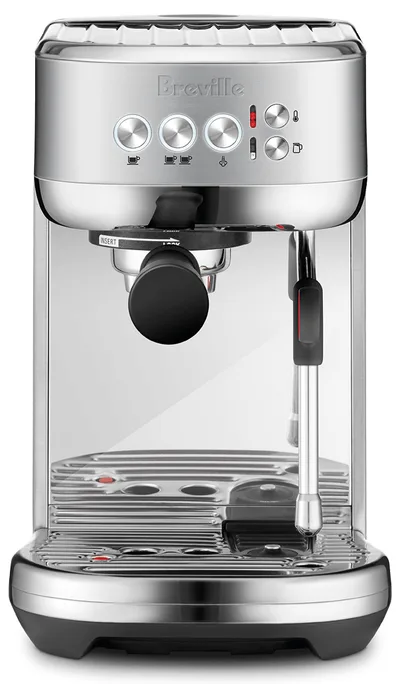
Breville the Bambino Plus
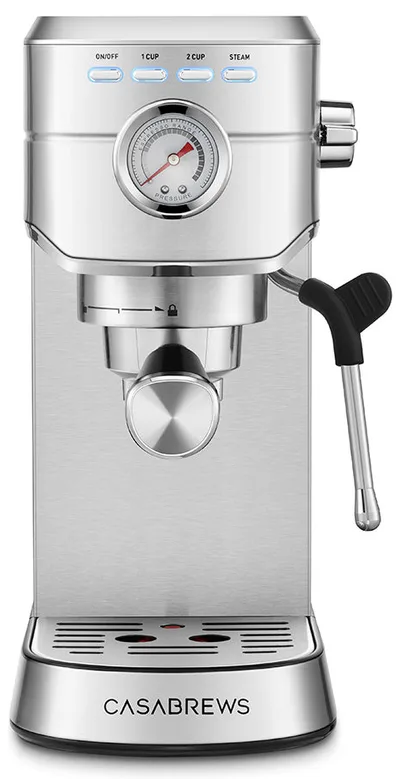
CASABREWS CM5418
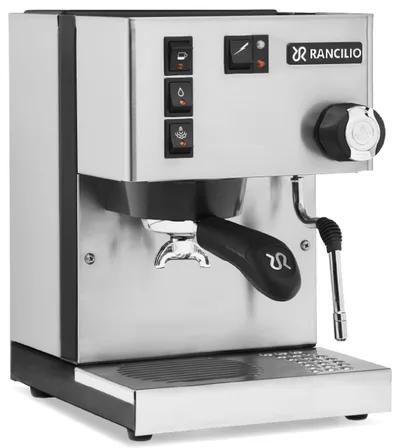
Rancilio Silvia
Frequently asked questions
Is a lungo stronger in caffeine than an espresso?
Does a bigger latte have more caffeine?
Is 200 mg a lot?
Sources
- Spilling the Beans: How Much Caffeine Is Too Much? (content current as of 08/28/2024) — U.S. Food and Drug Administration, accessed November 17, 2026
- Caffeine content for coffee, tea, soda and more (Feb. 6, 2025) — Mayo Clinic, accessed November 17, 2026
- Beverages, coffee, brewed, espresso, restaurant-prepared (FDC 171891, SR Legacy) — USDA FoodData Central, accessed November 17, 2026
- Beverages, coffee, brewed, espresso, restaurant-prepared, decaffeinated (FDC 174125, SR Legacy) — USDA FoodData Central, accessed November 17, 2026
- Beverages, coffee, brewed, prepared with tap water (FDC 171890, SR Legacy) — USDA FoodData Central, accessed November 17, 2026
- Espresso coffees, caffeine and chlorogenic acid intake: potential health implications (Crozier, Stalmach, Lean, Crozier; Food & Function 2012;3:30-33) — PubMed / Royal Society of Chemistry, accessed November 17, 2026
- What is the caffeine content of Nespresso capsules? (Canadian FAQ) — Nespresso, accessed November 17, 2026
- How are flat whites, cappuccinos & lattes different? — Breville US, accessed November 17, 2026
- How to make a latte: 3 easy steps — Breville US, accessed November 17, 2026
- Bambino Plus BES500 instruction book (US, Y25), pp. 11-13 — Breville, accessed November 17, 2026
- Breville Bambino Plus review (preset shot weight) — Tom's Guide, accessed November 17, 2026
- CM5418 instruction manual (EN/ES), baskets — CASABREWS, accessed November 17, 2026
- 2025 Home Line pricing and specs (Silvia: 8 g and 16 g baskets) — Rancilio Group North America, accessed November 17, 2026
- Gaggia Classic Pro, specifications (filter basket capacities) — Gaggia North America, accessed November 17, 2026
- Essenza Mini instruction manual (Nespresso C30), first use and factory settings — Nespresso, accessed November 17, 2026