Grinders
Coffee grind size chart, by brew method and grinder
The grind word for each method, then the number on your own grinder, as its maker prints it.
Assessment based on manufacturer documentation and independent published sources; we have not physically tested these products.
By Syed Hyder Ali · Updated · How we research
In short
A coffee grind size chart works in two steps: grind coarser the longer water stays on the coffee, then read the number your own grinder's maker prints. The National Coffee Association puts French press and cold brew at coarse, drip and pour-over at medium, and espresso at fine. Your brewer's own maker may use a different word, so check the brewer table before you set the dial.
The number to set depends on your grinder's maker, and every maker counts on its own scale. Baratza, Breville, OXO, KINGrinder and Comandante print a starting point for most methods, as do the Fellow Opus 2 and the 1Zpresso J‑Ultra. The Fellow Ode Gen 2, the K‑Ultra, Turin, Eureka and Timemore print none, so start from the grind word and adjust by taste. For a hand grinder, a click count only means something on that grinder.
Find your grinder: Baratza Encore, Virtuoso+, Encore ESP, Sette 270 and 270Wi, Breville Smart Grinder Pro, OXO Brew Conical, Fellow Opus 2, Fellow Ode Gen 2, Comandante C40, KINGrinder K6, 1Zpresso J‑Ultra and K‑Ultra, Turin, Eureka, Timemore.
Worked example
- Brewer
- Fellow Clara French Press
- Its maker's grind word
- coarse
- Grinder
- Comandante C40 MK4
- Its maker's line
- 25-35 clicks for French press
Take the brewer maker's word (coarse), find French press in the grinder maker's list, read its range
25-35 clicks from click zero
Illustrative example built from published figures, not a test. A starting point. Comandante says to trust your taste and adjust; click zero is where the handle stops falling. The same brewer on a Timemore C3 gets Not listed from Timemore.
Assumptions and exclusions
This assumes
- A burr grinder and whole beans
- Each maker's figures as printed, on its own scale
- US models
This does not cover
- Our own recipes or start settings
- Micron sizes: no maker here prints one
- Espresso dial-in steps, dose and ratio
What grind size does each brew method use?
The National Coffee Association (NCA) gives one rule for all of them: the longer the coffee is in contact with water, the coarser the grind should be. That is why its table runs from coarse for the slowest methods to fine for espresso.
| Brew method | Grind word | NCA's comparison | Contact time NCA gives |
|---|---|---|---|
French press | Coarse | Like rock salt | About 4 minutes |
Cold brew | Coarse | None given | A few minutes to 12-18+ hours; typically about 12 hours |
Drip | Medium | Like kosher salt | About 5 minutes |
Pour-over | Medium | None given | 2-4 minutes |
Espresso | Fine | Like table salt | 20-30 seconds |
NCA's table has no AeroPress or moka pot row, so the brewer table below uses those makers' own words. For how much coffee goes with the water, see coffee-to-water ratio; for the cold brew method itself, making cold brew. A blade grinder has no dial at all: its grind depends on how long it runs, which is why burr or blade grinder comes first if that is what you own.
What setting is that on your grinder?
Each row below is one maker's own table, on its own scale, with the unit it prints. A figure is a starting point the maker gives, not a result for your beans. Not listed means that maker's document has no entry for that method. Nothing here is converted between grinders. Burr shape is not a column because it does not change which number the maker prints; conical or flat burrs covers that question.
| Grinder and its scale | Espresso | AeroPress | Pour-over | Drip | French press | Other methods |
|---|---|---|---|---|---|---|
8 | 12 | 15 (Hario V60) | 18 (automatic brewer) | 28 | Chemex 20. Cold brew: Not listed | |
8 | 12 | 15 (Hario V60) | 18 (automatic brewer) | 28 | Chemex 20. Cold brew: Not listed | |
Baratza Encore ESP 40 settings, 1 finest; 1-20 is the espresso range, 21-40 the filter range Baratza manual v1.0, PDF page 5 | 15 (medium roast, 18 g dose) | 22 | 25 (Hario V60) | 28 (automatic brewer) | 32 | Chemex 30. Cold brew: Not listed |
Baratza Sette 270 and 270Wi Macro 1-31, higher is coarser, plus stepless micro A‑I Sette 270 manual v2.1, PDF page 7; 270Wi v2.4, PDF page 6 | Macro 3-9; start micro at E (270Wi: 9E) | Macro 10-15 | Macro 13-18 (V60) | Macro 15-25 (270Wi: 20E) | Not listed | Chemex macro 20-31, in the 270 manual only |
1-30; start at 12 with single-wall baskets, at 30 with dual-wall | Not listed | Not listed | 31-45 with a gold-tone filter; 46-54 with a paper filter | 55-60 | "Stovetop percolator / mocha machines" 1-30 | |
1-5 | Not listed | 6-10 (one range for pour-over and drip) | 6-10 | 11-15 (one range with cold brew) | Cold brew 11-15 | |
0-2 | 3-5 | 5-9 | Not listed | 8-10 (with cold brew) | Prismo 1-3. Aiden single-serve 5-7, batch 7-10 | |
Cannot grind fine enough for most espresso machines | Not listed (AeroPress's page lists 4) | Not listed | Not listed | Not listed | The manual's grind guide draws arcs by method with no numbers |
How to read the harder rows. The Sette pair is one table with two micro rules: Baratza says to start the micro ring at E, and for the 270Wi it names 9E for espresso and 20E for drip. The Smart Grinder Pro chart splits by filter type, not by brewer: the same drip coffee falls in 31-45 with a gold-tone filter and 46-54 with a paper one. The Opus 2 numbers are read off the bar ends on Fellow's chart against its 0-10 dial, to the nearest whole number, because the chart prints no ranges; Fellow adds that darker roasts take a higher number within the range. For the Ode Gen 2, AeroPress's own page lists setting 4 for an AeroPress, and Fellow's recipe for flat-bottom drippers uses 3.2-4.1, which is one recipe's range, not a pour-over range.
| Grinder and its scale | Turkish | Espresso | Moka | AeroPress | Pour-over | French press |
|---|---|---|---|---|---|---|
3-8 (ibrik) | 7-13 | 14-20 (Bialetti or stovetop) | "Depends on your recipe"; AeroPress's page lists 18-20 | 18-35, depending on dose and brewer | 25-35 (with cupping) | |
20 | 40 | 60-70 | 60-70 | 100 | 120 | |
About 75-120 | 100-170 | 200-270 (one bar with AeroPress and drip) | 200-270 | 270-330 (one bar with siphon) | 400-440 | |
Not listed: the manual page sends you to a separate setting tutorial and prints no figures | ||||||

The J‑Ultra figures are read off the bars of 1Zpresso's chart against its 0-500 click axis, rounded to the nearest 5 clicks. Comandante's and KINGrinder's lines are printed numbers. KINGrinder's own caution applies to the low end: do not turn the handle at 0, or below 15 clicks, as that can damage the burr set.
If your grinder's maker lists no setting by method
- Turin DF54 and DF64 Gen 2.7. Turin states there is no universal espresso dial number: the working position depends on beans, burr set, basket and the grinder's calibration. For the DF64 it says to record the setting for each coffee as a starting point, "rather than expecting a dial number to work on every grinder". Start from the grind word and write your own number down.
- Eureka Mignon Specialita. Eureka's data sheet lists Turkish, espresso, moka, drip and French press as suited uses on a stepless dial and prints no setting numbers, so there is nothing to look up.
- Timemore C3. Timemore lists no manual for the C3 and no per-method setting. AeroPress's own page lists 14-20 clicks from zero for an AeroPress on a Timemore C2 or C3; for every other method the C3 is Not listed. The C3's dial changes the click size, which the next section covers.
- Any grinder not on this page. Use your maker's manual first. If it prints a table, use that. If not, the grind word from the first section is the only published guidance.
Where sources disagree: Encore and OXO on espresso
Baratza's manual lists setting 8 as an espresso starting point for the Encore, while The Coffee Chronicler (2022-01-12) reports the Encore is not suitable for espresso in a regular 58 mm portafilter. OXO's booklet lists espresso at 1-5 on the 8717000, while The Coffee Locator (2026-10-30) reports its 15 settings are too coarse for dialling in espresso. Both pairs are printed as found. If espresso is your main use, how to dial in espresso covers the shot itself, and the grinder picks cover what to buy.
Which grind word does your brewer's maker use?
Makers of brewers use their own words, and they do not all match NCA's. Pour-over is the clearest case: NCA says medium, Hario says V60 is medium-fine, and Chemex says its Ottomatic 2.0 takes medium-coarse. Read your brewer's word, then take the same method's row in the grinder table above.
| Method | Brewer | Maker's grind word |
|---|---|---|
Immersion with a press | Medium-fine with a grinder, or medium pre-ground. AeroPress's own five-step scale runs French press coarse, Chemex medium-coarse, drip medium, AeroPress medium-fine, espresso fine. | |
Pour-over | Medium-fine | |
Pour-over | Chemex Ottomatic 2.0 | Medium-coarse |
Pour-over, immersion | Medium-ground (its manual example uses 20 g) | |
Drip machine | Medium to medium-coarse. The KBGT: medium-coarse, "coarse sand or sea salt". | |
Drip machine | Bonavita Connoisseur 8-Cup | Medium/coarse recommended. The Enthusiast: medium, "similar to sand". |
Drip machine | Ratio Six Series 2 | Medium-coarse, "similar to raw sugar" |
Drip machine | Medium-ground (about 8 g per 5 fl oz cup) | |
Moka pot | Bialetti Moka Express and Brikka | Never fine-ground; for the Moka Express, do not press it into the funnel either |
French press | Fellow Clara, Frieling | Coarse; the Frieling adds never fine |
French press | ESPRO P3, P6, P7 | Coarse, always; never matcha or Turkish coffee |
Cold brew | OXO 32 oz, Toddy, Takeya | OXO: medium to coarse. Toddy: coarse. Takeya: coarsely. |
If your brewer is not here, its manual's word still beats a guess.
Why can't you carry a setting from one grinder to another?
A number is a position on one grinder's scale. The scale starts at different places, moves in different steps and runs in different directions: Baratza's 1 is finest, the Opus 2's 0 is finest, and a click count has no direction of its own until you know where its zero is. Turin says as much about its own dial. The step sizes the hand-grinder makers print show how far apart the scales sit.
| Grinder | Clicks | Movement per click |
|---|---|---|
1Zpresso J‑Ultra | 100 a rotation | 8 microns (0.008 mm) |
1Zpresso K‑Ultra | 100 a rotation | 20 microns |
KINGrinder K6 | 60 a round | 16 microns |
Timemore C3, Classic dial | 12 a rotation | 0.0833 mm (83 microns) |
Timemore C3, Espresso dial | 30 a rotation | 0.0233 mm (23 microns) |
Comandante C40 MK4 | Stepped click dial | Not listed |
The arithmetic from those two rows: one C3 Classic click (83 microns) moves the burr about as far as ten J‑Ultra clicks (83 / 8 = 10.4). These are burr movements, not particle sizes, so no maker's table can be turned into another's by multiplying.
Four other things move a setting even on one grinder:
- The zero point. Comandante defines click zero as the first position where the handle no longer falls when held level. 1Zpresso defines zero as the point where the handle starts to turn with resistance, and says the K‑Ultra's zero point may be offset by two or more clicks depending on how hard you tighten the dial. The J‑Ultra's starting point can vary by about 10 clicks.
- Parts settling and shims. Baratza says the Encore ESP's parts settle with use and a finer setting may be needed, and that one shim shifts the range by about five settings (setting 10 before becomes roughly 15 after).
- Roast and dose. Baratza's Encore ESP manual says darker roasts or larger doses need a higher number; Fellow says darker roasts take a higher number within the range.
- Taking the burrs out. A refit can move the zero point; 1Zpresso says to recalibrate after reassembly. The cleaning steps are in cleaning a grinder.
What do you change when the cup tastes wrong?
The one direction both Comandante and the NCA agree on: a finer setting raises extraction and a coarser one lowers it. Comandante says to grind finer to increase extraction and coarser to decrease it; the NCA says too fine reads as over-extracted and too coarse as under-extracted. Which taste means which, and what to do first, is its own question: sour vs bitter espresso takes it for espresso, and changing the dose belongs to coffee-to-water ratio.
Which grinders reach a Turkish grind?
Turkish coffee is made from beans "ground to a fine powder", in UNESCO's description. Among the grinders above, Comandante lists 3-8 clicks for an ibrik, KINGrinder's manual lists 20 clicks for Turkish "for reference", and the 1Zpresso J‑Ultra chart's Turkish bar sits at about 75-120 clicks. The Eureka Mignon Specialita lists Turkish among its suited uses with no number. Every other maker on this page is Not listed for Turkish, and ESPRO says its presses should never be used for Turkish coffee. This guide gives no Turkish recipe.
Models this page mentions
We may earn a commission when you buy through links on this page.
In the order the page mentions them; not a ranking.
Mentioned in: What setting is that on your grinder?
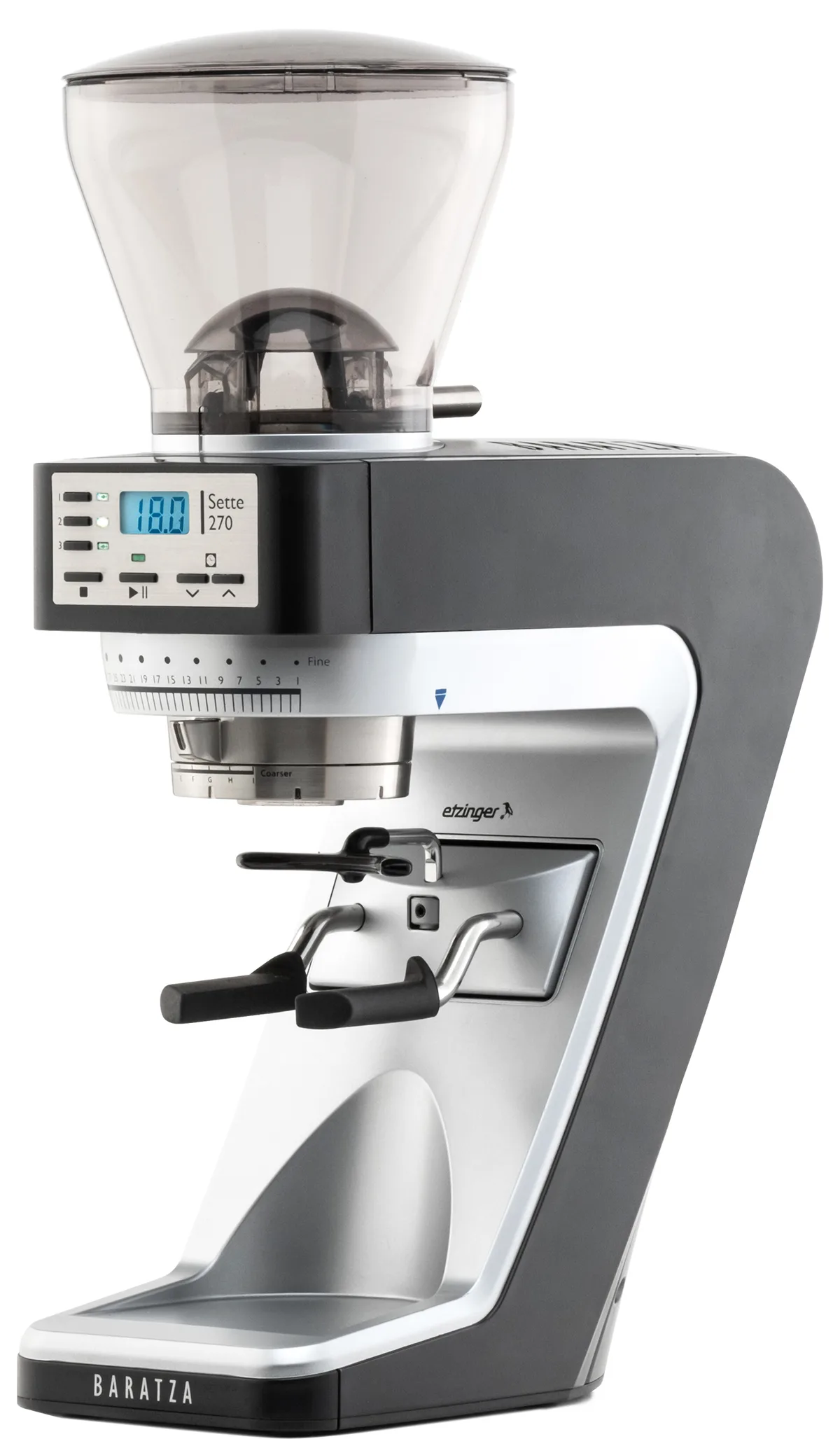
Baratza Sette 270
- Comandante C40 MK4 Nitro BladeView on Amazon, Comandante C40 MK4 Nitro Blade (opens in a new tab)
- KINGrinder K6 Straight Handle Manual Coffee GrinderView on Amazon, KINGrinder K6 Straight Handle Manual Coffee Grinder (opens in a new tab)
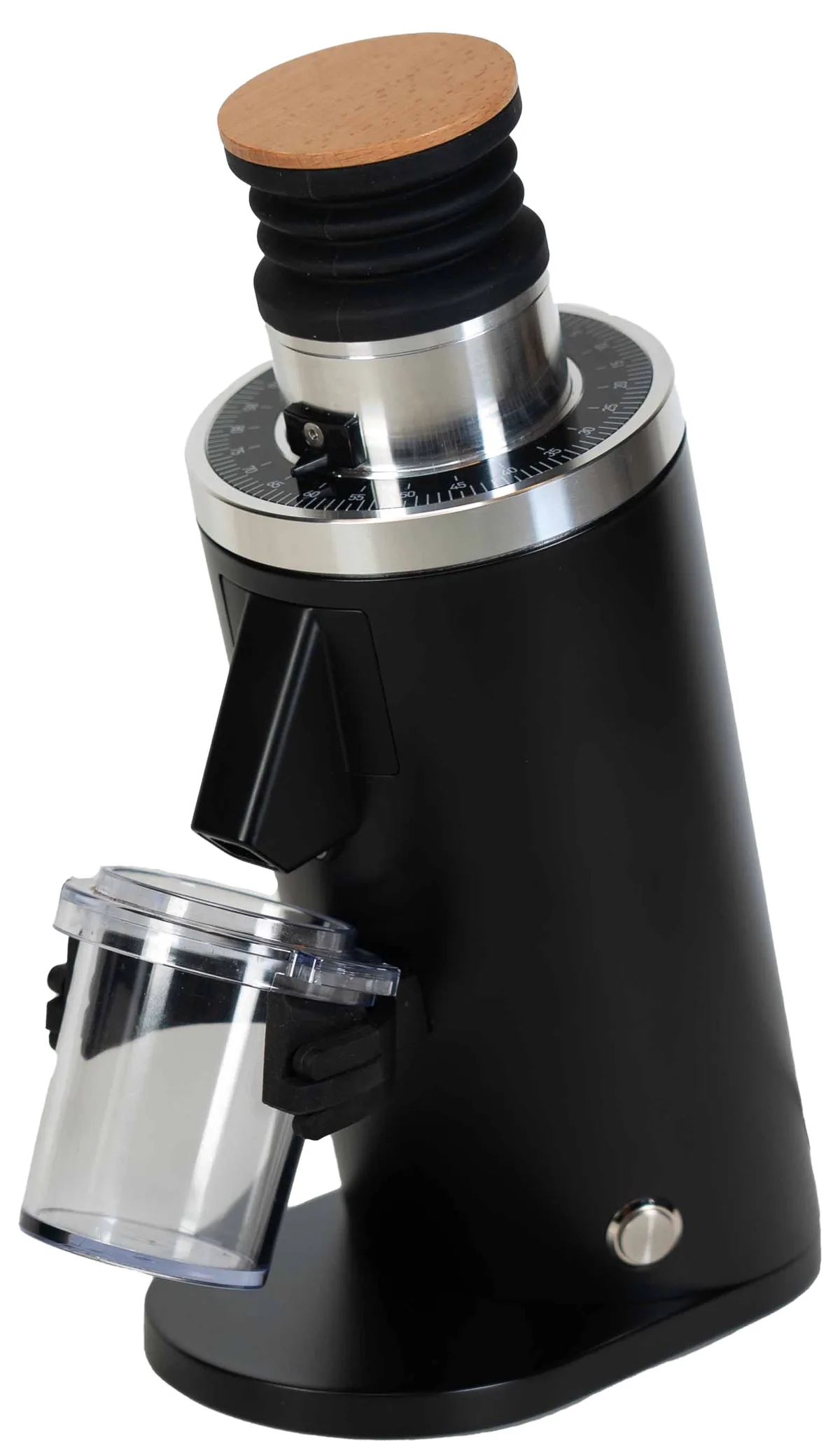
Turin DF54 v4.1 Single Dose Flat Burr Grinder
Sources
- Pick your French press / cold brew / drip / pour-over / espresso grind size (five NCA brewing pages) — National Coffee Association, accessed November 17, 2026
- Cold brew — National Coffee Association, accessed November 17, 2026
- Drip coffee — National Coffee Association, accessed November 17, 2026
- Pour-over — National Coffee Association, accessed November 17, 2026
- Espresso — National Coffee Association, accessed November 17, 2026
- What grind size should I use? — AeroPress, accessed November 17, 2026
- Encore Operations Manual v4.3 (December 2022) — Baratza, accessed November 17, 2026
- Virtuoso+ Operations Manual v1.6 (January 2023) — Baratza, accessed November 17, 2026
- Encore ESP Operations Manual v1.0 (January 2023) — Baratza, accessed November 17, 2026
- Sette 270 Manual v2.1 (August 2019) — Baratza, accessed November 17, 2026
- Sette 270Wi Manual v2.4 (August 2019) — Baratza, accessed November 17, 2026
- the Smart Grinder Pro instruction book (BCG820, US) — Breville, accessed November 17, 2026
- OXO Brew Conical Burr Coffee Grinder booklet (8717000) — OXO, accessed November 17, 2026
- Opus 2 Conical Burr Grinder Get To Know You Guide — Fellow, accessed November 17, 2026
- Ode Brew Grinder Gen 2 Safety and Maintenance manual (NGAAUS) — Fellow, accessed November 17, 2026
- Fellow's Take on Matchday by Kickoff Coffee Co. (brew recipe, 2026-06-25) — Fellow, accessed November 17, 2026
- FAQ: What grind settings are suitable for different brewing methods? — Comandante, accessed November 17, 2026
- KINGrinder K6 manual (English) — KINGrinder, accessed November 17, 2026
- User Manual J‑Ultra, with the J‑Ultra Grind Setting Reference chart — 1Zpresso, accessed November 17, 2026
- User Manual K‑Ultra — 1Zpresso, accessed November 17, 2026
- Turin DF54 single dose flat burr grinder (US product page) — Turin Grinders, accessed November 17, 2026
- Turin DF64 Gen 2.7 single-dose coffee grinder (US product page) — Turin Grinders, accessed November 17, 2026
- Mignon Specialita data sheet — Eureka, accessed November 17, 2026
- Turkish coffee culture and tradition (Intangible Cultural Heritage, 2013 inscription page) — UNESCO, accessed November 17, 2026