Manual brewers
How to make espresso without a machine
What each maker says its device makes, and how to run it.
Assessment based on manufacturer documentation and independent published sources; we have not physically tested these products.
By Syed Hyder Ali · Updated · How we research
In short
Pick by what you own. With a stove, use a moka pot: Bialetti lists no pressure and calls the result espresso-style coffee. With an AeroPress and its Flow Control Filter Cap, AeroPress says the result is "not real espresso". Only the manual levers state pressures from 5 to 9 bar.
Worked example
- Pot
- Bialetti Moka Express 6-Cup
- Coffee in the pot, per Bialetti's table
- 270 mL (9.1 oz)
- An espresso single, as the SCA defines it
- 25-35 mL
270 mL ÷ 35 mL and 270 mL ÷ 25 mL
7.7 to 10.8 espresso singles' worth of liquid
Volume only. Bialetti's table marks its columns only with drawings, so reading 270 mL as the coffee is ours. No source lists a moka pot's strength, so strength is not compared. The SCA definition is as AeroPress quotes it.
Assumptions and exclusions
This assumes
- Bialetti's size table is read from drawings
- The SCA definition is as AeroPress quotes it
- You have a kettle and a gas, electric or induction hob
- Bialetti's "oz" means fluid ounces
This does not cover
- Instant espresso powder
- Milk drinks and steaming
- Hand-pump devices by model
- Taste or crema quality
Which no-machine route fits your kitchen?
Three routes are documented by their makers: a stovetop moka pot, an AeroPress with its Flow Control Filter Cap, and a manual lever. They differ most in what you must already own, so the table starts there. "Not listed" means the maker prints no figure.
| Route | What its maker calls the result | Pressure its maker states | You also need | One batch | Skip it if |
|---|---|---|---|---|---|
Bialetti Moka Express 6-Cup (aluminum) | "Espresso-style coffee" (US page) | Not listed | A gas or electric hob, or Bialetti's induction plate adapter; ground coffee for Moka | 6-cup: 270 mL (9.1 oz); the 1-cup is 2 oz | You have an induction hob and no adapter plate |
Bialetti Venus 6-Cup Stainless Steel | "Espresso-style cup" (US page) | Not listed | Any hob; works on induction without an adapter in 4, 6 and 10 cups | 6-cup: 7.9 oz | You want a pot smaller than 4 cups: that is its smallest size |
Bialetti Brikka 2-Cup (aluminum, valve) | "Real Italian espresso with thick crema" (US page) | Not listed | A hob or camping stove; the adapter on induction; its measuring cup | 2-cup: 120 mL of water, 100 mL of coffee | You will not stand at the stove: it must come off the heat at once |
AeroPress Original Coffee Maker plus the Flow Control Filter Cap | "Espresso style"; "not real espresso" | 0.25-0.5 bar unmodified; with the cap, Not listed | The cap (all three recipes), a stainless steel filter (two of three), hot water, a sturdy mug; a fine or near-espresso grind | Up to three espresso-style shots | You cannot grind fine; AeroPress's espresso-style recipes ask for it |
Manual lever makers | "Espresso" | Cafelat Robot: 5-8 bar. Flair 58 Plus 2: 6-9 bar | Kettle water and an espresso-capable burr grinder; the Flair also a scale and a power supply for its preheat | One shot at a time | You want a stove-and-go batch |
If you drink milk drinks, AeroPress says its Flow Control Cap makes "an espresso-style concentrate that can be used in lattes, cappuccinos, and other espresso based drinks"; Bialetti's US pages list no milk use. Steaming the milk is a separate job.
Can you make real espresso without a machine?
It depends on the definition. AeroPress quotes the Specialty Coffee Association (SCA) as defining a single espresso as "a 25-35 ml beverage prepared from 7-9 grams of coffee through which clean water of 195°-205°F has been forced at 9-10 atmospheres of pressure", brewed in 20-30 seconds. AeroPress adds that 9-10 atmospheres "(or 9-10 bar)" is too much pressure for its coffee makers. What 9 bar means in a machine, and why a pump's 15 bar rating is a different number, is in espresso machine pressure.
| Route | Stated by | Pressure |
|---|---|---|
The SCA's espresso, as AeroPress quotes it | AeroPress blog | 9-10 atmospheres ("or 9-10 bar") |
Cafelat Robot | Cafelat (the maker) | Extract in the 5-8 bar range; keep to a maximum of 8 bar |
Flair 58 Plus 2 | Flair's manual | A 30-35 second shot at 6-9 bar |
AeroPress, unmodified | AeroPress, citing its inventor Alan Adler's calculation | 0.25-0.5 bar in normal use |
AeroPress "espresso-style" | AeroPress's comparison table, same page | "Low (~0.5 - 1.5 bars)" |
AeroPress with the Flow Control Filter Cap | AeroPress | Not listed: "it won't reach 9 bar, it will be enough to produce crema" |
Bialetti moka pots | Bialetti's leaflets and US pages | Not listed (the leaflets say the pot "develops pressure inside") |
Bialetti Brikka | Home Grounds, an independent reviewer, with a gauge on its Brikka | The valve opened at about 1 bar; Home Grounds says a Moka Express flows at around 0.3 |
AeroPress prints two ranges for itself on one page, and they are not averaged. Home Grounds gauged only its Brikka, and the 0.3 bar for a Moka Express is its statement, not a reading of that pot; neither figure is Bialetti's. Cafelat adds that traditional lever machines, as it measures them, typically extract at 6-7 bar and that its Robot is meant to be pressed within 5-8, which is why the Robot's row is a working range, not a target of 9.
How do you make espresso-style coffee in a moka pot?
Bialetti's Moka Express steps in short: cold water to the lower edge of the safety valve, ground coffee for Moka in the funnel without pressing it down, the top screwed on firmly, then heat with the flame inside the rim (on an electric plate, not the highest setting) and take the pot off when the upper unit is full. The full six steps, first use, faults and care are in how to use a moka pot. The Venus and Brikka leaflets word the steps a little differently.
Three things in that leaflet decide whether you are making anything like espresso. First, the leaflet says "never use fine grinding coffee" and lists "coffee for percolating filters or espresso machines" among the products not to put in the pot, so an espresso grind is outside Bialetti's instructions. Second, there is no pressure figure anywhere in it, only that the pot "requires a heat source for its operation and develops pressure inside". Third, the size: Bialetti's table lists 270 mL (9.1 oz) of coffee for the 6-cup, against a 25-35 mL single, so a moka pot makes a batch, not a shot. Bialetti's "cup" is about 2 oz.
The Brikka adds a valve and one rule: Bialetti says to take it off the heat the moment its froth has formed, or "the froth might disappear and the coffee might overflow". Home Grounds reports the foam it saw was gone from the cup about 20 seconds later. For an induction hob, the aluminum Moka Express and Brikka need Bialetti's adapter plate; the stainless-steel Venus does not. Bialetti's warranty does not cover failures from use that is "improper or not-compliant with the instructions".
How do you make an espresso-style shot with an AeroPress?
AeroPress publishes at least three espresso-style recipes, and they disagree on dose, water and time. The one on its recipe page, "An Espresso Style Shot with AeroPress" (dated Nov 13, 2026 on the page), is:
- Insert an AeroPress stainless steel filter into the AeroPress Flow Control Filter Cap and screw it onto the end of the AeroPress Original, Go or Clear chamber.
- Add 19 grams (a rounded scoop) of coffee ground on the coarse side of espresso, and shake to level.
- Pour in 60 grams (2 ounces) of hot water.
- Stir for 15 seconds.
- Insert the plunger and press through.
AeroPress's note: pressing all the way through and accelerating at the end forces more fines and oils through the filter; stopping at the hiss leaves slightly less texture.
| Where | Coffee and grind | Water | Stir and wait | Press | Filter in the cap |
|---|---|---|---|---|---|
Recipe page (2026-11-13) | 19 g, "coarse side of espresso" | 60 g, hot | Stir 15 seconds | Press through | Stainless steel |
Blog recipe card (2026-11-10) | 18-22 g, "fine grind"; "fine, but not as fine as espresso" | 75-80 g at 190-202 °F (86-95 °C), to the top of the "1" | Stir well, 30 seconds | Slow and smooth; accelerate at the hiss | Stainless steel |
Cap tips page | 15 g (1 heaping scoop), finely ground dark roast | Right off the boil (around 210 °F), to about the middle of the "1" (around 50 g) | Stir 20 times, 1 minute | Firmly all the way through, until the plunger makes a roaring sound | Paper |
The cap is in all three. AeroPress sells the Flow Control Filter Cap and the stainless steel filter as separate products; the cap takes a standard-size paper or metal filter, or both at once, and does not fit the XL size. A burr grinder is AeroPress's stated preference: "grind fine, but not as fine as espresso". The Original FAQ says it can brew up to three shots of espresso-style coffee, or one 10 oz serving if all the water is pressed through. Use a sturdy mug or carafe and never press into thin-walled glass, and AeroPress strongly discourages the inverted method because it is less stable and can expose you to hot liquid. The standard method is in how to use an AeroPress, and what a fine grind asks of a grinder is in burr vs blade grinders.
AeroPress's own wording is worth keeping straight. Its blog says AeroPress coffee makers "cannot make true espresso" and proposes "espresso style", and its help centre says the cap's result is "quite similar to espresso, it is not real espresso".
What about hand-pump and lever makers?
These are the only no-machine devices whose makers state a pressure near espresso's. Neither has a pump or a motor. Both need hot water from a kettle. The Cafelat Robot has no boiler or heating element: you fill its basket with water from a kettle and push two lever arms. The Flair 58 Plus 2 has no pump either, but its preheat controller runs from a power supply and is unplugged to brew; its manual says to boil water and use a burr grinder. Both need a grinder that goes fine, which the moka pot and the AeroPress do not ask for. Cafelat says blade grinders will not work with fresh-ground coffee and sells a pressurised basket for pre-ground coffee.
Whether a lever counts as "a machine" is yours to decide with those facts. If you have no grinder that goes fine, a lever adds one to what you must buy.
What does not work?
A French press does not make espresso. None of the six makers' guides in how to use a French press documents an espresso method, and two warn against fine grounds: Bodum's manual says "Fine grind can clog the filter and create high pressure", and Frieling's says never to use fine ground, "which may clog the filter". Instant espresso powder is not equipment and is not covered here.
What if you decide you want a machine?
If the answer is a machine, compact espresso machines is the next page, and moka pot vs espresso machine sets the two side by side. The machine route, step by step, is in how to make espresso at home.
Models this page mentions
We may earn a commission when you buy through links on this page.
In the order the page mentions them; not a ranking.
Mentioned in: Which no-machine route fits your kitchen?
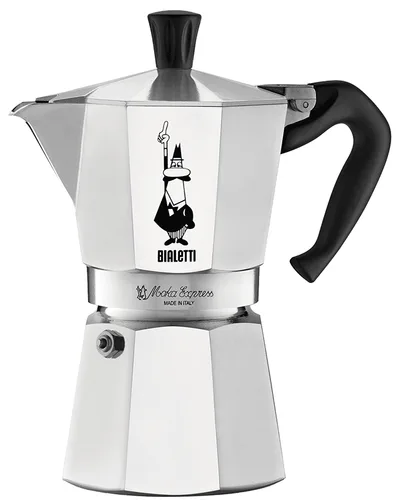
Bialetti Moka Express 6-Cup
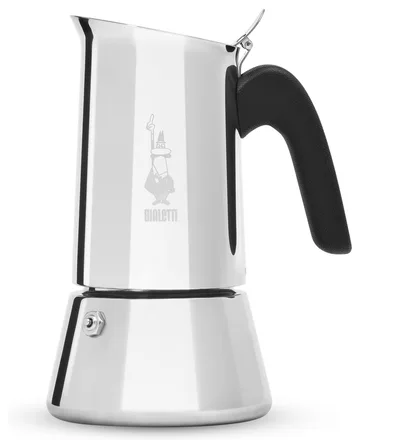
Bialetti Venus 6-Cup Stainless Steel
- AeroPress Original Coffee MakerView on Amazon, AeroPress Original Coffee Maker (opens in a new tab)
Frequently asked questions
What can I use if I don't have an espresso machine?
Can I turn regular coffee into espresso?
Is espresso just finely ground coffee?
Sources
- Moka Express instruction leaflet, edition 01/2021 (English section, water table) — Bialetti, accessed November 17, 2026
- Brikka instruction leaflet, edition 01/2021 (English section) — Bialetti, accessed November 17, 2026
- Venus (Acciaio) instruction leaflet, edition 01/2021 (English section) — Bialetti, accessed November 17, 2026
- Bialetti Moka Pot, Italian stovetop espresso maker (US product page) — Bialetti US, accessed November 17, 2026
- Bialetti Venus Stainless Steel Moka Pot 6 Espresso Cup (US product page) — Bialetti US, accessed November 17, 2026
- Bialetti Brikka Moka Pot (US product page) — Bialetti US, accessed November 17, 2026
- Client support FAQ (induction) — Bialetti US, accessed November 17, 2026
- How to Make Delicious Espresso‑Style Coffee With Your AeroPress (blog, Nov 10, 2026) — AeroPress, accessed November 17, 2026
- An Espresso Style Shot with AeroPress (recipe, Nov 13, 2026) — AeroPress, accessed November 17, 2026
- Does the AeroPress Flow Control Filter Cap make real espresso? (help article) — AeroPress, accessed November 17, 2026
- AeroPress Flow Control Filter Cap Tips — AeroPress, accessed November 17, 2026
- AeroPress Flow Control Filter Cap - Standard (product page) — AeroPress, accessed November 17, 2026
- AeroPress Original (product page, FAQ and safety) — AeroPress, accessed November 17, 2026
- Robot espresso maker (product page) — Cafelat, accessed November 17, 2026
- Flair 58 Plus 2 manual (Sept 2024, v5) — Flair Espresso, accessed November 17, 2026
- Bialetti Brikka Review: Better Than The Moka Express? (updated 2026-11-03) — Home Grounds, accessed November 17, 2026
- French Press Coffee Makers instruction manual ZP2019‑000001 (2019) — Bodum, accessed November 17, 2026
- French Press user manual (2015 edition) — Frieling USA, accessed November 17, 2026