Grinders
Conical vs flat burr grinders: what changes and what doesn't
What makers say, what one measurement set reports, and which of 18 grinders is which.
Assessment based on manufacturer documentation and independent published sources; we have not physically tested these products.
By Syed Hyder Ali · Updated · How we research
In short
Settle loading, espresso reach and step size before burr shape. Makers say conical and flat burrs taste different, but the one measured set cited here, Jonathan Gagné's 2023 analysis of 300 particle-size distributions from 24 espresso grinders, reports only that conical burrs averaged more fines and more oversized particles than flat ones, with a large overlap, at espresso-range settings. It says nothing about filter-range grinding or about any one grinder.
What separates the grinders you can buy is whether you fill a hopper or load one dose, whether the maker lists an espresso setting, and how fine the adjustment steps are. Among the 18 grinders below, every conical burr with a listed diameter is 38-48 mm and every flat one is 54-64 mm, so choosing between them also chooses a size. The decision table sends each situation to the page that picks.
Worked example
- Option A
- Baratza Encore, conical, 40 mm
- Option B
- Fellow Ode Gen 2, flat, 64 mm
- Loading A
- 300 g hopper
- Loading B
- 100 g single-dose bin
Diameter gap = 64 mm - 40 mm = 24 mm; loading gap = 300 g - 100 g = 200 g
24 mm
Illustrative comparison from the makers' figures, not a test. Shape, size and loading all differ at once, so the gap says nothing about the cup. For filter coffee only, the measured set cannot rank these two.
Assumptions and exclusions
This assumes
- Electric and hand burr grinders
- Maker figures as printed; US models
This does not cover
- Taste verdicts of any kind
- Setting numbers by method
- Built-in grinders, prices
What is the difference between conical and flat burrs?
A conical burr grinder has a cone-shaped inner burr resting inside a ring-shaped outer burr, and gravity helps pull the coffee down. A flat burr grinder uses two parallel rings with serrated edges, and centrifugal force pushes the grounds out. That is Fellow's description; Baratza's is close: in a conical set the gap between cone and outer ring sets a maximum grind size, and a flat set drives coffee between two circular flat burrs by centrifugal force.
Both makers then say what they think each shape is good for. These are maker statements, not measurements.
| Maker | Conical | Flat |
|---|---|---|
Baratza | 40 mm conical burrs give "balanced and delightfully sweet cups" | Steel flat burrs "sweetness and high-clarity flavors"; 54 mm ceramic flat burrs "full-bodied" with "rounded, syrupy textures" |
Fellow | Tend to produce "a specific ratio of fines to larger particles", which it calls excellent for espresso | "Incredibly uniform particle distribution", favoured for filter for "flavor clarity and separation" |
Fellow applies that to its own line: it says the 48 mm conical Opus 2 is built for espresso through cold brew, and the 64 mm flat Ode Gen 2 is tuned for brewed coffee and does not grind fine enough for espresso. Its advice is to start with the Opus 2 if espresso is anywhere in your routine. Whether you need a burr grinder at all is a separate question: burr or blade grinder.
Does burr shape change the grind or the cup?
The measurements come from the Kaffeemacher team's comparison of 24 espresso grinders. Marco Wellinger at the Zurich University of Applied Science (ZHAW) measured 300 particle-size distributions from their samples, using an imaging device from Retsch Technology and one 82-point natural Brazilian coffee. Jonathan Gagné then analysed the data in a Coffee ad Astra post (2023-09-21). He compares grinders at a median particle size of 340 microns, and uses two terms: unimodality is how many fines a grinder makes at a given median size (more fines, less unimodal), and uniformity is how few oversized particles, which he calls "boulders", it makes (a wider coarse side on the main peak means more boulders, so less uniform).
What he reports. Conical burrs were, on average, less unimodal and less uniform than flat burrs, "although there is a large overlap", so a particular flat burr can be less uniform than a particular conical one. The finding holds on average, not in every case. Larger burrs did not systematically give more uniform or more unimodal grinds in his sample, and he writes that "burr teeth geometry and coating appear much more important as driving factors" than size. The team's blind tasting covered only a subset of the grinders, and the grinders that did best in it sat near the middle of the unimodality and uniformity map rather than at an extreme.
What limits it. The grinders were compared at espresso-range settings. He notes there is no way to know whether the units were well aligned, which could change both measures, and that this would need a few units per brand. It is one coffee and one instrument, and he says how the measures map to taste still has to be worked out. The post does not state how many of the 24 are conical or flat.
What it does not tell you. Nothing about filter-range grinding: the post measures espresso-range settings only. Nothing about any one grinder, so none from the set is named here. None of the independent reviews cited for the 18 grinders below isolates burr shape from burr size or other design differences.
So the makers' tendency claims and the measured average point the same way for espresso, but the average is wide, and this page has no measurement for filter coffee. That is why the next section looks at the differences a maker does list.
What differs between the grinders you can actually buy?
Each row is one grinder: the shape as the maker states it, the diameter if it lists one, how the dial adjusts, how you load it, and whether the maker lists an espresso setting. Not listed means the maker prints nothing for that cell. For the settings themselves see grind settings by brew method.
| Grinder | Shape | Diameter | Adjustment | Loading | Maker lists an espresso setting |
|---|---|---|---|---|---|
Conical | 40 mm | 40 settings, twist the hopper | Hopper 300 g | Yes (start 8) | |
Conical | 40 mm | 40 settings, twist the hopper | Hopper 300 g | Yes (start 8) | |
Conical | 40 mm | 40 settings; 1-20 espresso range | Hopper 300 g | Yes (1-20; start 15) | |
Conical | 40 mm | Macro 1-31 plus stepless micro A‑I | Hopper 300 g, shut-off knob | Yes (macro 3-9) | |
Conical | Not listed | 60 settings | Hopper 18 oz (the book says 1 lb) | Yes (1-30) | |
Conical | Not listed | 15 settings plus micro-settings | Hopper 12 oz | Yes (1-5) | |
Conical | Not listed | 15 settings, 29 micro-adjustments | Hopper 50 g | Not listed | |
Conical | 48 mm | Dial 0-10 with micro-steps | Single-dose bin 100 g | Yes (about 0-2) | |
Flat | 64 mm | 11 settings, 31 steps | Single-dose bin 100 g | No: not intended for espresso | |
Flat | 54 mm | Stepless collar | Single dose, about 20 g (up to 50 g with the bellows) | Not listed (maker states espresso use, no dial number) | |
Flat | 64 mm | Stepless collar | Single dose, about 50 g with the bellows | Not listed (maker states espresso use, no dial number) | |
Flat | 55 mm | Stepless micrometric | Hopper 300 g (optional larger hopper) | Not listed (lists espresso among suited uses) | |
Conical | 38 mm | Two dials: 12 or 30 clicks a rotation | Hand, catch cup 20 g | Not listed (maker: "fine enough for espresso") | |
Conical | 48 mm | 100 clicks a rotation, 8 microns | Hand, catch cup 35 g | Yes (100-170 clicks on its chart) | |
Conical | Not listed | 100 clicks a rotation, 20 microns | Hand, catch cup 35 g | Not listed | |
Conical | Not listed | Stepped click dial | Hand, bean jar 40 g | Yes (7-13 clicks) | |
Not stated | Not listed | 60 clicks a round, 16 microns | Hand, hopper 30 g | Yes (about 40 clicks) |
Shape and size travel together here. Where a maker lists a diameter, the conical burrs are 38 mm (Timemore C3), 40 mm (five Baratza models) and 48 mm (J‑Ultra, Opus 2); the flat burrs are 54, 55 and 64 mm (two of them). The two ranges do not overlap, so comparing a conical grinder here with a flat one always compares size too. Gagné's own note points the same way: conical diameters in his sample were smaller, "but not necessarily shorter grind paths", so a conical's diameter and a flat disk's are not like-for-like. Six of the grinders list no diameter, and the K6 does not state its shape, so those cells say Not listed rather than borrowing a figure from a retailer or a reviewer.
Espresso reach does not follow shape. The "flat for filter, conical for espresso" rule fails inside the catalogue. The Turin DF54, DF64 and Eureka Mignon Specialita are flat and their makers state espresso use; the Ode Gen 2 is flat and its maker excludes espresso. Fellow sells one of each, and the conical one is the one it sends espresso drinkers to. Which setting to start from, and where makers and reviewers disagree on the Encore and the OXO 8717000, is on the grind size chart.
Reported retention does not sort by shape either. The Fellow Opus 2 (conical) is reported at 0.1-0.2 g and the Turin DF54 (flat) at about 0.2-0.3 g, both by The Coffee Chronicler (2026-11-03). The Baratza Virtuoso+ (conical) is reported at 1.5 g (Coffee Review, 2020-06-13) and the Eureka Mignon Specialita (flat) at about 1 g (The Coffee Chronicler, 2026-11-03). The publishers' methods differ, so the figures are not comparable, but each shape has both a few-tenths report and a gram-or-more one. The full list is in single-dose grinders.
Which difference should decide your grinder?
Shape settles least. The attributes in the table settle more, and each has a page that picks.
| Your situation | The attribute that settles it | Read next |
|---|---|---|
You load one dose at a time | Loading: a 100 g or smaller bin or hopper against a 300 g hopper | |
Filter coffee only | Whether the maker lists a filter range, not shape; the Ode Gen 2's maker excludes espresso | |
You want espresso from a grinder | An espresso setting or range the maker lists, and its step size | |
You are considering a hand grinder | Clicks, step size and catch-cup size | |
You still want a particular shape | Shape, with size travelling with it | The burr-type filter on the coffee grinders hub |
Do not read a maker's tendency claim as a measurement, a shape average as a verdict on one grinder, or shape as a guide to espresso reach.
What about ceramic burrs?
Baratza states its 54 mm flat ceramic burrs give "rounded, syrupy textures" and that "high-density ceramic is known to outlast steel burrs". None of the 18 grinders above lists a ceramic burr, so nothing here compares ceramic with steel. This page prints no lifespan figure for a home grinder's burrs, only one service check: Eureka's English handbook says to check, and possibly replace, the grinding "Blades" every 250 kg of coffee (its Italian text says macine, the burrs). For burr care, see cleaning a grinder.
Models this page mentions
We may earn a commission when you buy through links on this page.
In the order the page mentions them; not a ranking.
Mentioned in: What differs between the grinders you can actually buy?
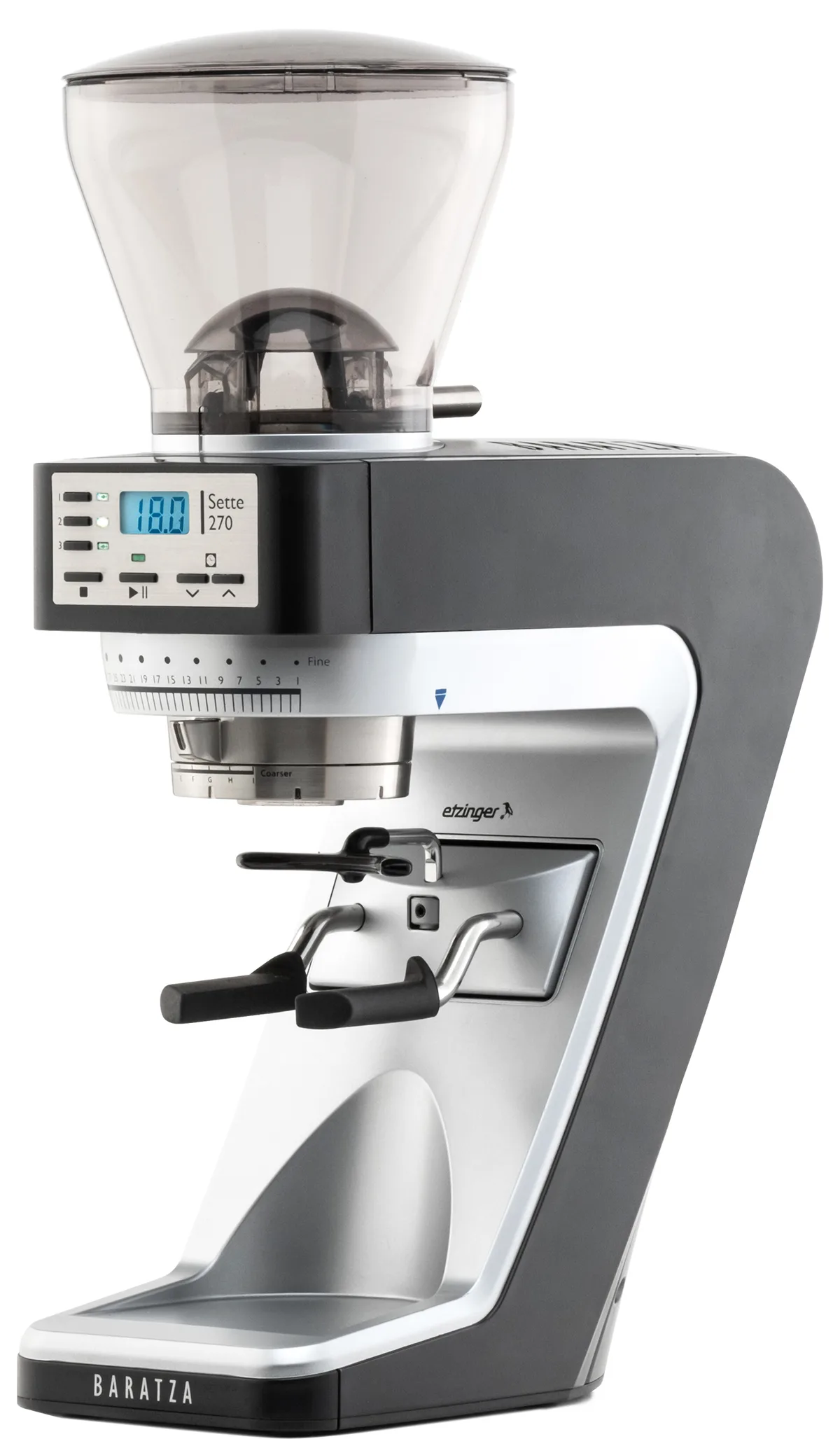
Baratza Sette 270
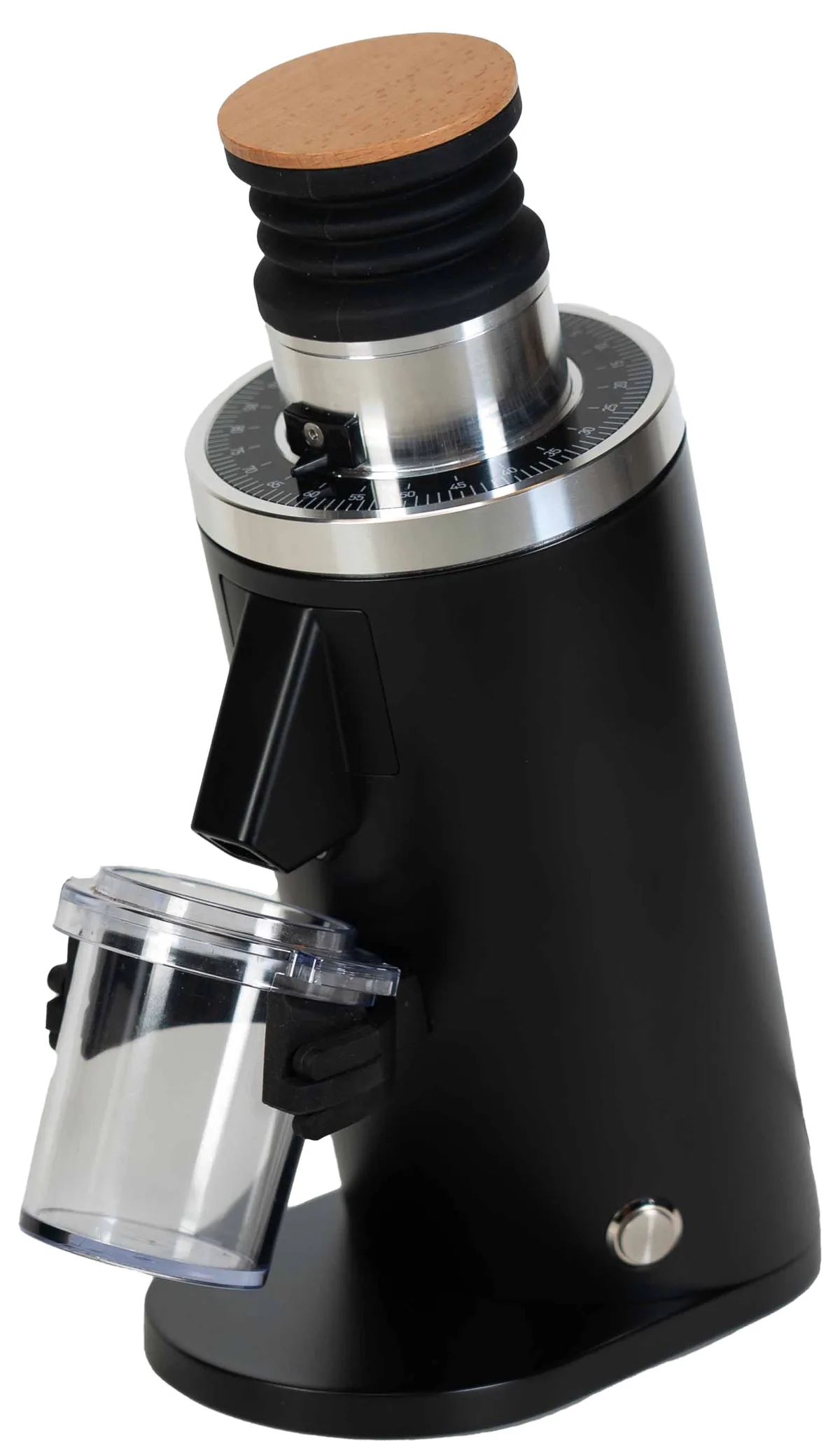
Turin DF54 v4.1 Single Dose Flat Burr Grinder
- Comandante C40 MK4 Nitro BladeView on Amazon, Comandante C40 MK4 Nitro Blade (opens in a new tab)
- KINGrinder K6 Straight Handle Manual Coffee GrinderView on Amazon, KINGrinder K6 Straight Handle Manual Coffee Grinder (opens in a new tab)
Sources
- What I learned from analyzing 300 particle size distributions for 24 espresso grinders — Coffee ad Astra (Jonathan Gagné), accessed November 17, 2026
- Burr Grinders vs. Blade Grinders (2025-03-31) — Fellow, accessed November 17, 2026
- Compare grinders — Fellow, accessed November 17, 2026
- Conical & Flat Coffee Grinders: Shop by Burr — Baratza, accessed November 17, 2026
- Mignon user manual, section 6.4 Maintenance — Eureka, accessed November 17, 2026
- J‑Ultra Grind Setting Reference chart — 1Zpresso, accessed November 17, 2026
- Eureka Mignon Specialita review (updated 2026-11-03) — The Coffee Chronicler, accessed November 17, 2026
- Fellow Opus 2 review (2026-11-03) — The Coffee Chronicler, accessed November 17, 2026
- Turin DF54 review (2026-11-03) — The Coffee Chronicler, accessed November 17, 2026
- Baratza Virtuoso+ review (2020-06-13) — Coffee Review, accessed November 17, 2026