Research review · Grinders · KINGrinder
KINGrinder K6 Review: 16-Micron Hand Grinder
Model K6 · Straight handle (the maker's current K6 page; colour not stated there) · US model
A hand grinder with 16 microns per click on a numbered external nut and a hopper of about 30 g. Its warranty appears only on its Amazon listing.
- Best for
- A household that grinds by hand, one to a few servings at a time, and wants a numbered external adjustment.
- Consider another if
- You want a warranty on the maker's own page (1Zpresso K‑Ultra), finer espresso steps (J‑Ultra) or several servings without cranking (an electric grinder)
We may earn a commission when you buy through links on this page.
Assessment based on manufacturer documentation and independent published sources; we have not physically tested this unit.
By Syed Hyder Ali · Updated · How we research
KINGrinderKINGrinder K6
- Burrs
- : Stainless steel burr kit
- Hopper
- : 30 g (≈ 1.06 oz) Sources disagree
Strengths
- 16-micron steps on a numbered external dial
- CNN Underscored ground 15 g for pour-over in 20 seconds
Limitations
- Do not wash with water or spray water onto the grinder; do RDT by spraying another object
- Do not turn the handle at 0 or below 15 clicks: it can damage the burr set
- Do not dismantle the exterior burr; grind only roasted coffee beans and avoid regrinding
In short
The KINGrinder K6 (straight handle) suits a household that grinds by hand, one to a few servings at a time, and wants a numbered external nut that moves 16 microns per click. The hopper holds about 30 g. KINGrinder's own pages list no warranty, weight or burr size for it; the Amazon listing says a 1-year warranty, 630 g and 48 mm seven-sided burrs, so those figures come from the seller's listing, not the maker's site. KINGrinder's English store prices in pounds and its Retailer page lists no US store, only an Amazon store entry, so a US buyer orders through Amazon.
If you want the warranty stated on the maker's own page, take the 1Zpresso K‑Ultra. If you want finer steps for espresso, take the 1Zpresso J‑Ultra at 8 microns per click; the K‑Ultra review sets the two side by side. If you grind several servings in a sitting, an electric grinder saves the cranking; manual or electric weighs the choice.
Still choosing among hand grinders? Compare them in the guide to manual grinders.
Our take
How many clicks for which method, and where do the two tables differ?
KINGrinder prints a click table in the K6 manual and again on the Amazon listing. The manual says it is for reference only and that you may adjust to taste. They agree at three methods and differ at two:
| Method | KINGrinder's manual | The listing says |
|---|---|---|
Turkish coffee | 20 clicks | 20 clicks |
Espresso | 40 clicks | 40 clicks |
Moka pot, AeroPress | 60-70 clicks | 60-70 clicks |
Pour-over | 100 clicks | 90-100 clicks |
French press | 120 clicks | 120-140 clicks |
One round of the nut is 60 clicks and one click is 16 microns, so the pour-over difference of up to 10 clicks is up to 160 microns and the French press difference of up to 20 clicks is up to 320 microns (our arithmetic from KINGrinder's step). The manual does not state a total range; the listing says up to four full rotations, which is 240 clicks at 60 a round (our arithmetic).
Keep the floor beside the table: the manual says not to turn the handle when the setting is at 0 or below 15 clicks, as that could damage the burr set. Its finest listed method, Turkish at 20 clicks, sits 5 clicks above the floor. To set zero, turn the nut clockwise until it stops at 0 and no further. The manual gives these figures without a dose, a ratio or a roast, so they say where to start for a method, not what to brew. Other grinders' maker figures are in grind settings by method.
What does KINGrinder's own site say, and what only the listing says?
KINGrinder's store page, exterior-adjustment page and manual give a "stainless steel burr kit", 16 microns per click, 60 clicks per round and a hopper range. They list no burr diameter, weight, dimensions or warranty. The listing, branded "Visit the KINGrinder Store", fills those in:
| Item | KINGrinder's own pages | The listing says |
|---|---|---|
Warranty | Not listed | 1 year; replacement-part shipping may be the customer's |
Burr | Stainless steel burr kit | 48 mm, seven sides |
Weight | Not listed | 630 g |
Size | Not listed | 2.48"L x 2.17"W x 6.89"H, as printed |
Cleaning interval | Manual gives none | Every 2 to 4 weeks, not over 30 days |
Burr replacement | Not listed | Burrs cannot be replaced individually |
What this means: the one-year warranty, the weight and the burr size rest on the seller's page. The listing's warranty line says service follows KINGrinder's "official policy"; no policy page turned up on KINGrinder's own site. If the warranty decides the purchase, ask KINGrinder to put the policy in writing before you order, or take the K‑Ultra card below, whose warranty is on its maker's store.
Where can a US buyer get it?
KINGrinder's English store page is priced in pounds sterling and its Retailer page lists retailers for the United Kingdom, Iraq, the Philippines, Saudi Arabia and Kuwait, plus a "KINGrinder Amazon Store" entry ("Visit our official Amazon Store now"). It names no US store and no US buyers. The Amazon button opens a listing for the K6 in Silver with the straight handle, the model reviewed here. Whether that listing is KINGrinder's own store is not confirmed.
Check the colour and handle on the listing: the button opens the Silver straight-handle K6 (the listing calls the colour Champagne Silver). An Iron Gray K6 and a K6 with a bent handle are other listings, and the bent-handle version is a different model not covered here.
Can you drive it with a screwdriver?
KINGrinder allows it. The manual says to use an electric screwdriver at 15 to 25 Nm of torque with a 6.35 mm (1/4 in) hex shank: take the handle off, fit the black O-ring to the polycarbonate lid (the white O-ring is for the hand crank), push the bit holder fully into the centre shaft, hold the grinder firmly and apply power gradually. It adds: slow the grinding speed down to prevent damage to the central shaft. The listing gives the same torque. This is KINGrinder's own allowance. If you grind several servings at a time, manual or electric sets the drive types side by side.
How much does it hold per grind?
About 30 g, but the sources give three ranges: 25 to 30 g on the store page, 30 to 35 g in the manual and on the exterior-adjustment page, and "Capacity 30 g" with "25-35g" elsewhere on the listing. Plan on 30 g or less. At a 15 g dose (an example size, not a maker figure) that is two doses; at a larger dose it is one. The manual adds two limits: grind only roasted beans, and avoid grinding the same coffee twice, as the fine powder may block the parts.
How do you clean it?
Never wash it or spray water directly onto any part of it; clean with the included brush and store it dry. To clean the inside: turn the adjustment nut anticlockwise three or four turns, hold the burr set and remove the circlip, then take out in order the burr set with its centre shaft, the bearing cover and spring, and the top bearing cover and bearing. Brush the parts. Reassemble with the curved side of the top bearing cover facing up. KINGrinder says not to dismantle the exterior burr or force the grinder apart with tools. Its manual gives no cleaning interval; the listing says every 2 to 4 weeks. Steps for any grinder are in how to clean a coffee grinder.
Will it fit your bag or counter?
KINGrinder's own pages list no dimensions or weight. The listing says 630 g and "2.48"L x 2.17"W x 6.89"H" as it prints them, and a body size of "17*5.5cm" in its comparison row. 6.89 in and 2.17 in are about 17.5 cm and 5.5 cm, which matches the second figure, so the body is about 17.5 cm tall and 5.5 cm wide. The 2.48 in length is unexplained; measure if space is tight.
K6 or a 1Zpresso, or the Timemore C3?
The step size and the dial decide most of it. The turn column is our arithmetic from the makers' figures and assumes every click moves the burrs the same distance; a click is a step of the dial, not a grind size, so a click count from one grinder does not carry to another.
| KINGrinder K6 | 1Zpresso K‑Ultra | 1Zpresso J‑Ultra | Timemore C3 | |
|---|---|---|---|---|
Step per click | 16 microns | 20 microns | 8 microns | About 83 (Classic dial) or 23 (Espresso dial) |
Clicks per turn | 60 | 100 | 100 | 12 (Classic) or 30 (Espresso) |
One turn moves the burrs | About 960 microns | About 2,000 microns | About 800 microns | About 1,000 (Classic) or 700 (Espresso) |
Where you turn it | Numbered external nut | External ring, ten numbers a turn | External ring | Internal dial |
Warranty | Own pages: none; listing: 1 year | 1 year, on 1Zpresso's store | 1 year, on 1Zpresso's store | Not listed |
What this means for you:
- K6 or the K‑Ultra. The K6's steps are finer (16 against 20 microns) and its nut is numbered, but only the K‑Ultra states its warranty on the maker's own store. The K‑Ultra review has the rest of that grinder.
- K6 or the J‑Ultra. The J‑Ultra's 8-micron steps are half the K6's, and 1Zpresso optimizes its coated burr for espresso. The trade is upkeep: after reassembly its zero point must be recalibrated and can shift by about 10 clicks, so cleaning it means setting it again. The K6 has its own floor: do not turn the handle at 0 or below 15 clicks.
- K6 or the Timemore C3. The C3's Classic dial has 12 stops a turn against the K6's 60, so each click is about five times coarser (83.3 ÷ 16 = 5.2); its Espresso dial has 30 stops a turn and a click about one and a half times coarser (23.3 ÷ 16 = 1.5). The C3's catch cup holds 20 g and the K6's hopper about 30 g of beans, and Timemore lists no weight, dimensions or warranty terms for it. Choose it only if 20 g doses are enough and you want its two dial options. It sits on the hand grinder guide with the others.
What do independent sources say about the three?
9 Bar Benchmark (published March 30, 2026, updated August 10, 2026) says KINGrinder suggests about 40 clicks for the K6 on espresso but that 30 is much more common, and measured a 2.2% coefficient of variation at 30 clicks in its own particle test and 0.1 g retained from 16 g; it also found the large external nut easy to bump out of place, particularly when lifting the lid. So treat the manual's 40 as a starting point, not a setting. For the Timemore C3 on espresso, The Coffee Chronicler (June 3, 2022) and Home Coffee Expert (March 4, 2024), both reviewing the standard C3, each found one usable setting, at 8 clicks on the Classic dial, and Home Coffee Expert reports no numbers on the dial, so you count clicks from zero. The Coffee Chronicler (October 22, 2026) names the J‑Ultra its top manual grinder for espresso and calls the K‑Ultra "probably the most well-rounded coffee grinder on the market". No source we read tests the K6 and a rival on one method, so this page ranks none of them on grind quality or speed.
Where can a US buyer get the others, and what do their makers leave out?
1Zpresso's own store is its global store, priced in US dollars and shipped from Taiwan. 1Zpresso says only items bought directly from its online store can be returned to it, and that a grinder from another distributor follows that distributor's policy, so check who sells an Amazon listing before you count on its warranty route. Timemore US sells the Jet Black C3 directly in four configurations (Standard, XL Catch Cup, Espresso Grind Dial, and the Espresso dial with a pull-to-fold handle); the Amazon listing we checked sells under another brand's store and names no configuration, so it is not matched to either dial. Timemore lists no weight, dimensions or manual titled for the C3, and its return page names a limited warranty with no length and no model; reviewers report 423 g and 430 g. Timemore's own pages disagree on the C3's catch cup (20 g, 30 g with the XL cup, and 25 g on its C3 ESP page), so check the configuration before you compare doses.
What's included
In the box
- Grinder, handle, PC lid with black O-ring, white O-ring and circlip, and a brush (the manual says versions may differ)
You'll also need
Not listed
Ongoing costs
Not listed
Compatibility
Electric screwdriver drive
Conditional
15~25 Nm, 6.35 mm (1/4 in) hex shank, handle removed and the black O-ring fitted to the PC lid; grind slowly to avoid damaging the central shaft. · KINGrinder ↗
Other strengths and limitations
Other limitations
- CNN Underscored found its grind less uniform than its top picks and disassembly difficult
How it compares
We may earn a commission when you buy through links on this page.
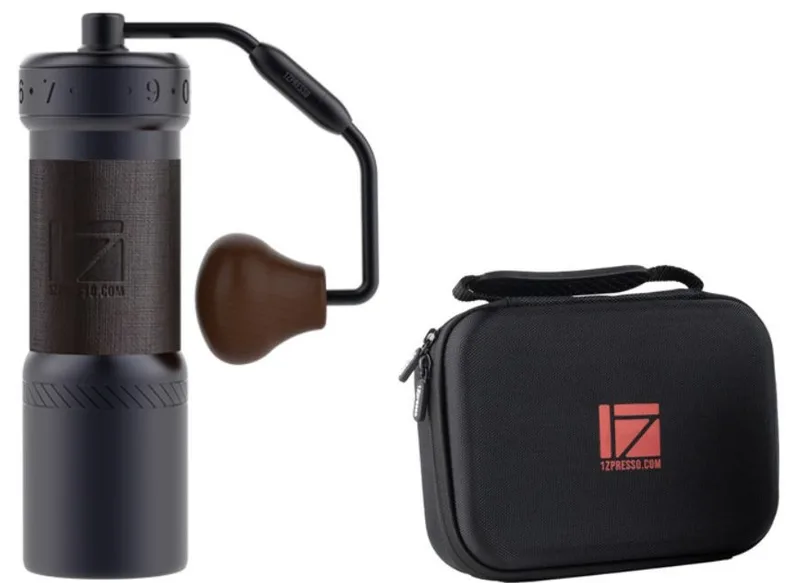
A warranty stated by the maker
1Zpresso K‑Ultra Manual Coffee Grinder
- Burrs
- : Conical, heptagonal stainless steel ('K Burr')
- Burr size
- : Not listed
List price $259 at 1Zpresso (Nov 16, 2026)
View on Amazon, 1Zpresso K-Ultra Manual Coffee Grinder (opens in a new tab)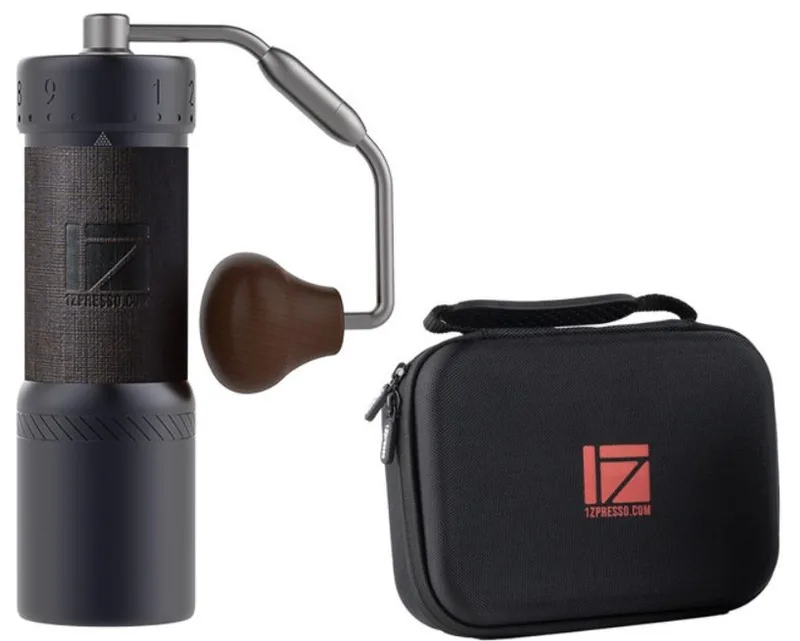
If espresso is the daily job
1Zpresso J‑Ultra Manual Coffee Grinder
- Burrs
- : Conical, coated espresso burr
- Burr size
- : 48 mm (≈ 1.89 in)
List price $199 at 1Zpresso (Nov 16, 2026)
View on Amazon, 1Zpresso J-Ultra Manual Coffee Grinder (opens in a new tab)A 20 g catch cup, two dial options
TIMEMORE Chestnut C3 Manual Coffee Grinder
- Burrs
- : Conical, S2C660 stainless steel, CNC-machined
- Burr size
- : 38 mm (≈ 1.5 in)
List price $79 at TIMEMORE (Nov 16, 2026)
Amazon listing not confirmed for this exact model · Maker's page (opens in a new tab)
Specifications
We may earn a commission when you buy through links on this page.
| Spec | Value | Source |
|---|---|---|
| Burr type | Stainless steel burr kit, note 1 | Source ↗ |
| Bean hopper | 30 g (≈ 1.06 oz), note 2 | Source ↗ |
| Espresso grinding | Manual: about 40 clicks for espresso (Turkish 20, moka pot and AeroPress 60–70, pour-over 100, French press 120), for reference | Source ↗ |
| Drive | Manual hand crank (straight handle); the manual also allows an electric screwdriver drive, note 3 | Source ↗ |
| Grind adjustment | Stepped external adjustment nut: 60 clicks per round, 16 microns per click, note 4 | Source ↗ |
| Material | Aluminum body; stainless steel burr kit; PC (polycarbonate) lid, note 5 | Source ↗ |
Notes
- 1 Burr type: The maker's pages do not state the burr shape or diameter.
- 2 Bean hopper: Manual: place 30~35 g of beans; exterior-adjustment page: hopper volume 30~35 g; store page: 25 g to 30 g.
- 3 Drive: Electric screwdriver at 15~25 Nm with a 6.35 mm (1/4 in) hex shank, handle removed and the black O-ring fitted; slow down to protect the central shaft.
- 4 Grind adjustment: Store page: '16 microns per click'; manual: 'One round is equivalent to 60 clicks'.
- 5 Material: PC lid from the manual.
Not listed by the maker: burr size, grind settings, grounds bin, motor, single dosing, burr speed, grind retention, dimensions (w × d × h), weight, warranty, voltage, wattage, dishwasher-safe parts, certification.
Where do the sources disagree?
The click tables disagree at pour-over and French press (the table above). The hopper figures differ across KINGrinder's pages and the listing:
| Source | Hopper |
|---|---|
KINGrinder store page | 25 g to 30 g |
KINGrinder manual | 30~35 g of beans |
KINGrinder exterior-adjustment page | 30~35 g |
The listing says | "Capacity 30 g"; "25-35g"; "30-35g" |
KINGrinder publishes no uniformity, retention or speed figure for the K6; the one independent measurement cited here is 9 Bar Benchmark's, in the comparison section above. The figures above come from different sources and are not averaged. The K6's espresso starting point is another disagreement: about 40 clicks in the manual and on the listing, and 30 is "much more common" per 9 Bar Benchmark. On the C3, Timemore's pages disagree with each other on catch-cup size (20, 30 and 25 g) and on materials ("durable plastic components" on its series page, "devoid of any plastic components" on its C3 ESP page).
Published findings
CNN Underscored · September 16, 2026
- In its sieve test (15 g dialed for pour-over, Kruve sifter with 700- and 1200-micron screens), 7.6 g landed in the target range, behind the Comandante C40 MK4 (9.1 g), the Timemore C5 Pro Esp and the KINGrinder K2. Ground 15 g for pour-over in 20 seconds; praised the numbered external dial and 16-micron steps for espresso; found disassembly difficult because of a hard-to-remove metal part.
Our verdict
Choose the K6 for a numbered external nut at 16 microns per click, 60 clicks per round, and a maker-printed click table, in a grinder that comes apart by hand for brushing. Weigh three limits: a hopper of about 30 g, no warranty on KINGrinder's own pages (the listing says 1 year) and a floor of 15 clicks below which you do not turn the handle. For a warranty on the maker's page take the 1Zpresso K‑Ultra; for finer steps the J‑Ultra.
Sources
- KINGrinder K6 Straight Handle Manual Coffee Grinder (store page, English store) — KINGrinder, accessed November 17, 2026
- KINGrinder | Exterior Adjustment (K6 features) — KINGrinder, accessed November 17, 2026
- KINGrinder K6 manual (PDF, English) — KINGrinder, accessed November 17, 2026
- KINGrinder | Official Retailer — KINGrinder, accessed November 17, 2026
- The best manual coffee grinders (updated 2026-09-16) — CNN Underscored, accessed November 16, 2026
- KINGrinder K6 instructions (English), PDF page 4: Precautions — KINGrinder, accessed November 17, 2026
- KINGrinder K6 instructions (English), PDF page 3: How to clean the grinder? — KINGrinder, accessed November 17, 2026
- Kingrinder K6 Review and Grind Chart (published March 30, 2026, updated August 10, 2026) — 9 Bar Benchmark, accessed November 17, 2026
- Timemore C3 Review: Upgrade or Sidegrade? (June 3, 2022) — The Coffee Chronicler, accessed November 17, 2026
- Timemore C3 Review: Quality Hand Grinder on a Budget (March 4, 2024) — Home Coffee Expert, accessed November 17, 2026
- TIMEMORE Chestnut C3 ESP Manual Coffee Grinder (product page) — Timemore, accessed November 17, 2026
- 1Zpresso K‑Ultra (product page) — 1Zpresso, accessed November 17, 2026
- 1Zpresso J‑Ultra (product page) — 1Zpresso, accessed November 17, 2026
- TIMEMORE Chestnut C3 (product page) — Timemore, accessed November 17, 2026
- Best manual coffee grinder (published October 22, 2026) — The Coffee Chronicler, accessed November 17, 2026
- Return Policy (limited warranty) — Timemore, accessed November 17, 2026
- C3s / C3 Series (tech specs) — Timemore, accessed November 17, 2026
- K‑Ultra - product page — 1Zpresso, accessed November 16, 2026
- User Manual - K‑Ultra (HTML, dated November 3, 2022) — 1Zpresso, accessed November 16, 2026
- 1Zpresso grinder overview (published 2025-06-07, updated 2026-10-26) — The Coffee Chronicler, accessed November 16, 2026
- J‑Ultra - product page with J-series comparison table — 1Zpresso, accessed November 16, 2026
- User Manual - J‑Ultra (HTML, dated November 6, 2023) — 1Zpresso, accessed November 16, 2026
- Download Center (manuals) — Timemore, accessed November 16, 2026
Update history
Published