Buying guide
Best Single‑Dose Grinders: Which One Fits How You Brew
Assessment based on manufacturer documentation and independent published sources; we have not physically tested these products.
·By Syed Hyder Ali · Updated · How we research
We may earn a commission when you buy through links on this page.
Our 3 picks
In short
A single dose grinder takes the beans you weigh, not a hopper of them. For filter coffee only, the Fellow Ode Gen 2 fits. If espresso is on your list, the Fellow Opus 2 and Turin DF54 are the two here; the DF54 needs a scale and a seller Turin authorizes.
Full answer ↓
Choose the Ode Gen 2 if you brew only filter coffee. If espresso is on your list, the Opus 2 lists it through cold brew and has an automatic stop; the DF54 has flat burrs, no timer listed, and needs a scale. Buy a Turin grinder only from Espresso Outlet or an authorized retailer: its warranty covers no other seller. No maker prints a retention figure, so the reports below come from reviewers who each measured their own way, and they are never averaged.
Key caveat
No maker lists a retention figure, and Turin's warranty covers only units bought from authorized sellers; check the seller.
- Burrs
- : Flat
- Settings
- : 11 settings
Why it fits: Grinds what you load and stops on its own
Our analysisList price $399.95 at Fellow (Nov 16, 2026)
View on Amazon, Fellow Ode Brew Grinder Gen 2 (opens in a new tab)Weigh each dose, espresso to cold brew
Fellow Opus 2 Conical Burr Grinder
- Burrs
- : Conical, stainless steel
- Settings
- : 48 settings Sources disagree
Why it fits: Covers all your methods with a single machine
Our analysisList price $199.95 at Fellow (Nov 16, 2026)
View on Amazon, Fellow Opus 2 Conical Burr Grinder (opens in a new tab)Weigh each dose, flat burrs, small body
Turin DF54 v4.1 Single Dose Flat Burr Grinder
- Burrs
- : Flat
- Settings
- : Not listed
Why it fits: Flat-burr grinding that fits a narrow counter
Our analysisList price $225 at Turin (Nov 16, 2026)
View on Amazon, Turin DF54 v4.1 Single Dose Flat Burr Grinder (opens in a new tab)
Compare the picks
| Spec | 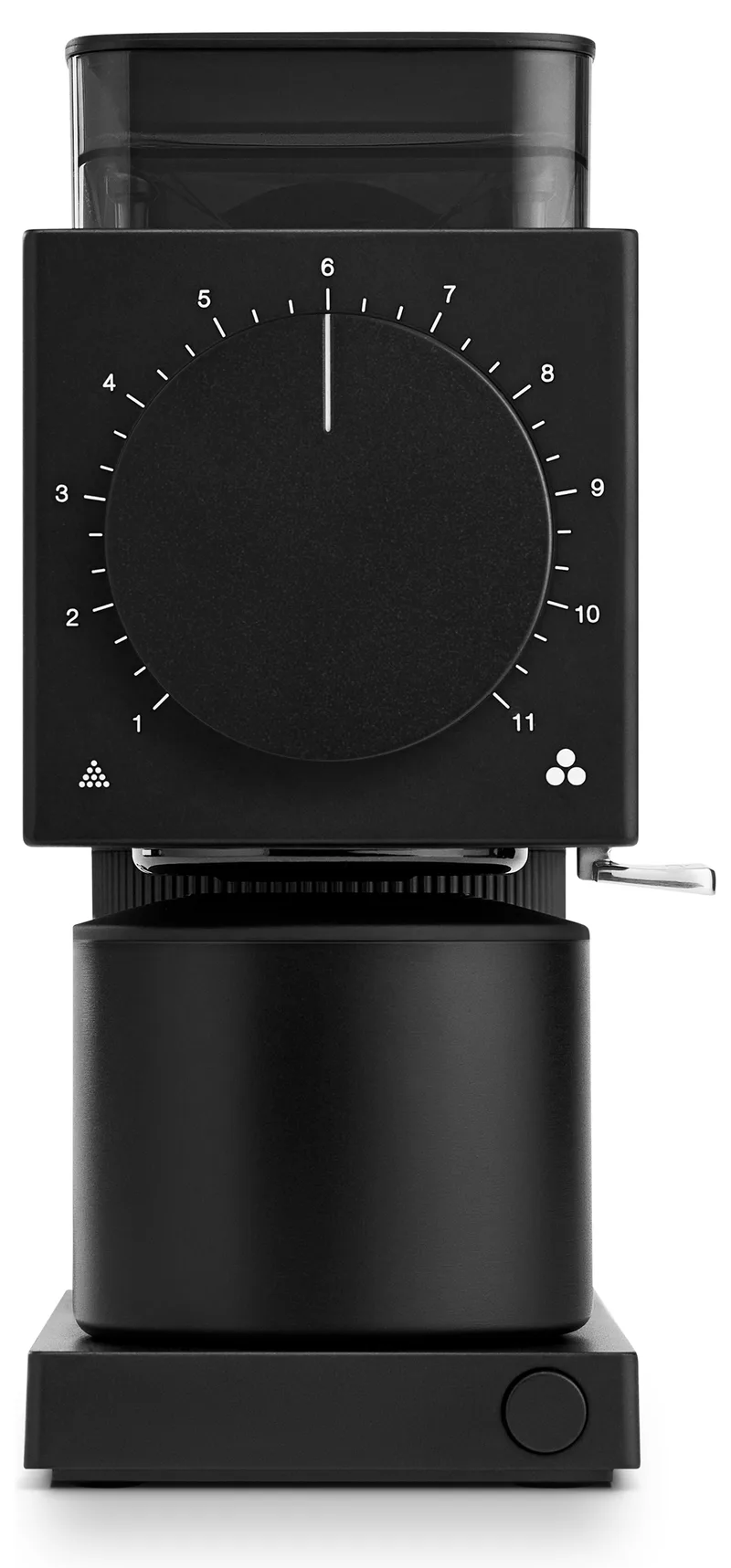 | | |
|---|---|---|---|
| Burr size | 64 mm (≈ 2.52 in) | 48 mm (≈ 1.89 in) | 54 mm (≈ 2.13 in) |
| Grind adjustment | 11 settings with 31 total steps | Stepless adjustment dial | Stepless collar |
| Bean hopper | 100 g (≈ 3.53 oz) | 100 g (≈ 3.53 oz) | 50 g (≈ 1.76 oz) |
| Warranty | 2 years | 2 years | 1 year |
- Burr size
- 64 mm (≈ 2.52 in)
- Grind adjustment
- 11 settings with 31 total steps
- Bean hopper
- 100 g (≈ 3.53 oz)
- Warranty
- 2 years
- Burr size
- 48 mm (≈ 1.89 in)
- Grind adjustment
- Stepless adjustment dial
- Bean hopper
- 100 g (≈ 3.53 oz)
- Warranty
- 2 years
- Burr size
- 54 mm (≈ 2.13 in)
- Grind adjustment
- Stepless collar
- Bean hopper
- 50 g (≈ 1.76 oz)
- Warranty
- 1 year
Same for all 3 models — Single dosing: Yes. Values as the makers publish them; conditions in each model's spec sheet. Figures after "≈" are our unit conversions.
We may earn a commission when you buy through links on this page.
- Fellow Ode Brew Grinder Gen 2View on Amazon, Fellow Ode Brew Grinder Gen 2 (opens in a new tab)
- Fellow Opus 2 Conical Burr GrinderView on Amazon, Fellow Opus 2 Conical Burr Grinder (opens in a new tab)
- Turin DF54 v4.1 Single Dose Flat Burr GrinderView on Amazon, Turin DF54 v4.1 Single Dose Flat Burr Grinder (opens in a new tab)
How we chose
Each model is a US one with its maker page or manual read through.
Electric grinders only; hand grinders have their own guide.
Built for a loaded dose, or listed by its maker for one.
Retention shown only as a named reviewer's figure, with method and date.
Unknown figures are marked Not listed, never filled in.
A button appears only after the Amazon listing title matches the model.
Our picks in detail
Fellow Ode Brew Grinder Gen 2 — Weigh each dose, filter only
Model NGAAUS · Matte Black, standard burrs (SKU D1211MB‑US‑SB), US 120 V
- Best for
- Someone who weighs each dose, brews only filter coffee and wants the grind to stop by itself.
- Skip if
- Espresso matters (Fellow states the Ode is not intended for it; the Opus 2 lists espresso through cold brew).
- Important limitation
- Fellow states it is not intended for espresso, and Home Grounds (2024-09-22) says the catch cup is hard to empty completely.
- Burrs
- : Flat
- Burr size
- : 64 mm (≈ 2.52 in)
- Settings
- : 11 settings
- Hopper
- : 100 g (≈ 3.53 oz)
We may earn a commission when you buy through links on this page.
List price $399.95 at Fellow (Nov 16, 2026)
Our take
Pick it to grind weighed doses for filter coffee. If espresso is on your list the Opus 2 is the one to take, and a hopper grinder suits brewing by the batch.
The Ode loads one dose at a time: pour up to 100 g into the bin, and an automatic stop ends the grind when the beans are done, or hold the power button to grind while it is held. It has 64 mm flat burrs (conical against flat) and 11 settings with 31 total steps, designed for brewed coffee. Fellow lists anti-static technology, a magnetically aligned catch cup and a built-in knocker, and its page says "low grind retention" without a figure. Home Grounds, which reviewed it, gives no retention figure either, so the table below shows none.
Fellow's manual says to run it under 90 seconds at a time with at least 90 seconds rest, to stop for 30 minutes if it works more than 6 minutes in 10, and not to put the magnetic catch on an electronic scale. Buy the standard Gen 2 Brew Burrs version; the Upgraded SSP set is a separate variant. Warranty: two years, plus one when you register (US electric products). Cleaning and parts: the Fellow Ode Gen 2 review.
Strengths
- 11 settings with 31 steps for brewed-coffee methods
- Automatic stop
- 2-year limited warranty
Limitations
- Not intended for espresso
- Duty cycle: run under 90 seconds at a time with at least 90 seconds rest; not more than 6 minutes in any 10 minutes, then rest 30 minutes
What matters: Grinds what you load and stops on its own
Fellow Opus 2 Conical Burr Grinder — Weigh each dose, espresso to cold brew
Model OP01AANA · Black (SKU 1222MB-NA), plastic lid and dial, US 120 V
- Best for
- A buyer who weighs each dose and wants a single grinder that Fellow designs to cover espresso through cold brew.
- Skip if
- You brew only filter coffee (the Ode) or want flat burrs (the DF54).
- Important limitation
- Fellow's "near-zero" retention is a claim with no figure, and Coffee Chronicler's review used a 220 V unit, not the US 120 V model.
- Burrs
- : Conical, stainless steel
- Burr size
- : 48 mm (≈ 1.89 in)
- Settings
- : 48 settings Sources disagree
- Hopper
- : 100 g (≈ 3.53 oz)
We may earn a commission when you buy through links on this page.
List price $199.95 at Fellow (Nov 16, 2026)
Our take
Pick it for weighed doses across every method, with an automatic stop and an espresso catch cup in the box. Choose the Ode for filter only, or the DF54 for flat burrs.
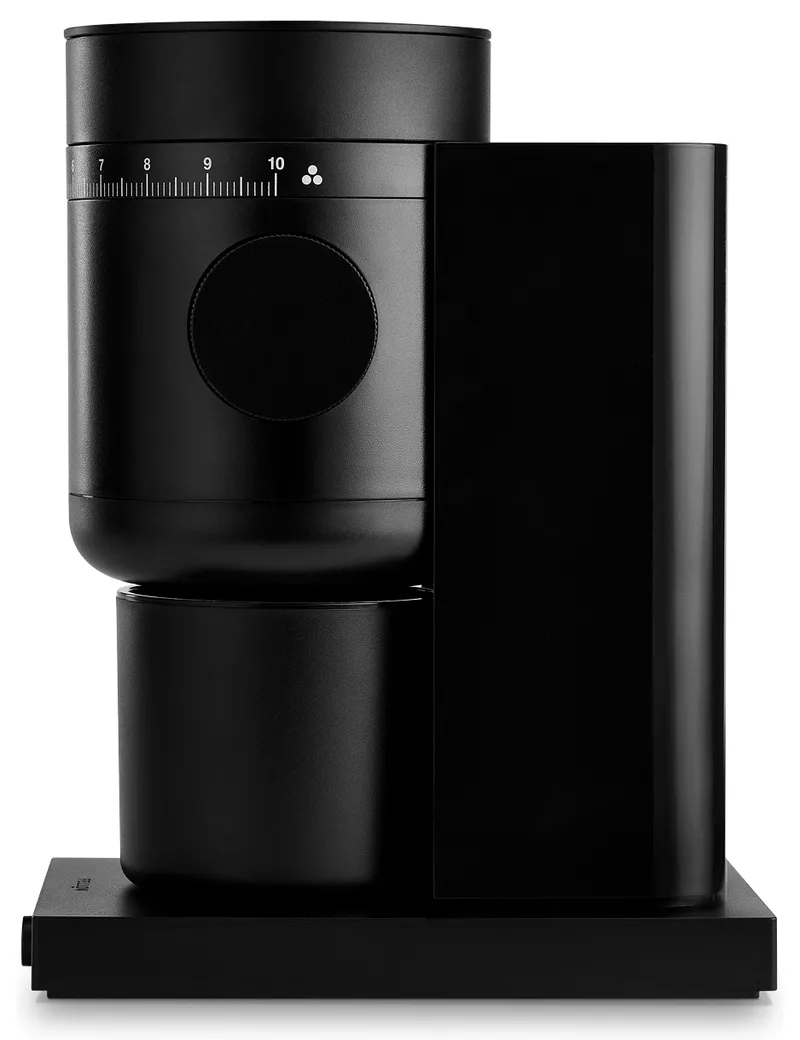
The Opus 2 has 48 mm conical burrs, a stepless dial numbered 0 (fine) to 10 (coarse), a 100 g load bin and an automatic stop; a long press grinds for 45 seconds. Fellow says it is designed for espresso, pour-over, electric coffee makers, French press, AeroPress and cold brew, and the box adds a 30 g espresso catch cup that fits 54 mm and 58 mm portafilters. It has an integrated ionizer against static and an internal impeller to clear grounds.
Fellow's page lists "Near-zero grind retention" and its guide says "low grind retention", with no figure. Coffee Chronicler, which reviewed a 220 V unit, reports about 0.2 g retained straight out of the grinder and about 0.1 g after pushing the lid down a couple of times, and 84–85 dB. Fellow's manual says to run it under 45 seconds per cycle with at least 60 seconds rest and not to put the magnetic catch on an electronic scale; re-grinding already-ground coffee wears it faster and voids the warranty. Warranty: two years for the original consumer, through authorized retailers, with proof of purchase.
Strengths
- Rated for espresso through cold brew, with a 54/58 mm portafilter dosing cup in the box
- 48 mm stainless steel conical burrs, up from 40 mm on the original Opus
- Coffee Chronicler measured 0.1-0.2 g retention and very little static
Limitations
- Duty cycle: grind under 45 seconds per cycle with at least 60 seconds rest; more than 3 minutes of grinding in any 10-minute window triggers a 30-minute automatic rest
- No part is dishwasher safe; the burrs must not be washed with water, and the wooden lid must not be washed or immersed
What matters: Covers all your methods with a single machine
Turin DF54 v4.1 Single Dose Flat Burr Grinder — Weigh each dose, flat burrs, small body
Black, 100-120 V / 60 Hz U.S. model
- Best for
- Someone who weighs each dose, wants flat burrs in a body about 110 mm (4.3 in) wide, and buys from a seller Turin authorizes.
- Skip if
- You want a hopper (the Encore ESP), an automatic stop or a stated run limit (the Opus 2 or Ode), or you can't confirm the seller.
- Important limitation
- Turin covers only units bought from Espresso Outlet or its authorized retailers, so check who sells the Amazon listing.
- Burrs
- : Flat
- Burr size
- : 54 mm (≈ 2.13 in)
- Settings
- : Not listed
- Hopper
- : 50 g (≈ 1.76 oz) Sources disagree
Our take
Pick it for weighed doses with flat burrs and a stepless collar, bought from Turin or an authorized seller. Choose the Opus 2 for an automatic stop and a stated run limit.
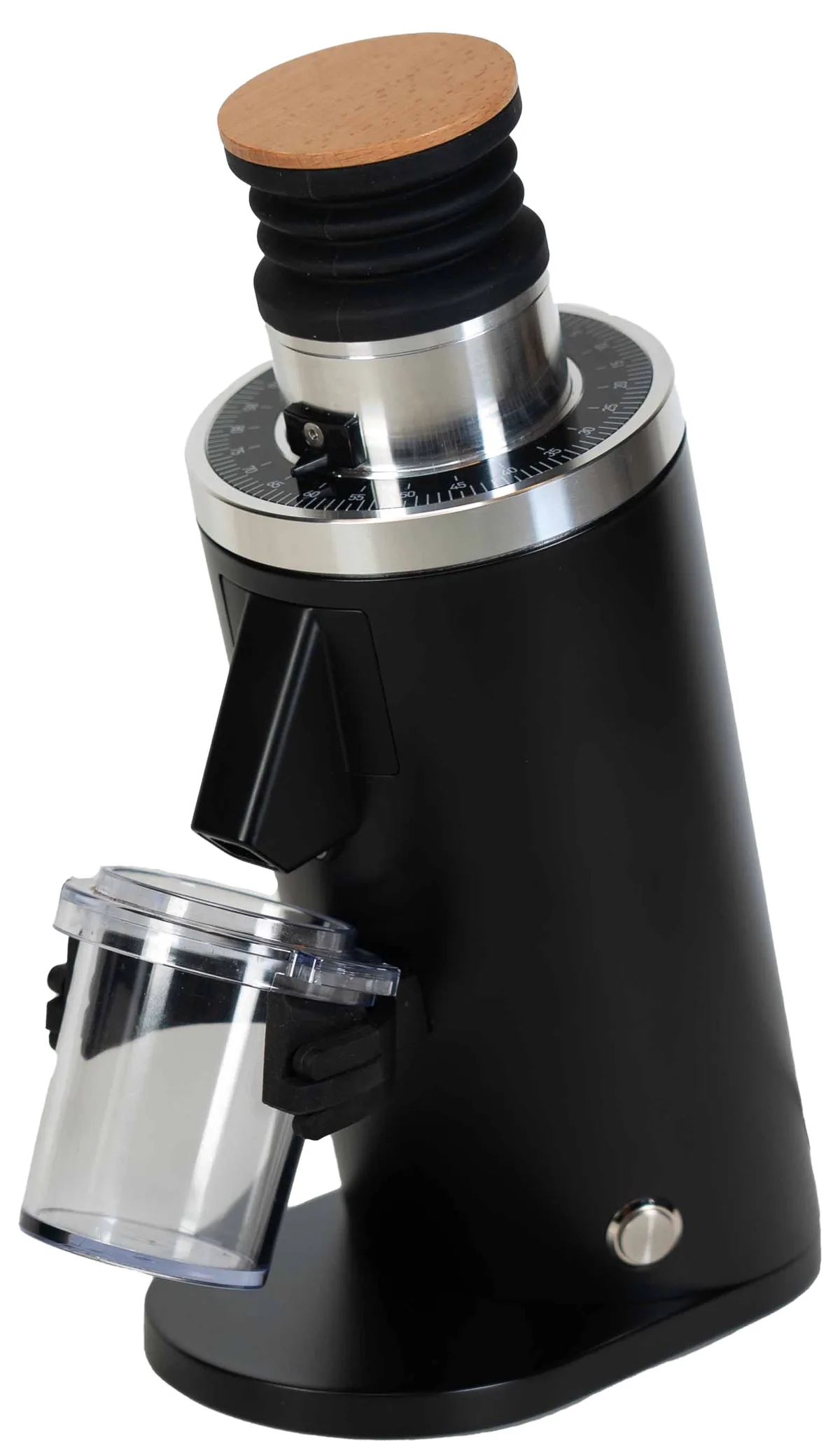
The DF54 has 54 mm flat burrs and a stepless collar that you move finer only with no beans in the grinder and the motor running. Turin says it is built around single dosing: one button starts and stops it, Turin lists no timer or dose program, and a scale helps you track the beans in and the grounds out. A plasma ion generator, an anti-popcorn feature and a bellows are there to cut static and leftovers, but Turin says they "do not promise zero mess or exactly zero retention", and that static and retained grounds "vary with humidity, roast, grind size, and maintenance".
Coffee Chronicler reviewed a MiiCoffee-supplied unit, and Turin says reviews of the DF54 may show earlier units with different seller branding, burrs or chute design; Turin's current listing is v4.1 with a metal declumper and larger exit chute. That reviewer reports about 0.2–0.3 g retained without the bellows and 0.0–0.1 g with it, and calls the grinder not quiet but a bit milder than the DF64. Turin calls the DF54 home equipment for a few weighed doses, not continuous cafe service. Its capacity figures disagree: Turin's page says about 20 g without the bellows and up to 50 g with it, and its manual says 25 g. The DF54 against the DF64: DF54 vs DF64 Gen 2.
Strengths
- Compact single-dose flat-burr grinder for espresso, with a brew-burr option for filter
- Coffee Chronicler found retention of about 0.2 to 0.3 g without the bellows and 0.0 to 0.1 g with it
Limitations
- No adjustable RPM
- Home equipment for a few weighed doses, not for continuous cafe service
What matters: Flat-burr grinding that fits a narrow counter
What do makers and reviewers say about retention?
No maker of these grinders prints a retention figure. Fellow words it as a claim and Turin declines to promise it:
| Grinder | What the maker says | Figure listed |
|---|---|---|
Fellow Opus 2 | Page: "Near-zero grind retention". Guide: "Leave no bean behind thanks to low grind retention." | None |
Fellow Ode Gen 2 | Page: "Low grind retention": anti-static technology and a built-in knocker "reduce leftover grounds". | None |
Turin DF54 | The features "do not promise zero mess or exactly zero retention"; static and retained grounds "vary with humidity, roast, grind size, and maintenance". | None |
Turin DF64 Gen 2.7 | "Low retention does not mean every dose will have identical input and output weight"; its manual says the bellows help minimize grounds retention. | None |
Baratza Encore ESP | No retention statement. | None |
So "near-zero" is Fellow's word, not a measurement. What reviewers reported is below, grouped by what they weighed, ordered by grinder name within each group, never averaged or ranked. Each used its own dose, unit and method, so the figures are not comparable.
| What was weighed | Grinder | Reviewer, date | Reported | Unit and method |
|---|---|---|---|---|
Per dose, grounds against beans | Baratza Encore ESP | Tom's Guide, 2025-03-14 | 0.6 g on an 18 g dose; 2.1 g (1.4%) on a full 150 g hopper | A hopper grinder as reviewed, not with the single-dose accessory; the reviewer suggests loading about 100 g at most |
Fellow Opus 2 | Coffee Chronicler, published 2026-09-29, updated 2026-11-03 | About 0.2 g straight out of the grinder; about 0.1 g after pushing the lid down a couple of times | A 220 V unit; 18 g ground in 9 seconds | |
Turin DF54 | Coffee Chronicler, published 2024-04-08, updated 2026-11-03 | About 0.2–0.3 g without the bellows; 0.0–0.1 g with it | A MiiCoffee-supplied unit; a 13 g dose gave 12.9 g in the catch cup at setting 55 | |
Turin DF64 Gen 2 | Home Grounds, updated 2025-02-28 | An average of 0.3 g using the bellows | 20 g doses for a double shot; a Gen 2, not the Gen 2.7 sold now | |
Found when the grinder was opened or emptied | Baratza Encore ESP | Coffee Chronicler, published 2024-07-26 | About 1.1 g | Opened and scooped out; the review reports static and clumping at espresso settings |
Baratza Virtuoso+ | Coffee Review, 2020-06-13 | 1.5 g | Emptied for a cleaning; the review also reports beans popcorn at the end of a dose | |
Eureka Mignon Specialita | Coffee Chronicler, published 2021-10-02, updated 2026-11-03 | "Around 1 gram" of exchange | The reviewer's own test; it reports popcorning in the hopper when single dosing | |
Not reported | Fellow Ode Gen 2 | Home Grounds, updated 2024-09-22 | No figure | Says the knocker pushes remaining grounds out of the chute and the catch cup is hard to empty completely |
Check what a figure measures before you set one against another: grounds left per dose, grounds found when the grinder is opened, and grounds you purge are three different things.
Is a single dose grinder the right workflow for you?
Single dosing means weighing the beans for one brew, loading them, grinding and emptying the catch. It keeps one bag from sitting in a hopper and lets you switch beans between doses; the cost is a scale and the weighing each time.
- A scale. Turin says a scale helps you track the beans in and the grounds out of the DF54, and says to weigh the beans and check the grounds on the DF64. Fellow says the magnetic catch on the Ode and Opus 2 must not sit on an electronic scale, because the magnet can disturb its accuracy or damage it.
- A funnel for a smaller basket. Turin says to grind into the dosing cup and move the grounds with a funnel sized to your basket, because the cup is nominally 58 mm.
- Whole beans only. Fellow says re-grinding already-ground coffee wears the grinder faster and voids the warranty.
If you grind a full carafe every morning and rarely change beans, a hopper grinder does the same job with less work: grinders for pour-over compares them, and the guide to coffee grinders compares hopper, single-dose and hand grinders. Turin describes the DF54 and DF64 as home equipment for a few weighed doses. Prosumer single-dose grinders such as the Niche Zero aren't covered here.
What about the DF64 and the Encore ESP?
Turin DF64 Gen 2.7. Same situation as the DF54 with bigger burrs: 64 mm flat, a stepless collar, a fixed-speed 250 W motor and a 45-second automatic stop. Turin says it doesn't weigh or meter doses, so you need a scale and a funnel for a smaller portafilter. Capacity is 30 g, or about 50 g with the bellows hopper; its manual and page agree on both. Home Grounds reported an average of 0.3 g retained with the bellows and over 90 dB, on a Gen 2 rather than the Gen 2.7 sold now; Turin's page adds that low retention doesn't mean identical input and output weight, and its retention video shows a clean chamber without a figure. The warranty condition is the DF54's. Amazon listing not checked yet, so there is no button here. DF54 vs DF64 Gen 2 compares it with the DF54.
Encore ESP with the single-dose hopper. If you already own a hopper grinder, Baratza names a single-dose hopper accessory for the Encore ESP and sells it in its Accessories Shop; the accessory's size and retention aren't listed. The ESP figures in the table above, 0.6 g on an 18 g dose and about 1.1 g when opened, are for the grinder with its normal hopper, not with the accessory. Encore or Encore ESP? compares the pair.
Hopper or single dose: Encore ESP or DF64?
Choose by routine before burr. The Baratza Encore ESP (ZCG495) takes beans from a hopper and grinds on demand with 40 stepped settings; the Turin DF64 Gen 2.7 asks you to weigh a dose, pour it in, grind, and push the last grounds out with the bellows every time. Baratza lists a single-dose hopper accessory for the ESP, so a hopper is not a reason to rule it out if you single-dose.
| Encore ESP | DF64 Gen 2.7 | |
|---|---|---|
Loading | Fill a hopper; grind on demand | Weigh a dose, pour it in, add the bellows |
Stopping | You stop it: pulse button, on/off knob; no timer | One button; stops itself after 45 seconds |
Setting the grind | 40 clicks: 1-20 espresso, 21-40 filter; shims shift it about five settings | Stepless collar; adjust finer only with the motor running and no beans |
Needs beside it | A 54 or 58 mm portafilter | A scale and a funnel sized to your basket |
Support | 1-year limited warranty from purchase | 1 year, only if bought from Espresso Outlet or an authorized retailer |
Cleaning | Hand-wash hopper, lid, bin; keep burrs dry | No water; dry brush or handheld vacuum |
The burrs differ too, 40 mm conical against 64 mm flat; what that changes is in conical vs flat burr grinders, and no source read compares these two in the cup, so this page does not.
Does the ESP's espresso range run out? Baratza's manual says that as parts settle a finer setting may be needed, and that the finest settings may stop being fine enough; shims move the range. Coffee Chronicler (July 26, 2024) needed a few notches finer for a medium roast in a 58 mm precision basket, and reports that installing the shims led to more retention, clumpy grounds and heat. Tom's Guide (March 14, 2025) reports a grind less uniform than other grinders it has used. If you have already reached the end of the ESP's dial, a stepless collar serves you, but Turin says never to grind at or below the finest setting, because the burrs rub.
If you also brew filter coffee: Baratza gives the ESP a filter range, settings 21-40, where each setting changes the grind by larger amounts than in 1-20. Home Grounds (February 28, 2025) reports the DF64 performs best at finer settings, that uniformity drops a little at coarser settings, and that it would suggest another grinder if drip is the main use.
What else you need: the DF64's scale is not optional, because Turin says the grinder does not weigh or meter the dose, and a nominal basket size does not guarantee that a portafilter fits the support forks, so Home Grounds suggests grinding into the dosing cup. Espresso Outlet says the declumper is a normal wear item that needs changing periodically. For counter space, Baratza lists the ESP at 13 x 15 x 34 cm (about 5.1 x 5.9 x 13.4 in); Turin's page lists the DF64 at approximately 10 in deep, 5.2 in wide and 12 in high and asks you to allow about 10 inches of counter depth and clearance above the bellows. Turin's manual lists L225 x W130 x H300 mm (about 8.9 x 5.1 x 11.8 in) with L, W and H where the page says D, W and H, so the figures conflict; measure counter to cabinet underside. Turin's page also says buyers who prefer to leave beans in a hopper and press a programmed dose button should consider its GF64, a model not covered here.
Not compared: the ESP's reviewers' noise and retention figures against the DF64's (the methods differ, and the retention table above prints each by its own method); step size (Coffee Chronicler reports about 18.8 microns per step in the ESP's first 20 settings, Baratza lists none, and the DF64 is stepless). Reviews may not describe the units sold now: Coffee Chronicler's DF64 was a 2023 MiiCoffee Gen 2, before the Gen 2.7 revision, and the Encore ESP Pro is a different model. The plain Encore is covered in Encore or Encore ESP.
Which grinders come with a single-dosing caution?
- Baratza Sette 270Wi: the maker's manual says "Don't Single Dose": the grinder can't dose accurately or consistently from a single dose of beans, so keep two or more doses in the hopper.
- Breville Smart Grinder Pro: Breville's book says not to store beans in the hopper and to run the grinder for 2 seconds to purge some coffee before each use. Its review has the details.
- Baratza Virtuoso+: Coffee Review (2020-06-13) says single-dose grinding is not what it is specifically designed for, calls its low retention an attractive fit for people who switch coffees often, and reports that the last beans of a dose bounce for some seconds and a few pulses may be needed. The Baratza Encore review covers the pair.
- Eureka Mignon Specialita: Coffee Chronicler reports popcorning in the hopper when single dosing. The coffee grinder guide notes that Eureka's manual lists no 110–120 V rating.
What limits run time, how loud are they and what does the warranty need?
| Grinder | Run limit the maker states | Noise a reviewer reports | Warranty condition |
|---|---|---|---|
Fellow Ode Gen 2 | Under 90 seconds at a time, at least 90 seconds rest; over 6 minutes in 10 means a 30-minute rest | 82 dB with a medium roast (Home Grounds, 2024-09-22) | Two years, plus one when registered |
Fellow Opus 2 | Under 45 seconds per cycle, at least 60 seconds rest; over 3 minutes in 10 means a 30-minute rest | 84–85 dB on a 220 V unit (Coffee Chronicler, 2026-11-03) | Two years: original consumer, authorized retailers, proof of purchase |
Turin DF54 | "Not for continuous cafe service"; no figure | Not quiet, "a bit more mild" than the DF64 (Coffee Chronicler, 2026-11-03) | One year, only for units bought from Espresso Outlet or its authorized retailers |
Turin DF64 Gen 2.7 | No duty figure listed; 45-second automatic stop | Over 90 dB on a Gen 2 (Home Grounds, 2025-02-28) | As the DF54 |
Baratza Encore ESP | Baratza lists none | 82 dB at most (Tom's Guide, 2025-03-14) conflicts with about 92 dB (Coffee Chronicler, 2024-07-26) | One year, limited, US and Canada |
Static and mess: Fellow lists anti-static technology on the Ode and an ionizer on the Opus 2; Turin lists a plasma ion generator on both the DF54 and DF64. Care: Fellow says to clean the Ode's and Opus 2's burrs at least every three months with daily use, using grinder cleaning tablets or a stiff brush; Turin says to clean the DF54 with a dry brush or a handheld vacuum and not to wash it with water. The grinder cleaning guide has the steps. For the quietest or the most compact electric grinder, grinders for pour-over prints noise for its own shortlist. If the Encore ESP is on your list against a hopper grinder, Encore ESP vs Smart Grinder Pro sets the two side by side.
Prefer a hand grinder?
A hand grinder takes one dose at a time by design, and you supply the crank. Choosing among them is a different decision: hand grinders compares them.
Sources
- Ode Brew Grinder Gen 2 product page — Fellow, accessed November 17, 2026
- Ode Brew Grinder Gen 2 Safety and Maintenance manual (NGAAUS) — Fellow, accessed November 17, 2026
- Fellow Ode Coffee Grinder Review (updated 2024-09-22) — Home Grounds, accessed November 17, 2026
- Opus 2 Conical Burr Grinder product page — Fellow, accessed November 17, 2026
- Opus 2 Get to Know You Guide (789-00283 D) — Fellow, accessed November 17, 2026
- Opus 2 Safety and Maintenance manual (789-00291 F) — Fellow, accessed November 17, 2026
- My Fellow Opus 2 Review (published 2026-09-29, updated 2026-11-03) — Coffee Chronicler, accessed November 17, 2026
- Turin DF54 v4.1 Single Dose Flat Burr Grinder product page — Turin Grinders (Espresso Outlet LLC), accessed November 17, 2026
- Turin DF54 user manual — Turin Grinders, accessed November 17, 2026
- Turin DF64 Gen 2.7 Single‑Dose Coffee Grinder product page — Turin Grinders (Espresso Outlet LLC), accessed November 17, 2026
- Turin DF64 Gen 2 support guide — Espresso Outlet, accessed November 17, 2026
- Encore ESP Operations Manual v1.0 (January 2023) — Baratza (Breville USA), accessed November 17, 2026
- Turin DF64 Gen 2 user manual — Turin Grinders, accessed November 17, 2026
- Warranty Terms (Espresso Outlet LLC, DBA Turin Grinders) — Turin Grinders, accessed November 17, 2026
- DF54 review (published 2024-04-08, updated 2026-11-03) — Coffee Chronicler, accessed November 17, 2026
- DF64 Grinder: Reviewing The Updated DF64 Grinder (updated 2025-02-28) — Home Grounds, accessed November 17, 2026
- Turin DF64 Gen 2, First Look at Retention (video, read as a transcript) — Espresso Outlet on YouTube, accessed November 17, 2026
- Encore ESP ZCG495 product page — Baratza US, accessed November 17, 2026
- Baratza Encore ESP review (published 2025-03-14) — Tom's Guide, accessed November 17, 2026
- Baratza Encore ESP review: Read THIS before buying (published 2024-07-26) — Coffee Chronicler, accessed November 17, 2026
- Baratza Virtuoso+ Coffee Grinder Review (published 2020-06-13) — Coffee Review, accessed November 17, 2026
- Eureka Mignon Specialita review (published 2021-10-02, updated 2026-11-03) — Coffee Chronicler, accessed November 17, 2026
- Sette 270Wi Operations Manual v2.4 — Baratza, accessed November 17, 2026
- the Smart Grinder Pro instruction book, BCG820 Series — Breville, accessed November 17, 2026
- Ode Standard Brew Burrs - US parts page — Fellow, accessed November 16, 2026
- Fellow Stagg EKG Pro Kettle & Ode Grinder 2 Review: Worth the Upgrade? — Gear Patrol, accessed November 16, 2026
- Fellow Ode Brew Grinder Gen 2 Safety and Maintenance manual (US/Canada, model NGAAUS, file SM_NA_V3; PDF pages are two-page spreads), PDF page 4 (printed pages 6–7): Important; Caution — Fellow, accessed November 16, 2026
- Fellow Ode Brew Grinder Gen 2 Safety and Maintenance manual (US/Canada, model NGAAUS, file SM_NA_V3; PDF pages are two-page spreads), PDF page 5 (printed pages 8–9): Cleaning and Use (Before Use) — Fellow, accessed November 16, 2026
- Fellow Ode Brew Grinder Gen 2 Safety and Maintenance manual (US/Canada, model NGAAUS, file SM_NA_V3; PDF pages are two-page spreads), PDF page 6 (printed pages 10–11): General Cleaning; Automatic Cleaning — Fellow, accessed November 16, 2026
- Fellow Ode Brew Grinder Gen 2 Safety and Maintenance manual (US/Canada, model NGAAUS, file SM_NA_V3; PDF pages are two-page spreads), PDF page 7 (printed pages 12–13): Removing and Replacing the Grinding Burrs — Fellow, accessed November 16, 2026
- Fellow Ode Brew Grinder Gen 2 Safety and Maintenance manual (US/Canada, model NGAAUS, file SM_NA_V3; PDF pages are two-page spreads), PDF page 8 (printed pages 14–15): Removing and Replacing the Grinding Burrs (continued) — Fellow, accessed November 16, 2026
- Fellow Ode Brew Grinder Gen 2 Safety and Maintenance manual (US/Canada, model NGAAUS, file SM_NA_V3; PDF pages are two-page spreads), PDF page 9 (printed pages 16–17): Warranty — Fellow, accessed November 16, 2026
- How do I keep the Ode Brew Grinder Gen 2 clean? (Fellow Help Center, Ode Gen 2: Product Care & Materials) — Fellow, accessed November 16, 2026
- How to clean & maintain your Ode Brew Grinder (Fellow Help Center; covers Ode Gen 2 and Ode Gen 1) — Fellow, accessed November 16, 2026
- Replacement Parts collection (product feed, US market) — Fellow, accessed November 16, 2026
- Fellow Opus 2 Conical Burr Grinder Safety and Maintenance manual (789-00291 F; PDF pages are two-page spreads), PDF page 4 (printed pages 6–7): Important Safeguards (General; Electrical) — Fellow, accessed November 16, 2026
- Fellow Opus 2 Conical Burr Grinder Safety and Maintenance manual (789-00291 F; PDF pages are two-page spreads), PDF page 5 (printed pages 8–9): Important Safeguards, continued (Usage) — Fellow, accessed November 16, 2026
- Fellow Opus 2 Conical Burr Grinder Safety and Maintenance manual (789-00291 F; PDF pages are two-page spreads), PDF page 6 (printed pages 10–11): Cleaning and Maintenance; Automatic Cleaning — Fellow, accessed November 16, 2026
- Fellow Opus 2 Conical Burr Grinder Safety and Maintenance manual (789-00291 F; PDF pages are two-page spreads), PDF page 8 (printed pages 14–15): Removing and Cleaning the Grinding Burrs; Warranty — Fellow, accessed November 16, 2026
- Turin DF54 support guide — Espresso Outlet, accessed November 16, 2026
- Turin DF54 User Manual (image PDF, read by OCR), PDF page 2: Safety Precautions; Cleaning Process of Grinder — Turin Grinders, accessed November 17, 2026